The Industrial Science Report: Heavy equipment manufacturers accelerate AI, autonomy, and electrification strategies
Key Highlights
- Heavy equipment manufacturers are expanding AI and autonomous capabilities, integrating sensors, computer vision, and edge computing.
- Electrification and hybrid power systems are being adopted to meet sustainability pressures, with innovations like trolley-assisted haul trucks reducing emissions and improving energy efficiency.
- Partnerships with educational institutions and trade organizations are crucial for developing a skilled workforce capable of maintaining complex, software-driven machinery.
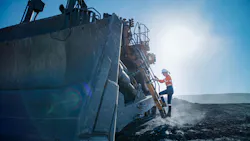
Autonomous systems are already operating at industrial scale in heavy equipment applications for mining, transportation, and construction. Manufacturers that once built purely mechanical assets are incorporating software-defined systems more (or everywhere they can).
OEMs are pushing deeper into AI-enabled automation and connected machine architectures to achieve better real-time operational intelligence. At the same time, sustainability pressures are forcing changes in how equipment is powered and how manufacturing production systems are structured, accelerating the transition toward electrified and hybrid power systems.
Quiz: what makes the Orion crew capsule ready for deep space?
Need to study first? Read the article:
The Industrial Science Report: Inside Lockheed Martin’s Orion crew capsule
In addition to the workforce transformation taking place across industry, these stories all revolve around four converging themes (and we’ve heard these before): software-defined capability, autonomy, artificial intelligence (AI), and emissions reduction.
Caterpillar expands AI and autonomy strategy for heavy equipment manufacturing
Technology context: No surprise, heavy equipment manufacturing is all about machine intelligence, where AI and connected systems are part of how equipment is designed, operated, and supported across its lifecycle. Heavy equipment manufacturers, end users, and service technicians all have a role to play in automation. So far, it’s not an issue of automation taking or replacing jobs, but it’s certainly changing the nature of employment and the technical skills needed to build, operate, and maintain heavy machinery.
Caterpillar has been at the forefront of automation since the 1980s, beginning with its partnership with Carnegie Mellon that advanced software, GPS, and perception systems and led to its earliest autonomous truck testing programs. Today, that trajectory has scaled into an industrial autonomous mining fleet that has hauled more than 11 billion tonnes of material and traveled more than 380 million kilometers worldwide. Like many manufacturers across industries (aerospace, automotive, pharmaceuticals, semiconductors), heavy equipment machines are more software-defined and data-driven, and autonomy and AI are increasingly embedded into core operational features.
Innovation News: Caterpillar announced a broad expansion of its industrial AI and autonomy initiatives earlier this year at CES 2026, including new autonomous machine capabilities, AI-powered operator tools, and an expanded collaboration with Nvidia focused on connected equipment and supply chain operations. The company introduced the Cat AI Assistant, built on Caterpillar’s Helios data platform and Nvidia technologies, to provide conversational access to equipment, maintenance, and operational data across construction, mining, and power equipment applications. Caterpillar also detailed autonomous technologies for excavators, loaders, haul trucks, and compactors that use AI, machine learning, computer vision, radar, LiDAR, cameras, and edge computing to process real-time jobsite data and support autonomous operations. Through its collaboration with Nvidia, Caterpillar said it is using Nvidia Jetson Thor systems for onboard AI processing and Nvidia Omniverse technologies to build digital twins of factories and manufacturing processes, allowing teams to simulate and optimize layouts, production systems, forecasting, and scheduling before deployment in the real world.
Komatsu reaches mining milestone with autonomous trolley-powered haul truck
Technology context: Heavy equipment manufacturers are also under pressure to reduce emissions. And it’s a growing two-front challenge: building lower-emission machines for customers while also reducing the environmental footprint of the factories producing them. For mining operations, extreme productivity demands are driving rapid investment in electrification and efficiency-focused machine design. OEMs are rethinking haulage systems that can deliver higher energy efficiency, lower fuel consumption, and improved component life without compromising performance in harsh environments.
Komatsu recently demonstrated this direction with a new trolley-assist system that powers a moving, autonomously operated haul truck during uphill travel. It’s designed to reduce diesel engine load, cut emissions, and improve energy efficiency while supporting continuous high-load operations in surface mining. Komatsu launched its first commercial application of autonomous haulage in 2008, and now, it has a fleet of more than 875 autonomous haul trucks commissioned worldwide that have collectively hauled more than 10 billion metric tons of material.
Innovation news: Komatsu has successfully transferred power to a moving, autonomously operated haul truck through a trolley system. The test combined the company’s FrontRunner Autonomous Haulage System with dynamic overhead electric power delivery, allowing a driverless mining truck to draw energy while climbing. The trolley-assist approach is designed to reduce diesel consumption, lower emissions, increase uphill speed, and extend engine life in large surface mines. Komatsu said autonomous hauling is a big part in moving toward battery-electric and zero-emission haulage fleets that are still able to meet the extreme productivity demands of mining operations.
Industrial trends: Electrification and autonomy are rapidly converging across heavy equipment manufacturing. Caterpillar and Komatsu highlight the industry’s next competitive targets: how effectively OEMs combine onboard AI, predictive analytics, connected fleet systems, and lower-emission power architectures into autonomous machines. Similar trends are already reshaping additive manufacturing, robotics, and sustainability technology, where software and data are king.
Iowa State strengthens hydraulics workforce pipeline with advanced fluid power education
Technology context: For manufacturers of agricultural and construction equipment, fluid power issues can start on the production floor, where undetected air contamination can shorten a machine’s lifecycle. Iowa State University’s expanding fluid power research program addresses these design challenges and others by combining hands-on hydraulic training with advanced testing technologies that help future engineers better understand how complex off-highway systems perform under real operating conditions.
Its new lab includes a dynamometer, which allows engineers to test off-highway vehicles in a controlled and dynamic environment. The lab can test vehicles up to 450 kW (600 hp) per corner at speeds of up to 80 km/h (50 mph), with independent monitoring and loading of the traction system at each corner.
Predictive technologies are also key here, where SONAR-based sensing is used to detect entrained air in hydraulic lines, helping OEMs improve machine reliability and validate system performance earlier in the design process.
Innovation news: Iowa State University is partnering with engineering company Danfoss to build the Off-Highway Vehicle Chassis Dynamometer Lab, at Iowa State’s BioCentury Research Farm. The customized lab will pair industrial-scale testing capabilities with fluid power education. Iowa State is helping students and industry engineers better understand how high-powered hydraulic and pneumatic systems behave under real operating conditions. The initiative emphasizes hands-on student learning tied to real equipment, helping prepare graduates for careers designing, maintaining, and improving industrial motion-control systems. Fluid power technologies are widely used in manufacturing machinery, mobile equipment, agricultural equipment, automation systems, and heavy industry.
JLG expands skilled trades partnerships to build manufacturing talent pipeline
Technology context: Access equipment manufacturer JLG has made a solid commitment to the local workforce beyond its own facilities, and it is reaching out to local students interested in manufacturing. The company partners with trade associations, unions, training schools and equipment rental providers to upskill craft professionals, operating and servicing MEWPs (mobile elevating work platforms) and telehandlers. These partnerships include organizations such as: Associated Builders & Contractors (ABC), Association of General Contractors (AGC), Association of the Wall & Ceiling Industry (AWCI), Mason Contractors Association of America (MCAA), Steel Erectors Association of America (SEAA), regional apprenticeships, trade unions, community colleges and correctional/vocational programs.
Starting last year, JLG established a partnership with the Tennessee College of Applied Technology (TCAT), near its Jefferson City, Tennessee, facility. Students get technical education in real-world factory settings, and several students are working part-time on JLG’s maintenance team while attending school. Current team members and new hires are also getting better education, particularly in welding and industrial painting.
Innovation news: JLG Industries’ workforce initiative focused on rebuilding the skilled trades pipeline supports the manufacturing of mobile elevating work platforms and telehandlers. The company is working with high schools, technical colleges, trade associations, and industry organizations to expose students to careers in welding, painting, assembly, and other industrial trades while also helping current workers advance their skills. JLG’s School-to-Work (S2W) program allows high school juniors and seniors local to its manufacturing facilities in McConnellsburg, Shippensburg, Bedford, Greencastle and Chambersburg, Pennsylvania, to earn school credit while working paid roles in welding, assembly, painting, fabrication, warehouse support and more.
Penn College and GT&E expand hands-on heavy equipment workforce training
Technology context: Just as machines grow more software-driven and technologically complex, heavy equipment manufacturers and its customers are also facing a skilled labor shortage. Heavy equipment sales, rental and service company Groff Tractor & Equipment (GT&E) isn’t waiting around for new heavy equipment operators and technicians, it’s active in building a local workforce with the Pennsylvania College of Technology.
Pennsylvania College of Technology’s expanded partnership with GT&E addresses that pressure with something many manufacturers say the industry still desperately needs: technicians trained on real equipment, not just simulators or classroom diagrams. Through more than $90,000 in equipment rentals and program support, students are gaining hands-on experience with current John Deere backhoes and dozers used across construction and heavy industry. This kind of hands-on experience for future maintenance technicians and operators is uncommon, working with the latest machine technologies before they ever enter the workforce.
Innovation news: Pennsylvania College of Technology received continued support from GT&E through free rentals of two heavy machines and discounted access to a third for 2025, extending a multi-year partnership for heavy construction equipment education. The equipment is used to train students in heavy equipment operation and heavy equipment technician programs, giving learners direct experience on current machinery used in the field. GT&E also sponsored the college’s Diesel Summer Camp and has supported its Diesel Technology Competition, helping introduce high school students to diesel maintenance and equipment careers. For heavy equipment manufacturing and service industries, the partnership strengthens the technician pipeline at a time when skilled labor shortages continue across construction, mining, and equipment maintenance sectors.
Industrial trends: For the heavy equipment sector, stronger recruiting and upskilling pipelines can reduce hiring bottlenecks and support future production growth. While the workforce challenges are nothing new, across many industries, these equipment manufacturers are treating workforce development as a strategic investment rather than a separate HR or marketing function. Manufacturers can’t sit around and wait for workers to come to them.
Automation is not reducing the need for skilled labor so much as changing the type of expertise required, as highlighted by these workforce programs from JLG and GT&E. As heavy equipment incorporates more sensors, software, electrified systems, and autonomous controls, OEMs increasingly need technicians who can troubleshoot hydraulic systems and digital architectures. Across many manufacturing sectors, such as defense, semiconductors, and pharma, companies are responding by building tighter partnerships with technical schools and apprenticeship programs to secure long-term industrial talent pipelines.
About the Author

Anna Townshend
managing editor
Anna Townshend has been a journalist and editor for almost 20 years. She joined Control Design and Plant Services as managing editor in June 2020. Previously, for more than 10 years, she was the editor of Marina Dock Age and International Dredging Review. In addition to writing and editing thousands of articles in her career, she has been an active speaker on industry panels and presentations, as well as host for the Tool Belt and Control Intelligence podcasts. Email her at [email protected].