The Industrial Science Report: Robotics, exoskeletons, and AI accelerate industrial automation at scale
Key Highlights
- Robotics are evolving from task-specific machines to intelligent, scalable systems integrated into manufacturing infrastructure.
- AI system enables verbal commands to create 3D objects, reducing programming barriers and increasing flexibility on the factory floor.
- Strategic partnerships are advancing AI, digital twins, multi-robot systems, and laser-based manufacturing.
- Wearable exoskeletons are proving effective in reducing worker fatigue and improving productivity in physically demanding tasks.
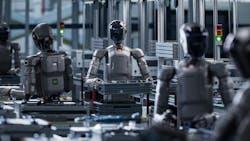
Robotics and automation are shifting from stand-alone machines to flexible, intelligent systems. These initiatives and research from MIT, NVIDIA, the U.S. Department of Energy, the ARM Institute, the Air Force Research Laboratory, University of Alberta, and The University of Texas at Arlington Research Institute (UTARI) trace the progression of robotics from task-specific automation to smart infrastructure, using artificial intelligence (AI), high-performance computing, and advanced control systems to integrate increasingly complex robotics platforms into manufacturing ecosystems.
At the same time, robotics is moving closer to workers and the human body, as wearable exoskeletons demonstrate measurable gains in productivity, quality, and workforce sustainability by reducing fatigue and variability in physically demanding tasks.
This week’s research in The Industrial Science Report reflects a broader push to make robotics more scalable and less confined to isolated cells. The future of manufacturing automation will be defined by the infrastructure and integration strategies that allow full systems to scale and adapt.
MIT AI-driven robotics system uses human speech to build objects
MIT researchers have only built a few pieces of furniture and (what I can only assume is) an adorable dog statue with robots that respond to natural language commands. However, the research signals a possible future where robotics can create objects on demand. Or what if programming a robot no longer required code, just words?
MIT’s speech-to-reality research helps imagine a future where operators can verbally instruct robots to adapt in real time, dramatically lowering the barrier to automation. For manufacturers, this could reduce commissioning time and improve flexibility on the factory floor. For maintenance and reliability teams, language-driven robotics may also simplify troubleshooting and reconfiguration during unplanned downtime.
Researchers at the Massachusetts Institute of Technology (MIT) have developed an AI-robotics system capable of “speaking” objects into existence. This effectively integrates language models with robot perception and manipulation, and 3D generative AI. The system uses a large language model to interpret natural language descriptions and then 3D generative AI creates a digital mesh representation, and a voxelization algorithm breaks down the 3D mesh into assembly components and an automated sequence that robotic hardware can execute to produce the object. Researchers have used the system to create stools, shelves, chairs, a small table, and a decorative dog statue. By leveraging natural language, the system makes design and manufacturing more accessible to people without expertise in 3D modeling or robotic programming. The team has immediate plans to improve the weight-bearing capability of the furniture by improving connections between the components.
NVIDIA and U.S. Department of Energy partner to advance AI infrastructure for manufacturing and scientific discovery
Advanced robotics and automation only become transformative when the infrastructure exists to support them at scale, and industry needs partnerships like this one to support AI, high-performance computing, and digital twins for managing these autonomous systems. These technologies also become key to modeling, simulating, and optimizing complex robotics and manufacturing processes before they hit the factory floor.
For operations, reliability, and engineering leaders, AI-enabled simulations and high-fidelity digital twins also make it possible to explore process change and equipment failure scenarios virtually. Next-generation automation and robotics will increasingly rely on robust AI and advanced computing platforms, and industry and government investment will help get us there.
NVIDIA has joined the U.S. Department of Energy’s (DOE) Genesis Mission as a private industry partner to accelerate AI, high-performance computing, and robotics applications across energy, scientific research, and national security. The collaboration focuses on AI-enabled manufacturing and supply chain optimization, autonomous labs, robotics, digital twins, and high-fidelity simulations to improve operational efficiency and innovation. NVIDIA also signed a memorandum of understanding (MOU) with DOE to outline priorities of the collaboration in support of accelerating scientific discovery, including AI for manufacturing and supply chains, open-source AI, fission energy, robotics, AI-enabled digital twins, fusion energy, quantum computing and science. Additional research areas include quantum computing, materials science, and synthetic design relevant to semiconductor manufacturing and energy industries.
ARM Institute and Air Force Research Laboratory forge $87M robotics and automation research partnership
Defense infrastructure has little tolerance for downtime, and that pressure can also produce manufacturing innovations that later spill into the wider industry. This partnership targets advanced robotics, such as multi-robot teaming and process modeling, for the Air Force, mirroring many of the challenges in commercial factories struggling with scaling automation tech alongside labor shortages and aging equipment. The scale of funding indicates a clear priority for Air Force robotics research.
The ARM (Advanced Robotics for Manufacturing) Institute announced a new five-year cooperative agreement with the Air Force Research Laboratory (AFRL) valued at up to $87.66 million to advance dual-use robotics and automation technologies critical to both U.S. manufacturing and Department of the Air Force (DAF) capabilities for maintaining, repairing, and supporting its aircraft and systems. The agreement will support research, development, testing, and evaluation of technology including robotic mobility, multi-robot/multi-human teaming, process modeling, monitoring, and control, advanced visualization, and scalability and rapid commissioning. The consortium will foster collaboration among DAF entities, robot and automation equipment OEMs, technology developers, academia, integrators, and other government agencies.
Canadian laser manufacturing cluster to advance manufacturing competitiveness
Advanced manufacturing competitiveness now depends on tightly integrated, multi-technology systems rather than standalone machines. For maintenance teams, laser-robot integration raises new reliability challenges around moving equipment and operation within the larger system. The cluster’s collaborative model is important to accelerate industry-wide best practices in maintaining these complex systems.
The University of Alberta announced a new laser manufacturing cluster initiative designed to position Alberta as a global hub for advanced laser-based manufacturing technologies, supporting industrial sectors such as oil and gas, mining, agriculture, aerospace, renewable energy, and heavy machinery. The Canadian Cluster for Laser and Advanced Manufacturing (C:CLAD) will connect university researchers with industry partners to share laser process innovations, advances in robotics, and digital solutions to strengthen applied research, and help translate technological advances into commercial solutions. The initiative emphasizes collaboration across sectors to support advanced manufacturing capabilities, preserve industrial infrastructure, and protect local jobs. By bringing together expertise in laser systems, surface engineering, and automation, the cluster aims to accelerate adoption of precision manufacturing technologies. With a $1.3-million grant from Prairies Economic Development Canada, C:CLAD will also foster sector-specific professional development.
University of Texas at Arlington research demonstrates ergonomic benefits of a soft robotic exoskeleton
Robots on the shop floor are no longer limited to cages and cobots. Some new robotics are worn by the workforce itself, showing measurable implications for productivity and quality. Research indicates that a pneumatically actuated soft wearable robotic elbow exoskeleton can significantly reduce muscle activity and perceived workload, enabling workers to sustain performance with less fatigue and greater consistency. According to Veysel Erel, Ph.D., research scientist III in the Biomedical Technologies Division at The University of Texas at Arlington Research Institute (UTARI): “Exoskeletons can lower muscle activity and reduce perceived workload, leading to faster cycle times, fewer errors, and more consistent outputs—all of which directly support higher productivity and quality.”
Rather than positioning ergonomics solely as a safety or compliance function, the research reframes wearable robotics as a production technology that directly supports operational performance. “When physical demand drops, fatigue develops more slowly, which helps workers maintain steadier force control, more consistent movement patterns, and faster, more accurate task execution,” Erel explains, citing broad evidence from studies looking at repetitive assembly, material handling, and overhead work.
Several automotive manufacturers, including Ford, BMW, and Toyota, have already begun redesigning workstations and workflows around upper-body exoskeletons, demonstrating how wearable robotics can influence task design and production processes at scale.
Wearable robotic systems can also collect a wide range of data, when equipped with force, motion, position, and electromyography (EMG) sensors, which measure muscle response or electrical activity in response to a nerve’s stimulation of the muscle. “The data captured such as joint angles, muscle load reduction, posture frequency, task duration, and movement patterns can be aggregated and analyzed to identify trends across shifts, tasks, or workstations,” Erel says.
For manufacturers facing an aging workforce and persistent injury risks, wearable robotics may become a reliability strategy for human capital as much as physical assets. Reduced fatigue directly correlates with fewer errors, safer interventions, and more consistent maintenance execution.
This peer-reviewed study, published in the Journal of Rehabilitation and Assistive Technologies Engineering, reports the design, development, and human evaluation of a pneumatically actuated soft wearable robotic elbow exoskeleton aimed at reducing muscle activity and perceived workload during repetitive tasks. Developed by researchers from the Industrial, Manufacturing, and Systems Engineering Department and the Biomedical Technologies Division at The University of Texas at Arlington (UTA) and UTA Research Institute, the device integrates a single-piece pneumatic structure with human joint mechanics to assist elbow motion. In trials with 19 participants, the exoskeleton reduced biceps muscle activity by 22.36 percent and triceps activity by 18.19 percent at 18 PSI, and demonstrated rapid actuation speeds. It shows potential for mitigating work-related musculoskeletal disorders in industrial settings involving lifting, assembly, or repetitive arm use.
About the Author
 Anna Townshend
Anna Townshend
head of content
Anna Townshend is the chief editor and head of content for Plant Services. She has been a journalist and editor for more than 20 years and joined Plant Services and Control Design as managing editor in June 2020. Previously, for more than 10 years, she was the chief editor of Marina Dock Age and International Dredging Review. In addition to writing and editing thousands of articles in her career, she has been an active speaker on industry panels and presentations, as well as host for Great Question: A Manufacturing Podcast. Email her at [email protected].