The Industrial Science Report: Inside Lockheed Martin’s Orion crew capsule
Key Highlights
- Orion's design integrates life support, navigation, communications, and radiation shielding to protect astronauts during deep-space travel.
- Manufacturing involves advanced techniques like friction-stir welding and silica-fiber thermal tiles to ensure structural integrity and thermal protection.
- The spacecraft's heat shield, made of Avcoat, is the largest ever used, enabling safe re-entry at temperatures up to 5,000°F.
- Extensive testing at NASA facilities verifies Orion's systems, including environmental control, waste management, and fire suppression.
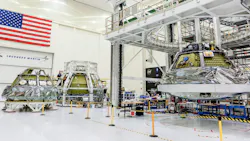
Before astronauts ever see the Moon’s surface, they have a long journey to get there. The responsibility to keep them safe falls to Orion, the deep-space crew capsule built by Lockheed Martin for NASA’s Artemis program. The spacecraft combines life support, navigation, communications, radiation shielding, propulsion systems, and the world’s largest heat shield to sustain and protect the astronauts during the mission.
During the Artemis II mission, Orion completed a flyby of the Moon’s far side and set a record for the farthest human-capable spacecraft from Earth at 252,756 miles away. Along the journey, crews and mission teams conducted critical evaluations of Orion’s life support, navigation, communications, propulsion, avionics, and manual piloting systems. They also captured amazing science imagery and observations of the lunar far side.
Spacecraft are more complex than traditional manufacturing systems, but it relies on many of the same equipment and processes, such as thermal management, atmospheric control, redundancy, and human-machine interfaces, as our machines here on earth.
Unlike the SLS rocket boosters and propulsion systems designed primarily for power and speed, the Orion’s engineering challenge is more about maintenance, maintaining a fully self-contained life-support environment in deep space. Spacecraft are more complex than traditional manufacturing systems, but it relies on many of the same equipment and processes, such as thermal management, atmospheric control, redundancy, and human-machine interfaces, as our machines here on earth.
Lockheed Martin’s Orion spacecraft
Lockheed Martin specializes in defense technology, headquartered in Bethesda, Maryland. It designs and builds aeronautics, missiles and fire control, rotary and mission systems, and space technology. It employees about 120,000 people in the U.S. and internationally.
Unlike missions operating in low Earth orbit, Artemis crews must survive for days in deep space without GPS satellites or constant communications coverage, so Lockheed Martin developed Orion with fully integrated environmental control and life support systems. The spacecraft continuously regulates cabin pressure, temperature, humidity, and air quality. Orion’s Crew Survival System spacesuits can also interface directly with onboard life support, allowing astronauts to survive for up to six days in the event of cabin depressurization. Because deep-space radiation poses a major risk to both electronics and human health, Orion incorporates radiation protection throughout the spacecraft, including emergency shelter areas inside stowage lockers designed to shield crews during solar radiation events.
Friction-stir welding has become increasingly important across aerospace and defense manufacturing because it creates stronger, lower-defect joints than conventional fusion welding while reducing structural distortion in lightweight alloys. It’s great for spacecraft cruising under extreme pressure and thermal cycling.
Innovations in industrial science: Withstanding the heat
The most demanding engineering challenge for the mission occurs during Orion’s return to Earth. Re-entering the atmosphere from lunar velocities generates temperatures approaching 5,000 °F. To survive those conditions, Orion relies on the world’s largest ablative heat shield, measuring 16.5 feet in diameter, made of a material called Avcoat. A similar material was used on the Apollo missions, and it was reformulated for Artemis. The shield is designed to gradually burn off or ablate during re-entry, carrying heat away from the spacecraft.
Orion Spacecraft Facts
- Can support 4 crew for up to 21 days.
- Including the crew and service module and launch abort system:
- GROSS LIFTOFF MASS: 79,000 lbs / 35,380 kg
- TRANS-LUNAR INSERTION MASS: 58,500 lbs / 26,536 kg
- POST TRANS-LUNAR INSERTION MASS: 57,000 lbs /25,854 kg
- USABLE PROPELLANT: 19,000 lbs / 8,618 kg
- Crew Module
- HEIGHT: 11 ft / 3.35 m
- DIAMETER: 16.5 ft / 5 m
- HABITABLE VOLUME: 330 ft3 / 9.34 m3
- PRESSURIZED VOLUME: 690.6 ft3 / 19.56 m3
- LUNAR RETURN PAYLOAD MASS: 220 lbs / 100 kg
- REACTION CONTROL SYSTEM: 12 THRUSTERS 160 lbs / 73 kg
- THRUST EACH MASS AT LIFTOFF: 22,900 lbs / 10,387 kg
- NOMINAL LANDED MASS: 20,500 lbs / 9,299 kg
Material and equipment re-engineering is a common trend in modern aerospace manufacturing, where engineers revisit legacy technologies using contemporary materials science, digital simulation, and precision manufacturing methods. In deep-space systems, engineers often prioritize proven reliability over entirely new materials, especially in components where failure is catastrophic, such as the RS-25 engines.
Earth’s atmosphere will slow Orion from roughly 25,000 mph to about 325 mph, then, an 11-parachute deployment sequence reduces splashdown speed to approximately 20 mph. Three 7-foot diameter Kevlar parachutes, along with pyrotechnic thrusters, separate the cover that keeps the parachutes protected during re-entry. Two drogue parachutes slow and stabilize the crew module, made of a Kevlar/Nylon hybrid at 23 feet in diameter.
Orion’s service module provides propulsion, power, thermal control, and consumables for the mission. The module contains 33 engines, including a large main engine used for deep-space orbital maneuvers and lunar flyby operations. Once the service module separates before re-entry, 12 reaction control system thrusters mounted on the crew module orient the capsule heat-shield-first and maintain vehicle stability throughout descent.
Redundancy plays a critical role in Orion’s design philosophy. Multiple backup systems ensure that critical spacecraft functions, including computers, avionics, navigation, and life support, remain operational if failures occur during the mission.
Those technologies are expected to play a growing role as NASA expands the Artemis program. Lockheed Martin has finalized contracts for six Orion missions with the option for up to 12 spacecraft in total, supporting NASA’s long-term plans for sustained lunar exploration and future deep-space missions. Artemis III will be another test mission to demonstrate critical docking with NASA’s Human Landing System, and the Artemis IV mission will return astronauts to the moon surface.
Artemis II also continued testing advanced communications technologies, including experimental laser-based communications systems designed to support future deep-space data transmission with NASA mission control in Houston.
Close quarters: Crew area and environmental control and life support system
The interior backbone assembly supports crew seating, storage systems, and mission equipment. The four adjustable crew seats are designed to accommodate nearly 99% of the human population. Updated Artemis II displays and controls allow astronauts to operate the spacecraft using three primary display screens, roughly 60 physical switches, hand controllers, and integrated electronic procedures that replace large paper manuals.
An aluminum structure of crisscrossing beams provides the floor structure where the crew seats are attached, along with crew lockers. Orion’s hygiene bay has a new compact toilet that is easier for men and woman to use.
Orion also includes a galley for food preparation, potable water systems, exercise equipment for aerobic and strength training, and a waste management system for the hygiene bay.
Known collectively as the environmental control and life support system (ECLSS), these critical systems are designed to create a habitable environment for four crew members during both normal operations and emergency scenarios, from launch through splashdown recovery. Orion’s ECLSS maintains breathable air, regulates cabin pressure and temperature, supplies potable water, manages waste, and protects astronauts from hazards such as fire or cabin depressurization.
Of all the spacecraft technology this to me feels the closest to highly integrated industrial process environments, albeit on a much grander scale. But, like a semiconductor cleanroom, the spacecraft is continuously monitoring airflow, contamination, thermal loads, humidity, pressure stability, and fault conditions in a closed environment.
Key Orion ECLSS subsystems include:
- Air Revitalization System—Inside Orion’s sealed cabin, air must be continuously monitored and conditioned to remain breathable. This system maintains oxygen and nitrogen levels while removing carbon dioxide and trace contaminants generated by both crew members and onboard electronics. Orion uses regenerative amine swing-bed chemical scrubbers to capture carbon dioxide, while atmospheric monitoring systems continuously track cabin conditions. The system also removes excess humidity generated from respiration, exercise, and onboard activities, converting water vapor into wastewater for storage and disposal. In emergency scenarios such as cabin leaks or contamination events, the system can maintain breathable pressure and thermal cooling for four suited astronauts for up to 144 hours.
- Active Thermal Control System—Spacecraft operating in deep space encounter extreme thermal swings, with intense solar heating on one side and freezing darkness on the other. Orion’s Active Thermal Control System regulates internal spacecraft temperatures by circulating coolant fluids through heat exchangers and external radiators, functioning similarly to an industrial liquid-cooling system or automotive radiator. The system protects both astronauts and sensitive avionics from overheating while maintaining the crew cabin at approximately 70–75°F, including during the intense heat loads generated by atmospheric re-entry.
- Potable Water System—Orion’s water management system supplies astronauts with drinking water, food preparation capability, medical-use water, and hygiene support throughout the mission. The spacecraft carries approximately 74 gallons of water distributed across four storage tanks. Pressurized plumbing systems, filtration components, and controlled distribution systems ensure water quality and supply during long-duration missions.
- Waste Management System—Orion’s Universal Waste Management System is based on technologies already used aboard the International Space Station but redesigned for the mass and space limitations of deep-space missions. The spacecraft includes a dedicated hygiene bay for crew privacy, while airflow-assisted collection systems and dual-fan separators direct waste into sealed storage containers. Filtration systems help manage particulates and odors, maintaining cabin cleanliness and protecting crew health throughout the mission.
- Fire Detection and Suppression System—Fire represents one of the most dangerous failure scenarios inside a closed spacecraft cabin. Orion’s fire detection system continuously monitors the atmosphere for smoke and combustion byproducts using onboard sensors similar in concept to advanced industrial smoke detection systems. If combustion is detected, alarms alert astronauts so they can respond using specialized fire suppression equipment engineered for microgravity environments. Rapid detection and response are considered essential safeguards for future deep-space missions where immediate evacuation is impossible.
Critical mission testing
The ECLSS went through extensive testing at the Orion Life Support Integration Facility (OLIF), a lab at NASA’s Johnson Space Center, developed jointly by Lockheed Martin and NASA. Here, physics tests verify the core engineering principles for pressure-control checks on cabin oxygen, nitrogen, and carbon dioxide. A humidity-feedback loop was evaluated to maintain safe moisture levels in the crew’s suit ventilation system, and vaccum-chamber tests could validate seals in near-space conditions.
The Integrated Test Lab (ITL) near Denver complements OLIF with software and hardware validations. Engineers verify closed loop control across simulated mission phases, adjusting oxygen levels, CO₂ filtration, and coolant flow automatically. They also conduct full mission end to end simulations, injecting sensor noise, timing glitches, and fault conditions (e.g., a stuck valve) to test diagnostics and resolution capabilities.
The first three Artemis missions themselves are all about testing before we actually land astronauts again on the moon. As NASA expands the Artemis program beyond Artemis II, testing and sustainment operations are as critical as spacecraft manufacturing itself. To support Orion’s growing fleet, the Lockheed Martin Enterprise Logistics and Test Solutions (ELTS) team in Orlando, Florida is developing specialized test equipment designed to keep future Orion spacecraft flight-ready for lunar missions.
About the Author
 Anna Townshend
Anna Townshend
head of content
Anna Townshend is the chief editor and head of content for Plant Services. She has been a journalist and editor for more than 20 years and joined Plant Services and Control Design as managing editor in June 2020. Previously, for more than 10 years, she was the chief editor of Marina Dock Age and International Dredging Review. In addition to writing and editing thousands of articles in her career, she has been an active speaker on industry panels and presentations, as well as host for Great Question: A Manufacturing Podcast. Email her at [email protected].