The Industrial Science Report: Why artificial intelligence is becoming manufacturing infrastructure
Key Highlights
- AI is moving from research labs into real-world manufacturing systems, enhancing materials discovery and plant operations.
- Major investments, such as Nokia's $4 billion expansion, aim to develop AI-ready networks critical for Industry 4.0.
- The DOE's Genesis Mission seeks to leverage AI for accelerating scientific discovery and transforming U.S. manufacturing infrastructure.
- Autonomous AI systems are being developed to monitor, diagnose, and correct manufacturing processes in real time, even in unpredictable environments.
- AI-compatible chemistry platforms like Excelsior Sciences' are addressing data bottlenecks in drug discovery and small molecule manufacturing.
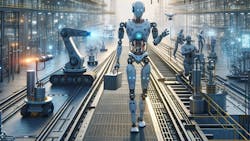
Artificial intelligence (AI) is becoming an operational force in manufacturing, shaping everything from how materials are discovered to how machines correct themselves on the plant floor. This week’s stories show AI moving out of the lab and into real systems. National research initiatives are positioning AI as core infrastructure. Autonomous platforms are running experiments at factory-like scale, and new approaches to chemistry and additive manufacturing are being designed specifically so machines can generate and interpret the much coveted data. At the same time, billions of dollars are flowing into the network infrastructure required to move that data reliably and in real time.
It isn’t just about better algorithms anymore. We need more data and fast enough to feed data-ravenous algorithms. For manufacturers, these developments point to a future where performance, uptime, and reliability increasingly depend on how well physical assets, processes, and connectivity support artificial intelligence.
U.S. DOE Genesis Mission to transform U.S. science through artificial intelligence
Artificial intelligence is often seen as a tool for accelerating science. What if it becomes a national infrastructure for designing the next generation of industrial systems? The Genesis Mission could signal a structural shift for manufacturers and a future where materials, processes, and systems are increasingly developed through AI-driven experimentation rather than traditional engineering or trial-and-error. For maintenance and reliability professionals long-term, assets and systems designed with AI-enabled modeling may arrive with more predictable performance packages, better failure modeling, and data architectures built for lifecycle optimization out of the box.
The U.S. Department of Energy (DOE) launched the Genesis Mission via an Executive Order from President Trump in late November, establishing a national effort led by DOE to transform American science and innovation through artificial intelligence. The initiative will mobilize DOE’s 17 National Laboratories together with industry and academia to build an integrated discovery platform. The mission wants to harness AI and advanced computing to double the productivity and impact of U.S. science and engineering within a decade. The focus will address three key challenges:
- energy dominance though advanced nuclear, fusion, and grid modernization
- advancing discovery science with DOE and industry investment in the quantum ecosystem
- ensuring national security with advanced AI technologies for security missions, safe U.S. nuclear stockpiles, and development of defense-ready materials.
The platform will connect supercomputers, AI systems, quantum systems, and advanced instruments, and draw on DOE scientists, engineers, and private-sector innovators.
DOE launches artificial intelligence-driven biotechnology platform at Pacific Northwest National Laboratory
When research facilities begin to operate like autonomous factories, the line between science and manufacturing begins to disappear. With the autonomous, AI-enabled AMP2 platform, DOE is demonstrating how research environments are beginning to resemble advanced manufacturing cells. For maintenance and reliability professionals, AMP2 highlights the growing importance of maintaining complex automated systems. Downtime, sensor accuracy, and system integration will directly impact how biomanufacturing and process industries operate in the future.
The U.S. Department of Energy has commissioned the Anaerobic Microbial Phenotyping Platform (AMP2) at Pacific Northwest National Laboratory (PNNL), a new AI-driven biotechnology platform for high-throughput microbial experimentation. The platform was built by Ginkgo Bioworks and is the world’s largest autonomous-capable system for anaerobic microbial research, according to DOE. AMP2 supports Genesis Mission goals by enabling faster exploration, growth, and optimization of microbial systems using automation and AI, potentially transforming how biological research is conducted. DOE also says that the platform will serve as a prototype for larger systems, including the planned Microbial Molecular Phenotyping Capability (M2PC).
Excelsior Sciences raises $95 M to advance artificial intelligence-compatible chemistry for small molecules
AI isn’t falling short in manufacturing because of inadequate algorithms. It’s failing where the physical world can’t provide data quickly enough, creating a critical bottleneck in AI adoption. Excelsior wants to develop a new form of chemistry performed by machines, ultimately redesigning chemistry to be compatible with automation and AI-driven equipment. Right now AI performance for manufacturers continues to be constrained by how consistently processes can be executed in the real world, and automated, synthesis-friendly chemistry may have some answers to consistency. For maintenance and reliability professionals, as AI-driven processes proliferate, maintaining equipment consistency, calibration, and repeatability becomes even more central to ensuring model accuracy and process reliability. Reliability will depend on maintaining AI infrastructure.
Excelsior Sciences has raised $95 million in funding to advance a novel chemistry platform designed to be compatible with machine automation and AI for small molecule discovery and manufacturing. The Series A financing was co-led by Deerfield Management, Khosla Ventures, and Sofinnova Partners, with a $25 million grant from New York’s Empire State Development and participation from Cornucopian Capital, Eli Lilly and Company, Illinois Ventures, and MIT. The company’s proprietary “smart bloccs” chemistry enables automated synthesis and is intended to support closed-loop AI systems in generating data for discovery, accelerating the integration of AI with chemical and pharmaceutical manufacturing. Excelsior wants to reinvent the process of discovering and manufacturing small molecules by creating systems that use AI to automate chemistry, addressing challenges in drug discovery and manufacturing by enabling faster generation and testing of compounds.
Nokia expands U.S. R&D and manufacturing investment by $4 billion for artificial intelligence-ready networks
AI on the plant floor is only as smart as the networks carrying its data, and those networks are becoming critical infrastructure. The more tightly integrated artificial intelligence becomes with production, inspection, and maintenance systems, network performance and reliability will further merge OT and IT responsibilities. For maintenance and reliability professionals, this expansion signals a future where predictive analytics, condition monitoring, and remote diagnostics depend on deterministic, high-capacity networks that must be maintained with the same rigor as physical assets.
Nokia plans to expand its U.S. research, development, and manufacturing investment by $4 billion to accelerate innovation in AI-ready network connectivity technologies. This investment builds on Nokia’s existing $2.3 billion commitment in U.S. manufacturing, R&D, and AI connectivity tied to its acquisition of Infinera. Approximately $3.5 billion of the expanded investment is expected to support R&D in mobile, fixed access, IP, optical, and data center networking technologies, with $500 million allocated to capital expenditures in manufacturing and R&D activities in states including Texas, New Jersey, and Pennsylvania. The expanded investment will strengthen AI-optimized networking solutions and advanced technology areas such as automation, quantum-safe networks, semiconductor manufacturing, testing, packaging, and material sciences.
Rutgers engineers develop autonomous artificial intelligence to enhance resilience and discovery
The next leap in manufacturing intelligence is not better dashboards, but machines and processes that know how to correct themselves. This latest research from Rutgers University highlights how autonomous artificial intelligence is moving beyond analytics and into direct control of physical processes. AI systems that can monitor and correct additive manufacturing in changing environments could address one of manufacturing’s persistent challenges: process stability under non-ideal conditions. For maintenance and reliability teams, the work foreshadows equipment that can self-correct, self-diagnose, and operate with fewer manual interventions, changing how reliability strategies are defined and executed.
Research led by Rutgers University engineers demonstrates autonomous artificial intelligence systems that can improve expeditionary additive manufacturing and experimental discovery. One of the studies focuses on making additive manufacturing robust in unpredictable environments such as space, war zones, and disaster areas by using AI with cameras to monitor and adjust 3D printing in real time. The researchers also published work showing how AI can accelerate innovation in manufacturing by reducing the need for costly physical experiments. These AI systems do not require retraining to work in new environments and can operate without expert human intervention.
About the Author
 Anna Townshend
Anna Townshend
head of content
Anna Townshend is the chief editor and head of content for Plant Services. She has been a journalist and editor for more than 20 years and joined Plant Services and Control Design as managing editor in June 2020. Previously, for more than 10 years, she was the chief editor of Marina Dock Age and International Dredging Review. In addition to writing and editing thousands of articles in her career, she has been an active speaker on industry panels and presentations, as well as host for Great Question: A Manufacturing Podcast. Email her at [email protected].