Podcast: Do safety leaders need to improve their emotional intelligence?
Key Highlights
- Emotional intelligence can improve decision-making, relationships and stress management across the safety organization.
- Empathy helps uncover the gap between work as prescribed and work as done, strengthening trust and psychological safety.
- AI can tailor safety messaging and analyze data, but effective communication still requires audience insight and human feedback.
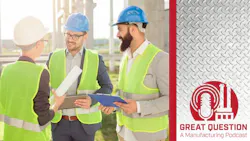




In this episode of Great Question: A Manufacturing Podcast, EHS Today's Adrienne Selko talk with safety expert Camille Oakes, who says improving emotional intelligence skills for safety managers helps create stronger outcomes in complex workplaces.
Below is an excrpt from the podcast:
Adrienne Selko: Skills are essential to high functioning safety organizations. However, many leaders do not have the opportunity to improve their skills. Can you talk about why this is especially important for EHS professionals?
Camille Oakes: Sure. Safety professionals are often, we're technical experts. And some of us ended up in the job because we knew the rules, we passed the tests, we understood the hazards, maybe even we got hurt at work or we were assigned this job. No matter how we got there, most of us have learned the technical side, but nobody took us aside to say, and now here's how to lead people. And that gap is real and it's costly and it is hard. EHS is one of the few roles in which we are responsible for outcomes that we have almost no direct authority to control. We're asking people to change their behaviors, adopt new habits, trust my judgment, and let me build up their judgment without a relationship in which I'm your boss. That requires leadership and not just expertise.
If you think about the amount of people that a safety professional, an EHS professional, just in a single week that we have to interact with and influence. You might, in the morning, be in a meeting with executives, and then in the afternoon, be doing a toolbox talk with frontline workers who have, you know, as people have said to me, “been doing this since before you were born, sweetheart.” And then in the evening, like before you go home, you're having a negotiation with an operations manager. That demands leadership range. So it's not just about leading the people that maybe report to us, but also leading kind of everybody in a way.
So EHS people, we go to school, we get certifications, we take classes, maybe even go to conferences. And there's a lot of discussion about leadership development, but it's not necessarily built to scale, even going through the CSP, the certified safety professional. You're getting some questions about leadership development and all of that, but there's no one that's really teaching you that.
So I found a gap there, and that's part of the reason that I wrote my book, EQ for the Safety Leader, is because it is what I needed.
I was, I went to school for safety. I had gotten my ASP, my associate safety professional, and there I was, you know, working on a plant floor, completely lost. I knew what the rules were, but I had no idea like how to have a conversation with a frontline worker who was doing something at risk or dangerous. And I learned that from watching an operations manager have that conversation. Those leadership skills, ideally, you wouldn't have to learn after you've already spent years messing them up, like me. I had to learn how to be a human at work.
And so when our safety leaders, when we lack leadership skills, those ripples go deep. It makes it so that folks don't trust us. And like it or not, we're the face of safety. If they don't trust us, they don't trust anything safety related. We get a blame culture. We get compliance-only engagement. Your supervisors are doing reports where everything is A+ 100%, not a single safety hazard over here. Everybody's silent in your meetings. When you do have leadership skills, you get something completely different. You get what you're looking for.
AS: You mentioned emotional intelligence. So can you talk about that in terms of its importance as a capability of a safety leader? And then can you talk about some practical methods we can use to develop this skill?
CO: This is my favorite topic, emotional intelligence. So I want to back up and start with what is a definition of EQ, emotional intelligence. Some people call it EI. The Q stands for quotient, your capacity. Your emotional intelligence is, there's a lot of different definitions. This one is my favorite: The ability to recognize, understand, and manage your own emotions, sure. But for us, it is also the ability to recognize, understand, and influence the emotions of people around you. And if we've established that in the EHS world, we are influencing people, then we need to understand that people have emotions.
I have been talking about EQ for most of my 20-year career in safety. And there's always someone who says, but I'm not an emotional person. And that's an oxymoron because what you might mean is that you are not emotionally expressive. But if you are a person, you are emotional. If you've ever been angry, if you've ever been sad, those are emotions. And everyone has experienced those and they do affect the decisions that we make.
For EHS folks, emotional intelligence, the power that comes from it, is the power that helps us influence our workers to wear their PPE. Great, that's great. But more importantly, it is also gives us the ability to influence the executives to pay for that PPE, to influence HR to actually require it in a policy. And probably most importantly, it allows us the ability to influence the engineer to redesign the work, eliminate the hazard so that we don't actually have to wear the PPE.
I sometimes call us guidance counselors, a lot of safety people talk to me and identify with that, that you're some combination of a school nurse and a counselor, because you'll find, if you're strong at your position, people will tell you stuff. And everything that we do involves emotion. We are folks who have to deliver bad news after an incident. We're trying to get people to report things. We're trying to build buy-in from, let's say we're rolling out some new initiative and we've got a whole bunch of folks who are not happy with this, but I want them to be on board. It won't work. And I think everybody knows this inherently. It won't work to just tell them now you have to. Life would be a lot easier if we just told people what to do and then they listened, but that's not how people work.
So EQ is a collection of skills. It is not a personality trait. Like I'm emotionally intelligent and I'm not. You're not born with it. It is something that can be built. It may be harder for different folks to build these skills. If they're not used to it, if they're neurodivergent, this might be a little bit more difficult. But it is a collection of skills that you can develop.
Most of my work is based on this model of EQ called the EQI 2.0. And in that model, there are five overarching skills, and then each of those has three skills underneath it. And I would say if a person is hoping to develop EQ, or simply hoping to develop leadership skills in their EHS work, that I would focus on a few of those.
So the five overarching skills are:
- Self-perception, how you understand yourself, what you believe to be true about you.
- Self-expression, how you communicate to others and how they might perceive you.
- Interpersonal relationships. So this is like, do I lean on people and do they lean on me? Am I somebody that they trust? That sort of thing.
- Decision-making, which is an incredibly necessary skill for an EHS person.
- And then also really necessary is stress management.
So the EQI, there are assessments you can take. The first step is to know how you show up at work. And that is with that self-perception. So what I did to learn more about myself is go through this EQI assessment. And now I can give that to other folks now. So I've done some EQ assessments and some coaching with folks. But what I liked the most about it is learning things about myself that I really didn't know. So you learn in that the skills that you're using tremendously. My flexibility is off the charts, which is great in a consultant role. But let's say I was an OSHA inspector. Would I want to be using flexibility as much as I am? Would I want to be in a role in which that's really difficult for me to do the same thing all the time.
What I also found in that report was that, which was surprising, was my interpersonal relationships, the skill of managing interpersonal relationships for me was super low. And it was really shocking because in safety, you're sort of in the world of people, and certainly I am, but I learned a lot about my desire to work alone.
If your job and your work is going how you want it to go, you don't need to spend time building up these EQ skills. But if it's not working, you want to find out if there are any of these skills that you could use to help you navigate that situation. So on practical development, I would say start with self-perception. You can't develop what you can't see. How do I show up under stress? Am I fight, flight, freeze? What's going to happen when I'm in a confrontation with an executive or an ops leader, something like that, how am I going to react?
How do I express myself? A lot of this information, you know, we go through reviews in our work. You might be lucky enough to get a 360 review, which is where maybe the folks that work around you as well as above you. And even if you have folks that work for you, they're going to tell you hopefully, truthfully, what are some of your strengths and some of your opportunities? So hearing the truth about yourself and how you're perceived can be painful, but it's also necessary if you're really actually serious about building those skills.
Decision-making is another large category for EHS folks. All we're doing all day is decision-making, balancing operations with safety requirements and trying to find risks that are acceptable to you, to our workers, to our executives, to our shareholders. What is an acceptable level of risk and how can I push to reduce it maybe a little bit even more? So that decision-making, your emotions are going to influence your decision-making as well as the folks around you. But mostly that's an internal thing. So one of the things I use in my workshops with my clients, as well as in my book, is essentially keeping an emotional trigger journal. What is the stuff that sets you off? When you are going to, you know, for me, a big trigger is, I've already told you to do this. And now you're coming back and asking for clarification. That is something that will set me off. Knowing that about myself makes me able to show up better in the moment because I'm ultimately still trying to get the person to do the thing I want them to do.
So my decision-making is clouded by that emotion. And I've got to handle that. And that's not the fault of the other person.
So EQ is also like a team skill. You’ve got to build it individually and you’ve got to build it together. I have a book of emotional intelligence, this is not a book I wrote, of emotional intelligence activities for leaders. And I'll do some of those in my workshop where this is a really great one. You get a group of folks together and it was two safety people and everybody else was an ops manager, ops supervisor, and I think all the way up to the VP was in the room for this. And I handed out post-its. I gave everybody 5 pink post-its and two green post-its. And on the pink post-its, everyone had to individually write one idea for one task that you have to do this week for your regular job. And then everyone wrote a safety task on each of those green post-its.
Now we went outside the room and we stood in a big circle and everybody crushed up their post-its and held them in their hand. And already it's a little bit hard to hold. And then I would say stuff like pass one pink to your left, pass two pinks to your right. Now give all of your greens to the safety guy. And then of course, all of this is post-its falling all over the ground. Because we can individually say, well, you don't understand, I have so much work. But then the visual representation of how much work everybody has to do this week, you can understand the stress level of the people around you. And you can see for us in the safety world, you could see pretty clearly that the safety guy couldn't do everybody's safety tasks because he also had some pink stuff to do as well. So by the time this activity is over, all you see is post-its all over the floor, which are representing balls that have dropped for all of us. So it helps build a little bit of empathy. And that has been like useful, fun, workshoppy tools like that can help you build a lot of these, a lot of these skills.
AS: You mentioned empathy, which is another trait that is gaining momentum in the safety space as companies focus on psychological safety. Can you talk about this skill and how to use it as a core competency in a safety organization?
CO: For sure, empathy is a topic of conversation. So empathy is not just about being nice and friendly and never holding anybody accountable. The official definition from the EQ resources I use is that empathy is the ability to recognize, understand, and appreciate others' emotions and respond with genuine consideration. And I think that's legitimately the definition of what a safety professional does.
In safety, empathy closes that gap between what a worker is told to do versus what they actually do. So in HOP (human and organizational performance) and reliance and system safety, there's concepts called work as prescribed versus work as done. It basically means what you learn in the training class versus when you leave that room and you actually start to run the machine, what you actually do. And you're going to do what the folks around you do, as opposed to what you were taught as the rules. You're going to do work as done, not work as prescribed.
So empathy teaches us as leaders to start with understanding the person, the experience that they're having. So if we're not understanding the pressure that they're under, the culture in which they're operating, the fear they have about speaking up or telling the truth, then not knowing the truth leaves us in the dark.
And so we also talk about psychological safety. And psychological safety and empathy are connected, but they're not the same thing. Empathy is when I am having a conversation, when I am listening without judgment, doing that over and over and over again, seeing where someone is coming from, not saying you agree, but seeing and listening makes us eventually get to psychological safety. Because if I build up that trust with empathy over and over and over again, then we are headed towards an environment in which people feel safe to tell the truth.
As a core competency, empathy is something that we are teaching our leaders. We can do this in our incident investigation training. So instead of saying, here's the form, and here's how you fill out the form, and you hand a supervisor a form and they sit with the person and say, what were you doing before the incident? What is your date of birth? What happened? What can be done to prevent it from happening again? Instead of that sort of rote thing, you're teaching them to view a person as a person. So if they're investigating, instead of jumping to, well, why didn't you follow the procedure? Or were you trained in this? You're first going to ask something like,
What was happening for you in that moment, or what did you believe to be true when you made that decision?
And then it has to be real. Empathy has to be real. So we want to be training our leaders to listen first, to not punish for reporting, and to act on what folks tell us. If they tell us all these problems and then we don't do anything about it, they're going to stop telling us. We have to do those things because otherwise it's performance and people will realize the lack of authenticity pretty, pretty quickly.
People contribute, they report, they innovate in environments where they believe that there is trust and that they matter. And that's one of the ways in which you build safety.
AS: Communication has always been a high priority for companies, and especially with the introduction of AI in safety organizations. Can you talk about some best practices you have seen with regard to this?
CO: Communication is probably the most important thing when it comes to safety. The foundational problem with how we communicate safety has never been about the technology. It's been part of it, but that's never been the only solution. I teach a class called Communicating for Action as a two-hour, four-hour, 8-hour workshop because there's a ton of information that folks share with me.
And what they say is that, I've got a text message system, we've got videos, we've got training for it, we've got Slack messages, we've got all these 50 million ways to communicate. We have the technology, but still nobody's listening. So it's not about the tech.
Our workers at any level are going to tune out safety messaging that feels generic, procedural, or very specific to safety by someone who's never done that job. What do I know? My favorite meme is a picture of a young woman with a clipboard and she's wearing a hard hat on a construction site and it says, “I don't know how to do your job, but my book says you're doing it wrong.” And people get a kick out of that whenever I share it because that's their experience. You have to overcome that perception of you, because it looks like you're coming from the book side of things. And the folks that you're communicating to are saying you don't know anything. So the best communications in organizations have a couple things in common. They communicate in plain language. It's not a list of don't do's. A 25 list of don't do this, don't do this, don't do this. It's a list of one thing to do right.
And they're communicating in different ways. It's not just verbal. It is not just written. It is not just auditory. So you're getting that information in a way that works for all of the brains within your organization. They get to the point, and the most important thing in safety communication is that you frame things for why it matters to the person that you're telling. Not why it matters to the company.
When I worked for organizations, I cared about OSHA fines because I was the safety specialist. If you are talking to a random employee, do they care that this is an OSHA violation and OSHA could fine the company for $8,000? Do they care about that? Unlikely. So why are you referencing OSHA violations as a fear tactic or as a motivating factor? People are motivated by different things, and that is generally not one of them unless you're a safety person or an executive.
Now about AI. What AI can do is help you tailor that information. So drafting faster, more tailored messages to specific audiences. AI is also fantastic at data analysis. Now again, we can't remove the people from it. You should always be checking this work. But what it can do, in the same way a person could use it, I use AI to help me with social media. So it will make a post for me for LinkedIn, and then it will also make it for Instagram, and then it will also make it for Facebook. That should not have to take me a whole day. I can go do stuff that is more important and more beneficial.
A safety manager can do the same thing. I want this message to go to the executives. Well, what do executives care about? They care about cash. They care about productivity. There's probably some internal number that your top leadership cares about.
My background is in warehousing, so it's usually throughput. How many boxes do we get out in a day? That's what they care about, so that's what my messaging is going to be to them. To my supervisors, they care about different things. And to my workers, they care about different things. I'm going to talk about morality and getting home safe and getting the job done so that you get your bonuses. I'm going to talk about different stuff for different people. And that's what AI, I envision it taking that role on so that you can communicate more effectively.
Regardless, if you are changing communications, the way that you communicate, what you communicate out for, or you are trying to change something. Let's say you want to roll out a major safety initiative. Communication is one of the most necessary things to get right to make that safety initiative work. So identifying who your audience is, tailoring your message, and then creating feedback loops so that you are hearing from people and you are replying and getting as much buy-in as you can. And those principles of how we communicate, how we best communicate, they don't change because of AI. AI might make it a little bit easier though.
About the Podcast
Great Question: A Manufacturing Podcast offers news and information for the people who make, store and move things and those who manage and maintain the facilities where that work gets done. Manufacturers from chemical producers to automakers to machine shops can listen for critical insights into the technologies, economic conditions and best practices that can influence how to best run facilities to reach operational excellence.
Listen to another episode and subscribe on your favorite podcast app
About the Author
Adrienne Selko
Adrienne Selko is senior editor at EHS Today and Material Handling & Logistics. Previously, she was in corporate communications at a medical manufacturing company as well as a large regional bank. Adrienne received a bachelor’s of business administration from the University of Michigan.