Podcast: What safety issues should businesses be most concerned about?
Key Highlights
- Safety culture beats compliance: Focus on learning, risk prevention and systems design, not blame and box-checking.
- Roadway incidents cause 38% of workplace fatalities; safer driving habits and vehicle tech can save lives.
- Mental health, fatigue and stress directly affect safety performance and must be addressed alongside physical risks.
- AI, sensors and predictive tools help identify hazards early, enabling proactive prevention of serious incidents.
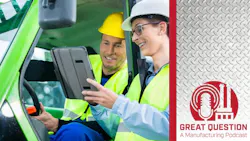


In this episode of Great Question: A Manufacturing Podcast, Lorraine Martin, CEO of the National Safety Council, explains why the NSC first developed National Safety Month in 1996—and what workplace safety issues they’re focusing on this year.
Below is an excerpt from the podcast:
Nicole Stempak: Welcome to this episode of Talking EHS, part of the Great Question podcast series produced by Endeavor Business Media's Manufacturing Group, a division of Endeavor B2B. Here is where you can get news, information, and compelling conversations on the latest developments in workplace safety. I'm Nicole Stempak, managing editor of EHS Today, which you can find at ehstoday.com. Welcome to the podcast. Joining me today is Lorraine Martin, CEO of the National Safety Council. So it is a pleasure to have you here today, Lorraine. And June is National Safety Month. For our listeners who aren't familiar, would you mind sharing more about this initiative and why National Safety Council first started this?
Lorraine Martin: Well, thank you, Nicole, and I'd be happy to. The council in about 1996 had already still been working to keep people safe around our nation for about eight decades. So we've been around for over 100 years. But in 1996, we realized that we still weren't getting to everyone. There were still people dying and millions of people were being injured, whether that was preventable activities at work, on our roads, in our homes, in our communities, and we said we need to raise some more awareness. And these risks that we were facing were very complex and varied. They could be a house fire, a car crash on our roads, an incident in a mine.
And so we said, we've just got to raise the visibility about what safety means across our nation and see if we could have kind of an annual moment where we all just paused in the month of June and understood the reality of these injuries, that they are all preventable in many cases predictable. And there are things that if we raise our awareness, we can truly decrease them and keep people safe. We picked June at the time because summer is a time when there's more travel, we're outdoors, lots more activity, people are more physical. And so June felt like the right place for us to raise that awareness each year to put down some markers to take action for ourselves and for those around us.
I'm just thrilled that literally, you know, this is still going on three decades later with just as much momentum and just as much vibrant a focus on what it means to keep people safe. So I hope we keep building on that for decades to come.
NS: Each week of June has a different focus. So there's culture, total or total or holistic worker health, road safety and preventing slips, trips and falls. So how and why, if you were involved in the planning process, did NSC decide those four areas of focus this year?
LM: Our focuses do shift every year. Some of that is to keep it fresh and to bring new ideas to everyone in our country. But we often ask our team two questions as we try to think about what do we want to focus on this year. And the first one is what are the most pervasive safety issues that businesses, because we do serve all of the businesses around our nation, are most worried about? And so what's on the top of their mind? What do they talk to their employees about?
And then specifically, what are the safety issues that they should be worried about? 'Cause it doesn't always mean that the things that we've got our attention on are the things that are the most emerging and perhaps evolving things that we wanna make sure we focus on. So sometimes the answers are very straightforward. Things like slips, trips and falls, they're a perennial worry for employees and for us as we walk around the world, right? Especially for elderly folks, slips, trips and falls can be very devastating, but it's the same for all of us. And they're very preventable injuries if we take the right precautions. And they're the third leading cause of preventable injuries at work, so it's an important one.
The other one that we're going to focus on here is roadway related incidents, and they are, which a lot of people don't realize, the top cause of preventable deaths at work. We know that when we go around in our communities, when we go to get in our cars or be on our roads on a bike or just walking, that there's a lot of risk associated with that. But it's also 38% of all workplace related fatalities, so it's a really important place for us to be. And that's a place that sometimes some employers aren't as aware that it is one of their highest risks. So we want to make sure to be bringing that forward and to be kind of loud about it.
The other two issues that we picked, and you highlighted them as you spoke earlier, are a little squishier. They're a little bit more intangible. And they are about having a good safety program, having a good safety culture, understanding what it means to have safety really baked into how you move around the world, how you go to work, And then the other one is about making sure we're looking at the whole person and what the hazards are around an individual and everything that is about who they are. So it's some of these real tangible ones and then making sure that some of these more systemic or infrastructure activities are part of our focus. And that's kind of how we think about, you know, we got four weeks in the month and we wanna pick something each month to focus on.
And we think that having kind of a mix of these more holistic things having to do with the human being, how they think, how they feel, how they're showing up to work, their mental health, their stress, fatigue, all of those kinds of things, as well as the very tangible things of an automobile can hit you and cause great damage. So it's kind of a mix of both. I hope I answered your question.
NS: You did, and I appreciate that because a lot of times when we think of safety, you know, is the occupational health, it is the physical health. And since I've been with EHS today in 2020, you know, just an overwhelming amount of attention at the time with COVID in the emotional and mental health too. As someone who hasn't been in the safety industry for a decade or two, I can't speak to whether or not that was a focus before COVID. And so it's just interesting to see and hear how the zeitgeist is affecting, you know, is affecting or influencing safety and and vice versa.
LM: Yeah, if I could, Nicole, that's a silver lining, I think, that came out of the pandemic is that we realized that how someone feels and how they are is related to their physical safety. Everybody got taken off their game during the pandemic. Something got askew for each and every one of us. And for some folks, that caused a lot of mental health related challenges and substance use disorders. It could have just been fatigue, right? Being in an environment or trying to get your work done with your kids in the next room going to school. There was a lot going on for folks and it became very clear for our nation and for businesses that dealing with and addressing head on those stresses was as important as the physical aspects of safety and that they are related to each other. that someone who is distracted or fatigued or just don't have their head in the game is putting themselves more at risk, whether you're in a car and distracted or working with a forklift, right? And we almost don't care why you're not on your game. We just want to make sure you're not doing something that's gonna put you at risk. And the National Safety Council really has leaned into what are those resources to provide folks to look at the whole person, to look at these other psychological aspects of being safe and connecting that with your ability to be safe at work. So, you know, it was a big learning, I think, and it's something that's going to stick with us and I'm really glad of that.
NS: I think earlier in my career, I would try to separate, you know, personal Nicole and professional Nicole and to the extent possible, try to clock in and clock out and you know, the COVID certainly laid bare that that's not possible. You're you all the time. It's just a matter of whether you are currently working or you're not. And the risks, like you mentioned with cars, they're the same, or maybe even worse, right? Because if you have a monitor in your car if you have the recording, you might be a safer driver while you're working than you are personally too. So yeah, just all the different facets of what makes us us and what risks are out there. So considering that it's the 30th anniversary of National Safety Month, I know you haven't been at NSC that entire time, but From your perspective, I was just curious what has changed since 1996 in safety and for better or for worse? Because I feel like there's probably things that have gotten worse and things that have gotten better too, right?
LM: Yeah, we just talked about one actually. I think it's that awareness that those stresses that a person has don't, you can't check them at the door. They come with you into the workplace. And so I do think since 1996 that has been And maybe just even in the last decade, something that we've really understood is an important part of all of our responsibilities to care for the people around us, but specifically for businesses also to lean into that. But every generation really faces new risks.
Every generation needs new things, new prevention guidelines, new leadership, just that has to evolve with who we are, where we are as a nation, where we are in the industries that are prominent, and specifically the technology that is around us, whether that's in the workplace or in our cars. The last 30 years, we've really seen a major shift truthfully also around kind of compliance based thinking for safety that you need to follow the rules and check the box and figure out who messed up and hold them accountable to really a much more culture based leadership, a much more holistic perspective of the systems around somebody trying to get hard work and and safety sensitive work done and how do we make sure that those systems and the cultures and the processes and the how we respond all support them going home at night or after their shift safely. And that's very different than checking a box and making sure the training is done. So that's been an evolution, I think, too. We now, I think, really understand that safety performance and strong business performance go hand in hand. I think that's a new learning that good business is safe business and vice versa.
Safe business is good business. I think the pandemic taught us that too. When our employees weren't safe to come to work, you didn't have a business, right? That could be because of a pandemic. It could be because they've hurt themselves and they're off the shift then. So I think that really was an awakening as well. And it can be just little things like so today, Back in 1996, you would hear us use the word accident a lot. And we actually unfortunately still use that a lot for roadway related accidents, right? And we've been very intentional not to use that term because it really implies that there's nothing you could do about it. It was just going to happen, right? And we do know that all of these things that we're focused on are preventable. There are things that we can do and have within our power to protect someone even when that risk is happening. Whatever that might be, something's falling, you know, from the top of a construction site that we've made sure that humans aren't uncovered and they aren't in the path of what something could fall. So you can still have things happen, but we can be proactive to ensure that humans are not harmed when that happens.
And that's why that term accident, I think is one that we've been very intentional to try to get out of our vocabulary. So little things like that, and that's just language, but it matters. And from back in 1996, I'm sure even if you looked at the National Safety Council materials, we probably were using that word more prevalently because we weren't as sensitive to really getting a new mind frame that these things are all preventable. And it means that there's something that we all should be doing to keep each other safe.
NS: I like that you brought up the words that we use and how they matter. I mean, that is my bread and butter. That is my work. But it's just kind of funny too, right, when you look at something and look at something years from now and say, oh, that's interesting why we use that or why we said that or I can't believe I wrote that. And it's just a nice reflection of growth. that we see internally, externally, whatever. Because I feel like if we're growing, then we're trying to get better, perhaps there's an effort.
LM: And that relates to, I think, to what's gone on in safety too, is that these learning cultures where something doesn't go the way you thought and what do you do about it? And there's still some room, you know, we're still talking to government agencies about you know, how they think about that too when something doesn't go wrong. Is it about blame? Is it about learning? Is it about how do we do something different so that that doesn't happen again versus who made the mistake and how do we hold them accountable? You do want accountable businesses to make sure their employees are safe. But humans make mistakes. We all make mistakes. And how do we build safety programs that make sure those mistakes, when they do happen, don't cause harm. And that's really our responsibility as opposed to saying we want a mistake proof human being. And if they do make a mistake, you know, all consequences come on their head. So I think that's a that is a change also. And that language is really important.
NS: You recently testified to a House subcommittee. I wanted to ask you about something else, but I think it'll dovetail. So what do you see as prominent areas of focus for safety or areas that NSC wants to focus on in the coming year?
LM: Yeah, thank you for that. You know the things that that we are really going to focus on and I've hit a couple of them here so I can go through them, but. And they are in my testimony. So thank you for that, which I'm sure my written testimony is not public. One of the first ones is driving. We've talked about it. It's the number one killer at work, and it's something that we all do every day. So driving behaviors telematics, which are the technology that we can have in our fleets and in cars. And you've got lots of new tech in new cars. And we're hoping that we just make sure for every car, no matter if it's high end or low end, has all of those safety features because they are saving lives, things like automated braking, lane departure, those kinds of things. And we want all that technology in fleets, too, so we can keep people who are working on the road safe as well.
So there's the behavior, driving technology, impairment we just talked about. That's a general term that somebody is doing their job and perhaps is not on their best for whatever reason. And then making sure that we have training for supervisors to identify it and take action, not getting involved with what the issue is, but making sure that person is not putting themselves in harm's way. And then just a lot of resources around employers being recovery friendly. Having the resources if somebody is under distress, like having an overdose, there's a lot of things that go around that that employers can lean into and we've been very vocal about and have lots of resources for. And then there's the issues of technology in general, AI coming into the workforce and how we can use it not only in our manufacturing environments for more productive and safer equipment.
And then also using it to identify safety hazards. We have some new tools now that we've partnered with some AI firms that help you find your high risks, find your hazards, and then literally give you incredibly accurate, here's how you would remediate that risk, how you would make sure it's not going to hurt anyone. You still need the human judgment in there, but they're really great assistance tools. So it's AI and making sure it's done safely in our work environments and then using it for safety as well. And then finally, one that's related to that is to really focus ourselves on what are the highest risks. We've spent a lot of time over decades just counting what happened. All the incidents, many of us in the safety community know of the TRIR, how many things happened and how did we record them and report them in to our management and to the government.
That's important to have, you need to know what happened, but much more importantly, to go alongside that, you need to know where your high risks are, where is there going to be energy that's released, gravity, things falling, things striking things, chemical reactions. Where is that high consequence event in your world and what have you done to control it? And really measuring that and focusing on that. We call that a serious incident and fatality prevention program. And you need that leading kind of preventive action to be a primary focus. And so we've got lots of tools to support folks both in the big business and small business to go through that.
And then our final one that we talk about is really just making sure that all workers are safe, whether they just started their job, and so it's day one, whether they're a gig worker, so it's a pickup game kind of for them every day with what they're doing, or perhaps a third-party contractor, and they aren't in your workforce, but now they're on your work site, so it's kind of day one. They could be you know, 30 year career, but they're day one on your site. And so really focusing on that as work and who you work for has really changed in our country. So those are the five areas that I outlined in the testimony. And I think for most businesses, something there is going to resonate.
NS: It seems like you've left no stone unturned for ways to improve, which is great. You know, while I was listening to you, I wondered about your own safety journey. You know, safety is personal. It can mean different things to different people. So what does that mean to you? And you know, how do you, even outside of your capacity of NSC president, try to communicate the importance of safety?
LM: Yeah, thank you for using that term, safety is personal. I have a sort of an interview series or a podcast series, and it's called Safety is Personal. And it is where I get to go and hear people's stories and ask them about their safety journey and why did it become important to them. And it's amazing the stories you hear, and everybody has a story of either someone in their life that has been impacted by something, maybe a roadway incident, a workplace, a grandfather who got hurt at work and then no longer could work. It's just amazing to hear their personal stories and then why they picked up the mission to be in the safety world.
And it's very clear when you're having those discussions, it's not about compliance and policies and checking boxes. It's about people. It's about protecting the ones you love, the friends that you have in your community, the coworkers that are beside you. It's about that, you know, very visceral feeling that we all want to feel safe and be safe and get to live our fullest life. So that's what's really, I think, rewarding about not only National Safety Month, but safety every day and every year is that it is about people and it is about making sure that they get to do whatever they want to do in the world and they aren't tripped up by something that we could have done something about. That's also that feeling that we could have spoken up. We could have had a guardrail there, whatever it might be. And it's very inspiring.
Storytelling changes life. Storytelling changes behavior. That's what you're doing here, Nicole, with your podcast. is enabling people to hear stories and to learn things. So I think it's just so really important that we do that around safety so that we can bring that personal aspect to it all. I get to speak a lot, probably too much for some people's tastes, but that's part of the job is to share what we're doing and stories. And at times I've been asked to share my own stories, not necessarily my comfort zone, but I do realize that It's really important to do that for all of us because when you do that, you hit a heart and a head and you can change lives, which is what's so exciting about being here at the National Safety Council.
NS: Yeah, listening to you, it made me kind of chuckle thinking that we're talking about the importance of talking to others and every TRIR is a person, but a lot of times it's just seen as I was gonna say, you know, paperwork that you have to file, right? Like it's, oh, you know, I gotta do this. But, you know, I think if you say, oh, that's my colleague Jan, or that's my colleague Jose, and now they're, they and their family are facing difficulties and I'm really worried about them. It's one of those things where with language, it just reframes and reshapes and, you know, makes it, makes it real. And gosh, if you're thinking, you know, oh, these workers are so lazy and they don't know how to do this and why aren't they doing this? And then you say, oh, well, you know, Jan was in a hurry and Jose was having a bad day. And it just makes you stop and pause because right, we're all human. You could be in a hurry, you could be having a bad day and You know, it's maybe not the same safety risk, but they're still there. And it could just be their day or it could be our day sometimes too.
LM: And we often talk about that, you know, when an unfortunate event does occur and an employee is harmed in some way, it's not just them, although that's tragic and we gotta stop them all. It's their coworkers, it's their family members, it's their children, it ripples, especially if it's a fatality, it ripples for generations. So it's really, really important. Each one of these preventable incidents, especially if it's serious and or fatality, is worth every ounce of our energy to make sure it doesn't happen.
NS: So trying to change the mood and be a little brighter. When you think of the next year, next five years and safety, what's exciting you? What tools or technology or regulations or other developments are you jonesing for because you think it has the potential to make a measurable improvement in the lives of others?
LM: There is a lot to be excited about compared to 30 years ago or even just 10 years ago. We have better tools, we have better data, we have better collaboration across industry types with the government. It's really a great time to be part of the safety profession because of all this innovation. Especially, I think some of these tools that enable us to find risks earlier, improve our training, strengthen prevention, really be able to look at complex worlds, whether it's physical or data, and have it tell us where those risks are. And some of these tools that I've seen are just, they're mind boggling, that we'll come back to that in a moment, but also things like robotics and sensors, connected systems and data analytics, they're really changing to safe work environments. Exoskeletons that make sure you don't get a ergonomic related injury or a sensor that can tell you whether or not something's out of tolerance way before you're gonna have an incident on that machine.
And then most recently, we worked with a company called CompScience and we've integrated our serious incident and fatality prevention model. So our model that says, where do you find risks that are high energy that could hurt people? And then what can you do about them? How do you classify them? We put it together with an AI tool that literally you can put in a picture of the world that you're trying to be safe in, ask it a question, how could I change this light bulb? How can I get up to that gutter safely? And it gives you the best step-by-step way of making sure you can do that safely. It is really pretty impressive.
You still need human judgment. You still want to make sure you look through the steps and make sure that you even have the tools to do what it's asking you to do and that it makes sense. But it really is a leg up of identifying hazards and then finding the critical controls, the way you can control a bad thing from happening and saving lives. So it's really exciting. of how we can put some of that sort of data analytics now into the real world and use it very dynamically to put it in an employee's hands to say, you know, how do I make sure I go home after this? And give me a little, give me some hints here. It's really exciting. So we're excited about bringing that.
You can go to nsc.org/nationalsafetymonter, NSM, to get a lot of these tools and resources around all four of the topics, but one of our four topics is around some of these kinds of activities. And we encourage everybody to go try them out. The tool I just talked about, that AI tool, it's free. Now you can just go use it. And we really wanted to make sure it was available to small businesses that don't have big safety teams and that might not have an AI group that can help their safety team. So really excited about partnering and getting that out to everybody.
NS: So talking about excitement, What advice do you have for listeners about how to garner buy-in from employees to convince them to participate, to create a safer workplace culture, to take the extra five minutes and put on their PPE?
LM: Well, thank you for that, Nicole, because it is not just helpful and a good idea, it is critical. Any change that you want to bring into your workplace, any new focus on A high hazard, you've got to include the employees and get their buy-in from day one. And once they realize that you're doing this to keep them safe and to make sure that they can get their work done and get it done safely and that they're part of that process for adopting the new technology. and understanding, because there's always going to be apprehensions about either using it or whether it has any kind of, you know, surveillance aspects to it that might be uncomfortable. You got to have them every step of the way. And that's really where you're going to get buy in and tying it to safety. We know that good safety is good business. but start with the good safety, start with making it easier for them to do their job and to do it safely. And it goes a long way.
We did a study on MSDs, which are ergonomic musculoskeletal disorders through our solutions lab. And it said that the perception gap between what safety leaders and frontline leaders think the experience is and who's experiencing pain from ergonomic related issues are not very well connected. A lot are not being reported. And so frontline leaders don't really know what kind of full up risks are happening to their workforce. And if you don't have their voice, if they don't have an environment where they feel comfortable that they can disclose that, you really don't know what's happening to your workforce. So that buy-in is not only important for change and bringing new technology, but also for really knowing what is going on in your environment so that you can do something about it. So put the employee first. As I mentioned before, it needs to be about learning and not blaming. And you're going to make a lot of progress that way.
NS: Yeah. And speaking about MSDs, I hurt myself, not a work related injury, just a little soft tissue injury. When I went to see the physical therapist, you know, the forms were, is this a workers comp? You know, getting lots of questions about that. I'm like, no, no, no. And, you know, work to get that sorted out. But I will say that, you know, during the times that I was going, I wasn't feeling my best. And it wasn't just, well, it was off the clock, it was on the clock too, you know. So even though it's not a workplace injury, you still can feel not great, you know, you can still feel that pain. So I think it's great to say it Doesn't matter when it happened, where it happened, how it happened. Well, I mean the how is, you know, important if it is on the workplace. But just to say we want you to feel your best and let us know what we can do or do we have programs that can help you either way?
LM: Fantastic. And I hope you're doing better.
NS: Yes, this was many years ago. So it's been a delight talking with you. But before we go, I want to ask if you have any parting words to reiterate or any final thoughts you want to share with our listeners.
LM: You know, it's been 30 years of doing this National Safety Month and it shows what's possible truthfully when we really focus and have awareness and turn that into action. So that's really what we're about here. We picked four topics that we hope folks will resonate with. But the real measure is not the fact that we've been doing it for 30 years. The real measure is that there are lives saved, injuries prevented and futures and made possible 'cause folks get to live their fullest life. So that's really what our work is all about and we appreciate being able to share that today.
About the Podcast
Great Question: A Manufacturing Podcast offers news and information for the people who make, store and move things and those who manage and maintain the facilities where that work gets done. Manufacturers from chemical producers to automakers to machine shops can listen for critical insights into the technologies, economic conditions and best practices that can influence how to best run facilities to reach operational excellence.
Listen to another episode and subscribe on your favorite podcast app
About the Author
Nicole Stempak
Nicole Stempak is managing editor of EHS Today and conference content manager of the Safety Leadership Conference.