Podcast: How to stay cool on the job as temperatures soar
Key Highlights
- Heat hazards affect indoor and outdoor workers; every workplace needs a heat stress management plan.
- Water, rest and shade are the basics, but training, cooling and emergency response complete an effective program.
- Low-cost cooling tools and better PPE can reduce heat strain and improve worker comfort and safety.
- Fast recognition and cooling of heat stroke can prevent permanent injury and save lives.
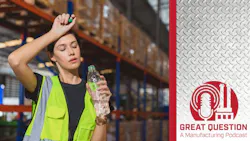




Employers have an obligation to protect workers from all jobsite hazards, including the summer heat and humidity. In this episode of Great Question: A Manufacturing Podcast, learn the current regulations, signs of heat stress and what you can do to help workers be comfortable—and safe—this summer from Corey Stringer Institute’s Maggie Morrissey.
Below is an excerpt from the podcast:
Nicole Stempak: Welcome to this episode of Talking EHS, part of the Great Question podcast series produced by Endeavor Business Media’s Manufacturing Group, a division of EndeavorB2B. Here is where you can get news, information and compelling conversations on the latest developments in workplace safety. I’m Nicole Stempak, managing editor of EHS Today, which you can find at ehstoday.com. Welcome to the podcast.
Joining me today is Maggie Morrissey. Maggie is an Assistant Professor in the Department of Health Sciences at Providence College and the Senior Occupational Heat Safety Advisor at the Korey Stringer Institute at University of Connecticut.
It's been a while since we last spoke, so it's great to be talking with you today, Maggie. You work at the Corey Stringer Institute at the University of Connecticut. For those listeners who are unfamiliar, can you share what the institute does, what you're researching, and maybe more about the conference that you co-hosted this spring?
Maggie Morrissey: Yes, I'm more than happy to. So I am an advisor at the Corey Stringer Institute. And for those of you have not heard of Corey Stringer, he was an NFL lineman for the Minnesota Vikings who tragically passed away from exertional heat stroke. And to carry on his legacy, the Corey Stringer Institute was created to protect everyone who performs physical activity, specifically in the heat.
So my area of research is on the workers. So how can we protect workers from heat stress? And not only do I focus on physiology research, the physiological strain of working in the heat, but more importantly, how can we better protect workers by creating these interventions that are evidence-based to alleviate that physiological strain?
NS: Back in 2022, Federal OSHA under Doug Parker, then-Assistant Secretary of Labor for Occupational Safety and Health, issued a National Emphasis Program, or NEP, for outdoor and indoor heat-related hazards. That NEP expired on April 8 of this year. Then two days later, on April 10, OSHA under David Keeling, the new head of the agency, issued an updated NEP that is active for the next five years. Could you tell listeners, at a broad level, what has changed and what has stayed the same under the new NEP?
MM: Yes, so this NEP is going to be longer in terms of its expiration date. So it's five years. And probably the biggest change is that rather than having 70 industries, it's a little bit more focused on 55. So it's more targeted to those that we have a better understanding of the level of heat stress that these industries are at higher risk of. And there's just a little bit more information as far as what they're looking for in terms of when they're thinking about a citation. And there are more programmed inspections during very high heat periods or days. So those are just some of the major changes to the new NEP.
NS: I guess I'm just wondering what happens to the workers in those 20 or so industries that are no longer included? How do we keep them safe, too?
MM: That's a great question. And unfortunately, I think one thing that people forget is that they think that heat stress or heat strain and heat-related injuries are only in industries that experience a high environmental heat. But in reality, actually performing physical work and generating heat in your body actually can increase your risk of a heat related injury. And so it has a lot to do with physical demands of the work too. So I think maybe some of those industries may not have a lot of environmental heat exposure, but they could be wearing a lot of PPE that can cause heat related injury, as well as just performing a physically demanding job. So I think these industries should not think of themselves as exempt from a heat injury or illness, but rather they still could get inspected, and they still need to have a heat stress management plan in place.
NS: Definitely. And as a quick story time aside, I was a community reporter years ago one summer and the editor assigned me a heat story. And so people who are working outside are obvious to talk to, construction workers and people whose job is spent outside. But there's plenty of folks who work inside who feel the heat too, like a pizza shop, right? If they're working with those ovens all day or any food industry or dry cleaners, they might have cool air blowing, but because of the work that's being done, they can't feel it. Or they might just be cycling around hot air with other chemicals. We usually talk about industrial and in manufacturing, but there's plenty of other folks who need protection from the heat too, especially ones you might not think of, right?
So it's just so much to be mindful of in keeping workers safe, all workers safe from all kinds of heat environments.
MM: I actually did a qualitative study a few years ago. It was specifically female workers who work in the heat, but some of the female workers that we interviewed were actually from the restaurant business and they were working at breweries and they had to take it upon themselves to protect themselves from the heat because it wasn't a hazard that their employer thought about and probably not the first thing that they're thinking of. Again, because they might not be part of that targeted industry. Another industry that people don't think about is the tourism industry, right? So you go to Disney World, the people there. And not only that is, I think when we're trying to create these heat stress plans, they’re often very limited in what's included across many different industries. But a lot of times these workers are low income and many of them don't speak English as their primary language.
And so a lot of the protections that are, you know, written down or spoken about. They don't necessarily think about right of mind because it's not in a language that they is very accessible to them immediately. So I think there's, even if you do have a heat plan, you have to think about how it's actually getting to the people who are performing the work.
NS: Absolutely. And it just makes me think of like in restaurants, front of house, back of house, right? Like the people in the front of the house and in more customer-facing roles are probably going to enjoy that air conditioning. But if you're in the back of house, that's where all the heat is.
MM: I would consider heat as almost a silent killer, which sounds really morbid, but it can be really problematic because a lot of times when we think about heat, we think only about heat illness. So like heat exhaustion, heat stroke. But there's so many other secondary injuries that are both acute and chronic, right? So we have things like cardiovascular strain that can cause a heart attack, or we have cognitive impairments that can cause an accident.
And on the chronic side of things, one area that's been starting to be really heavily studied now is acute kidney injury in workers. And so essentially what's happening is these workers are getting really hot because of the work they're doing, and they're also very dehydrated. So the combination of them being dehydrated and hot along with potentially having individual factors related to kidney injury or pesticide exposure. All those things can cause acute kidney injury. And if you have acute kidney injury days and days and months, consecutively, that can result in what we call chronic kidney disease of occupational origin.
And so what's really scary about this type of kidney disease is it manifests without having any symptoms. So it does not act like what we think of when we think about traditional kidney disease. So unfortunately, people don't know they have it until it's too late. And this is extremely prevalent in construction, agriculture, mining, but others as well. So I always like to share this information because again, a lot of people don't know that they have acute kidney injury and they need to focus on making sure they're hydrated and keeping their body temperature down to avoid that potential chronic condition.
NS: You brought up a couple other really great points too, as far as how heat affects the body. You know, first of all, that it can affect the medications or the medications that we take can affect sun exposure and heat and make you more susceptible, more vulnerable to the effects of the sun and of the heat. And also that our risks vary by person. We talk a lot about acclimatization and protocols, but they're not like a one-size-fits-all approach. Some people might not be as bothered by heat and others might be really affected by heat, even if they have the same schedule and work alongside each other.
MM: I think that there, especially responses to heat, are very, not only like, there's a lot of intervariability, meaning difference from person to person, there's a ton of intravariability. So like, if I go to work and I'm dehydrated one day, but then I go another day and I'm hydrated, my response is going to be very different. So it's differences between sexes, ages, you know, acclimatization status, as you said. So that kind of adds a complexity when we think about how to protect people and who is vulnerable and not, because there's some days where people are more vulnerable than others just based on what they may have done before work.
When I'm trying to educate people on protecting themselves from heat illness or heat injury, I always try to focus on not only those external factors like the environment, PPE, what the work regulations are, but what internal and modifiable risk factors. So medications you may not be able to change, but hydration, heat acclimatization status are just a few things that are important to recognize as risk factors.
NS: Absolutely. So let's talk about what employers are required to do as a baseline and then let's go from there. So according to the NEP, what do employers need to provide for their workers to protect them from the heat?
MM: So as far as like, if they're thinking about citations is unfortunately we have no heat federal regulation right now. And so everything as far as citation goes is going to come from the general duty clause. So which basically says that you have to protect your worker and provide a safe working environment without having known hazards, right? And so I think what's important to know is that's the type of enforcement when we think about the citations.
As far as specifics go, I think it's also important to recognize that not every state is going to be the same either, because there are some states like Oregon and California that do have mandated standards. So it's important if you're in those states or have jobs that go across multiple states is to utilize the most comprehensive standard when you're trying to implement things.
So some examples of things that should be done is, of course, providing a written heat stress plan, having some sort of plan for heat acclimatization, and making sure you're providing sufficient rest. OSHA has this campaign for water, rest, shade; it still applies the same, right? The only interesting thing is that there's a lot of ambiguity to what is considered, you know, actually including these specific things. Like heat acclimatization, as an example, is that term is technically a physiological process where you're getting these adaptations to tolerate heat better. But it's really hard for us to do in the occupational side because many people aren't actually measuring the physiology of their people. So in this context, what exactly would a heat acclimatization protocol be? As far as the specifics of what OSHA or within the NEP would suggest is a little bit up for interpretation.
NS: A lot to unpack there as far as the compliance threshold. But we like to talk about leading organizations. So let's focus on what employers can do. And if you have any ideas for, you know, products or things that they can purchase, you know, PPE or otherwise, or just programs that they can implement for how to make work more comfortable in the heat.
MM: I like to start by making sure everyone remembers the foundations, right? So again, we have the water, rest, shade. Everything starts from there, but it's important to know that it's only a starting point. I highly recommend having a much more comprehensive outlook. And one thing that's not included too within that water, rest, shade that I think is considered a foundational component is restroom access. And that sounds really interesting for me to say, but think about if you don't have access to restrooms, you're not really going to be hydrating well.
So I like to include that in those as for foundational components. But on top of that, I like to use the acronym called RESHAPE. It kind of adds another additional layer to OSHA's water, rest, shade. So we have rest, we have environmental monitoring. So essentially, meaning like, just make sure that you are reviewing what the wet bulb glove temperature or temperature is going to be during the day, but also, you know, in the next couple days, right? Also, heat acclimatization. So is there some sort of plan to gradually expose somebody to the heat? Hydration, of course, body cooling and shade is another, policies and procedures. So having something written so people know what to follow.
And then one thing that I think is really critical and very often forgotten is emergency procedures. Many times people think about how to stop the heat illness or injury from happening. And so that's like your hydration and your shade. But people need to recognize that not every plan is fail-proof. And so you have to have some sort of method if someone's going to have an exertional heat stroke. So having water and ice and cooling modalities available to aggressively cool somebody to reduce their body temperature.
NS: And I think, if I'm working out in the yard and get really hot, taking a break, sitting in air conditioning for a few minutes, having one of those electrolyte powdered drinks, you feel so much better after just that or you see people walking around, especially for kids, the little fans that they have. And it doesn't have to be really expensive or difficult, right? These are things that just offer quality and comfort to the working environment.
MM: There's always a huge thought that you need to have, like air conditioning is the only solution. And while yes, air conditioning is wonderful and great, and if you can work in air conditioning, that's fantastic, but it's not sustainable and it's not cost effective. And so as far as cooling the body, there's a lot of different modalities like cooling towels and arm immersion and fans that, again, are low cost that can have extremely effective cooling rates when they're used properly. And it's important to recognize they’re used properly because a lot of times, especially with these cooling garments, is people put them on and then they don't re-wet them. They just leave them on all day and then they're not doing anything for you.
And so also when you're cooling during a rest, I always recommend if you do have some sort of cooling or fan, try to cover as much of your body surface area as possible to cool yourself because that's going to cool yourself to a much greater degree than if you're only focusing on like how there's this myth that like you should only focus on the wrists and the back of the neck. And really, you just want to cover as much of your body as possible.
NS: And I think too, talking about how there's nothing at the federal level, some states are taking action. But this is part of a broader picture, a broader trend, talking about changing weather patterns and other things that we're seeing, you know, this year is an El Nino year, and more states are experiencing heat that they haven't had to before. So this isn't new, but it also is new for some folks.
MM: Absolutely. And I think too is we're very hyper-focused on what we consider, especially in the US, of like our hot states and our hot cities. Like thinking about the World Cup, which is happening now, is there's a lot of focus on those really hot host cities like Dallas or, you know, Miami.
But other places may not have on average more hot days. There's places that we would consider cooler cities that are going to have unprecedented periods of high temperatures. So again, it may not mean that they're going to have those high temperatures that the entire month, but it's going to happen. And so not only do you need to be prepared in these really hot places that we consider, we need to be now preparing for random spikes in temperature in what we would consider cooler states.
I actually think that the states that are having these sort of blips in high temperatures are the ones we need to look out for because they're not prepared. And so, I'm in Rhode Island and you don't consider Rhode Island a hot place, but we had a 100 degree temperature the other day and you're seeing people working outside because nobody was thinking ahead to prepare for that.
NS: I'm in Ohio and same thing, you see workers who aren't covering up, and I do have to think part of that's cultural too, like you haven't had to before. But when I go to Texas and when I visited Florida, people who are working outside are wearing long sleeve shirts and hats with the netting over the back of them. It's probably something that's been more ingrained. And they are just taught that this is what you need to do to keep yourself safe. So I do agree with your statement, just from my own anecdotal observations about our attitudes towards the sun, towards the outdoors, towards the heat.
MM: It’s interesting too, because when you see somebody who has long sleeves and things like that, it's like sometimes can be really beneficial and sometimes not depending on the garment. So if it's like a cotton or heavy shirt, they're probably not evaporating the sweat, like someone who would be wearing a short sleeve, but then they're more at risk for sunburn and sun exposure. So it's like trying to figure out what's the best method can always be hard too.
And I think people definitely in the south have the long sleeves and are starting to get these more breathable garments, but you don't see it as much, like I said before, in the cooler places.
NS: That’s such a great example though, because I feel that's an empowering one too, right? Like you have choice of what kinds of PPE you provide your workers. And there is a lot of development and work in fiber technology and textiles, composition, and what you can do to, with the sweat wicking and such. So even if a company always has provided shirts for workers, they can reconsider what other options are in the catalog or a different provider might have and, you know, test them out. And that's, it's the same thing, right? You're still providing that form of PPE, but just one that might be more comfortable and better suited for a season or for more days out of the year when it's hot.
MM: I think too, there's a lot of innovation right now in the heat space as far as creating PPE and better clothing garments, but also like creating artificial shade structures. I've seen a lot of different companies who are creating shade that's portable and easy so people can essentially be working and then just move the shade so that, especially in the farming industry. So as they're working, the shade is following where they go. And there's becoming a lot more tools for education.
So we live in a great time of innovation and technology. And so it's always important to see what's out there and what companies are providing. And it might even be within a company that you always buy things from. So always looking at the heat stress line is important.
NS: I think that there are so many things safety professionals and others in the manufacturing industrial space can't control, right? Like we cannot control the weather. You can't change the temperature. You can't change that it's sunny, but you can provide cooling spaces. You can provide those portable tents. And it's small, it's temporary, but it makes a shift a lot more comfortable for your workers and isn't that what we want, them to feel better?
MM: Exactly. I think a lot of times too is people don't think about the well-being piece, like having somebody feel like their employer is looking out for them by providing these options to make them feel better. That in itself is really important. Like, hey, I recognize that it's really hot today. Here are all the solutions that you can use. I think that's really important to not only having that feeling and recognition of, yes, it's hot and I want to protect you, in addition to just feeling better and hopefully actually having their physiology change and reduce the strain that they're having.
NS: And the other great thing I think about heat stress, if you can call it a great thing, is that there are known options and you don't have to reinvent the wheel. So if, you know, you're in Rhode Island, I'm in Ohio and it's hotter than it has been the past five or 10 years, employers, whether or not they have operations in, say, Florida, California, Oregon, places that are hotter, and places that have taken state-level initiatives can probably learn from others quite easily.
MM: I think that the most difficult thing is not necessarily the what-to-do piece. Like a lot of times, if you ask anyone, they're like, yeah, I generally know what to do when it's hot, but it's the how-to-do-it and the feasibility piece. A lot of times I come in because a company doesn't know how to do these things effectively. So I do a lot of on-site observations of different companies to say, okay, what you're doing is either working or not. Here's ways that your specific work environment, your specific industry can actually do that. Because again, no one size fits all approach. I mean, the general topics are the same, but the implementation is what's different. That's the hard piece, the implementation.
NS: Yes, for sure. And even what you're talking about being on site training and telling workers and trying to change the culture to say, hey, if you are hot, it's okay to take a break to have a sip of water. Or here are things that are available to you. I think sometimes, even if it's not intentional, we just kind of forget other things that are available to us. And you just assume the way you've done things is the way you have to keep doing them, that you have to keep pushing through, even if it's not optimal for you. And just to say, what else can I do? This is just the reality. But to say, hey, actually, there's other things available and we're going to provide them for you for free. And so your job is just to make sure you use them. That can sometimes be more difficult than picking out the products or the tools or the vendors themselves.
MM: Exactly. And I think a lot of times too, like when you said culture, that's a huge part of it. A lot of times, safety professionals who are on site will say, how do we get them to care about heat? And I think sometimes it's great if the messaging comes from the workers themselves, whether that be a safety committee that is part of or has a bunch of workers in it and they're providing some messaging related to the dangers of heat, or you have a champion for heat stress. One person that is very respected among workers, someone who is not a supervisor who's like, hey, it's hot, here's what you can do. And that then empowers others to go for those solutions as well. They don't have to have that macho attitude of, I don't need a break, I can do this. It's like, hey, no, this isn't a weakness. You need to protect yourself because it's so oppressively hot. So that's always been really effective, I think, across different industries.
NS: When you do training and other education and on-site observations, do you talk to workers about what they do on their off hours? You know, if they have things like fans and air conditioning at home, if they're sleeping well, and other things that can affect their well-being and productivity at work too.
MM: For education, a lot of it's focused on-site, but it's also the off-site as well. There's been a lot of focus actually on recovery. And like you said, we don't necessarily always know if someone's going home to an air-conditioned space or not, but encouraging that they have some sort of cooling ability, or whether that be fans or towels to help cool themselves so that they're better prepared for the next day, or hydrating, things like that.
The one big thing has been energy drink consumption. Because if you're having a cup of coffee or two, it's really not going to cause an increase in a lot of things, like your core temperature probably isn't going to increase. But if you're having like 6 Monsters a day, that is problematic. And that's the one area people are worried about, not only from heat, but also just in general, is the overconsumption of energy drinks and trying to make sure people are, one, not doing it on the job, but two, making sure they're not drinking them right before work or something like that.
NS: I remember, story time aside part 2. My freshman year of college, I was in a dorm that didn't have air conditioning. And it was so hot that I didn't want to eat. You know, I just lost my appetite. I think I just drank water and maybe had popsicles or probably got one of those kind of ice cream bars, because I didn't want to eat. And that can make you weak and hinder your recovery process, too.
MM: Absolutely. I think a lot of times people don't realize how, when we think about heat stress, it's also like you need to fuel your body as well. Like it takes extra energy for your body to dissipate the heat and try to protect yourself. And especially because if you're sweating and then you may be dehydrated. You need to be able to fuel your body adequately to not only perform the job, but also it's important in that recovery process of making sure you're well enough to do the same thing the next day and then the next day after that.
NS: Definitely. And because like you said, heat is a silent killer and it can affect you in ways that you don't immediately think of like suppressed appetite, but it's just as important and it might happen off the clock, but it affects everything on the clock too.
So we have covered a lot of ground. And I could probably talk to you for another hour or two easily. But for our listeners, do you have any final words of wisdom or advice or any kind of guidance that you want to share with them?
MM: Yes, I do, because I think a lot of times… I mentioned earlier that the emergency side of things is often forgotten. And a lot of times people who are actually performing the frontline workers or even supervisors don't think they're part of the emergency response if someone were to collapse from exertional heat stroke, but they are the first ones out there. So they are a part of the response.
And I think it’s really important for everyone to be educated in the signs and symptoms of exertional heat stroke. Of course, it's associated with having high body temperature, which you can't readily see, but it also has what we call central nervous system dysfunction, where someone's being like really bizarre or confused or they're collapsed. And so it's important to know those signs.
There's unfortunately situations where people think someone's on drugs, but really they're having exertional heat stroke. And that's really problematic because cooling them aggressively as quickly as possible is the treatment. And a lot of times people are looking for hot, dry skin as a sign and symptom, but that's actually not true when we think about heat in a physically demanding workspace, because they're obviously going to be performing work. They're going to be sweating. The reason why that myth exists is because it actually has to do with another form of heat stroke, which is called classical heat stroke. So classical heat stroke doesn't have any exertion related to it. It's like the unfortunate situation of a baby in a car or an elderly person in their home without air conditioning during a heat wave. And so when we're talking about someone who's on their job site working, don't think about hot, dry skin. They will be sweating. So those are some words of wisdom I like to share because that could save someone's life, knowing that information.
NS: And just the idea that if someone is in distress, that they need to be cooled immediately. You think about CPR for people, but for heat, it's cooling them down just as quickly as you possibly can. And they probably should be checked out too by a healthcare provider just to make sure, because for all the reasons you've discussed, heat affects the body and can have lasting, dangerous consequences too.
MM: I think if there's a medical provider or EMS who is a medical provider, they can assess core temperature to see how high it is. Cooling them within 30 minutes is critical because if they're not being cooled for more than 30 minutes, that's when we get into the long-term complications and permanent complications and then potentially death. So time is a massive component to treating someone if they have an exertional heat stroke.
NS: Thanks again to Maggie Morrissey. If you’d like to learn more about heat stress, heat illness or how to keep workers safe in extreme heat, please visit ehstoday.com. If you liked this podcast, we encourage you to subscribe to the Great Question wherever you get your podcasts. For EHS Today, I’m Nicole Stempak. Until next time, take care and stay safe!
About the Podcast
Great Question: A Manufacturing Podcast offers news and information for the people who make, store and move things and those who manage and maintain the facilities where that work gets done. Manufacturers from chemical producers to automakers to machine shops can listen for critical insights into the technologies, economic conditions and best practices that can influence how to best run facilities to reach operational excellence.
Listen to another episode and subscribe on your favorite podcast app
About the Author
Nicole Stempak
Nicole Stempak is managing editor of EHS Today and conference content manager of the Safety Leadership Conference.