The Industrial Science Report: Manufacturers target construction emissions with greener concrete and steel technologies
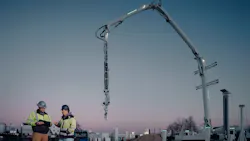
You could say I have a personal connection to the construction industry. My husband of almost 20 years is a tradesman, a carpenter. He’s worked a lot in the residential rehab space, but currently, he’s building new residential homes. While he considers the industry’s workforce issues job security—his company can’t hire enough qualified workers to build houses fast enough—I’ve heard a lot about the construction industry woes at the dinner table for years. Spiking lumber prices, concrete pours delayed by weather, material shortages, and tool and equipment theft. Don’t even get me started on the safety issues with residential home construction.
Manufacturing and construction are also largely intertwined and tightly tied to the U.S. economy. For example, the current spike in new home building is driven by the upside-down housing market, where low housing inventory and high mortgage rates have made new homes the only option in some areas.
Throughout the latest automation boom and even now with the swell of artificial intelligence, my hubby considers his blue collar, physical labor job safe from automation and robotics—immune to the AI wave drowning some professions. And I don’t have the heart to tell him yet.
This week on The Industrial Science Report, the research is all about innovations for the construction industry. It’s largely about making materials more sustainable, as the construction industry and the manufacturers that supply builders are huge carbon emitters. Concrete, steel, and composites are the focus here from using seawater and CO₂ to make aggregate and 3D-printed concrete made from industrial waste to new building materials manufactured from hemp and AI-enhanced materials design to improve steel.
And what I can’t bear to tell my husband yet. Robotics are close to construction sites after a crane and lifting equipment manufacturer has partnered with a 3D printing provider to create Titan, robotic 3D-printing for building. If the construction industry can’t find more tradespeople, it will eventually replace them with technology.
Carbon-storing concrete aggregate made from seawater and CO2 could replace mined sand
Researchers at Northwestern have effectively borrowed a play from coral reefs to produce aggregate, by using electricity and CO₂ to drive mineral formation from seawater. Coral and mollusks form their shells by harnessing metabolic energy, which converts dissolved ions into calcium carbonate. Instead of metabolic energy, this new process uses electrical energy to initiate the process and CO₂ to boost mineralization. The result is what we would typically call sand, and it can lock away around half its own weight in carbon dioxide.
Test your knowledge of clean chemical processing innovations.
Quiz: Can cleaner chemistry cut emissions without crushing industrial output?
Need to study first? Read the article:
The Industrial Science Report: New process science and clean chemistry target industrial emissions and costs
Aggregate is important for concrete production, about 60–70% of concrete is made up of sand and gravel. Cement is the other key ingredient in concrete, making up about 10 to 15% of the concrete volume. Water mixes with the aggregate and cement to make concrete.
According to the World Economic Forum, global cement manufacturing is responsible for about 8% of the world’s total CO₂ emissions. If the cement industry were a country, it would be the world’s third or fourth-largest emitter of CO₂, based on data from 2024.
Northwestern researchers would like to upgrade this ubiquitous and environmentally unfriendly building material, and the new aggregate could also be used to manufacture cement, plaster, and paint.
Ultimately, researchers don’t want to scale a new production process in our precious oceans, so they’re imagining modular, shoreline-based reactors to make sand. With plants and aggregate production facilities near the ocean, the new process could sequester CO₂ at the source, turning one of the world’s largest carbon emitters into a more sustainable circular supply chain.
3D-printed low-carbon concrete uses less steel and enables reusable building components
The European CARBCOMN (carbon-negative compression dominant structures for decarbonized and de-constructable concrete buildings) project has another idea for greening concrete. Researchers there are turning industrial waste into a low-carbon concrete. It is 3D printed into individual structural elements and then assembled into load-bearing systems. Instead of relying on bulky rebar grids, these structures take inspiration from historic stone arches, where geometry carries the load and concrete is kept primarily in compression.
Digital manufacturing plays a central role here too, so engineers can optimize designs to significantly reduce material use. Steel reinforcement isn’t eliminated entirely, but it is used surgically, where iron-based shape memory alloys (Fe-SMA) are inserted only where required and activated after placement. When heated, these pre-stretched alloys contract rather than expand, placing the concrete elements into compression. This new process replaces complex pre-stressing operations used for steel rebar with a more controllable, post-processing step. Most interestingly, it can be removed again at end of life to fully disassemble the structure and recycle the components.
With essentially recyclable infrastructure, no longer are the concrete structures that stand as rugged monoliths with limited end-of-life options. Could concrete structures become modular and easily broken down for reuse? The CARBCOMN team thinks so.
A European research team including Empa, ETH Zurich, and other EU partners have started the CARBCOMN project to develop a new generation of 3D-printed concrete components that use less raw material, require less steel reinforcement, and can be dismantled and reused after service life. Researchers are combining digital design tools, automated and 3D printing manufacturing, and alternative cement-free binders to create lighter structural forms while maintaining strength and stability. The research could reshape how precast and custom structural components are produced for the building industry.
Palfinger and Icon scale robotic 3D printing for heavy industry and automated construction
I had the best American Bulldog ever named Titan. He was tough as concrete, strong as steel, and a gentle giant. Except for that last characteristic, never missing a chance for cuddles, I think Palfinger and Icon chose the name Titan as its new robotic 3D printing construction system for the same reasons we chose it for our beloved big dog. It definitely represents size and strength. Titan is also the name of the largest moon of Saturn, and in Greek Mythology, the Titans were greater than the gods. I think the mythological reference make it an especially good name for bringing large-scale robotics to construction sites.
The robotic 3D printing system Titan runs continuously, layer by layer, forming structures up to 27 feet tall and multi levels. It integrates modular components, stabilizers, and crawler systems, giving the 3D printing technology the precision positioning and stability needed for rough terrain construction sites.
This is really the ultimate combination of manufacturing and construction, essentially a hybrid system that works as both a robotic cell and a mobile piece of heavy equipment at the construction site. It has to be strong and durable, but also flexible and reliable. Just like my Titan.
Palfinger says its initial Titan prototypes have already been successfully tested, and the partnership will bring the system closer to actual construction sites. Titan does signal a push toward industrialized, scalable large-format robotics. Can digital manufacturing technologies address labor constraints, safety exposure, and the need for faster, more cost-efficient production in sectors that historically resisted automation? Sorry honey, lifting and crane manufacturer Palifinger thinks so.
Palfinger and Icon Technologies have formed a strategic technology collaboration to expand large-size robotic 3D printing across construction, automation, and industrial production. Palfinger is contributing precision-engineered lifting and handling systems, modular platforms, and large-size robotics expertise, including its Special Lifting Solutions, in the Titan robotic printing system, along with Icon’s 3D printing ecosystem. Titan is designed to automate the printing of structures up to 27 feet tall, support multi-level construction, and run continuously 24/7 using modular components, stabilizers, and crawler systems. Palfinger said the partnership also supports its strategy to expand into digital manufacturing and large-size robotics, while Icon gains access to Palfinger’s industrialization capabilities, engineering standards, and global service network.
Hemp manufacturing lab to advance carbon-negative building materials
Hemp can be used to make structural blocks, natural fiber rebar, insulated retrofit panels, and next generation siding, but industrial hemp production has struggled to scale with limited processing equipment and the supply chain needed to support it. Rensselaer Polytechnic Institute’s hemp manufacturing lab is targeting that gap between promising bio-based materials and the industrial systems needed to produce them at scale. Hemp is a very strong material, which makes it great for turning into construction materials, textiles, and packaging products, but its strength can be tough on harvesting and processing equipment. Traditional agricultural equipment won’t cut it.
“If you use conventional farm equipment that's not designed to deal with hemp, it can get caught around rotating shafts, and it actually can bind up,” says Daniel F. Walczyk, Ph.D., PE, professor of mechanical engineering in the Department of Mechanical, Aerospace, and Nuclear Engineering at Rensselaer Polytechnic Institute and also associate director of manufacturing for the Center of Automation Technologies and Systems.
The same thing applies to processing equipment. Processing cotton, for example, for textiles typically doesn’t bind up in machines, but hemp will. “You have to design equipment that’s more robust and can take higher loads and has the higher torque required to process the material,” Walczyk says. And it’s definitely a unique process to turn hemp into other materials. Typically, the fibers lay in the field to rot for a little bit, so it’s easier to separate the inner woody part, which is called hurd, from the outer fiber. “Then they put it through what's called a decorticator, which is basically mechanically trying to separate the woody part from the outer fibers,” Walczyk says. Both the inner and outer fibers have uses in construction.
Hemp production might require entirely new lines of specialized equipment to scale, but Walczyk has also seen small scale examples in the U.S. where inventive engineers have used existing equipment that’s used for fiber processing, and upgraded it to make decortication equipment. There are many ways to do decortication, Walczyk says, but essentially you need to beat up the fibers to separate them out. Some creative engineers are processing hemp using a hammermill, which can break up the larger material into smaller pieces. Then, they use air handling equipment to separate out fiber from the hurd.
Not only are they developing new equipment and processing capability for hemp manufacturing, but the industry needs to define its supply chain. Counter to decades of global sourcing and worldwide markets, hemp manufacturing needs regional alignment between agriculture, manufacturing, and end users. Natural fiber composite materials are bulky and too expensive to transport long distances. “The economies need to stay local,” says Alexandros Tsamis, architect and associate professor at the School of Architecture, Rensselaer Polytechnic Institute.
By investing in downstream processing—from fiber separation to material formation—the lab aims to make hemp viable for construction applications such as composites and other high-performance building products, while reducing dependence on fossil-derived inputs and enabling more circular, regionally anchored production.
Rensselaer Polytechnic Institute (RPI) received a $1 million investment via New York’s Department of Agriculture and Markets to establish a manufacturing lab focused on processing industrial hemp into construction materials, textiles, and packaging products. The lab, part of RPI’s Seed to City Initiative, fills gaps in downstream manufacturing infrastructure and supports creation of regional supply chains for renewable, carbon-negative materials. Specialized equipment will enable the conversion of hemp fibers into high-performance materials that could replace carbon-intensive products in the construction industry. The initiative aims to reduce dependence on fossil-derived materials, build rural jobs, and foster a plant-based circular economy.
Arkansas State expands steel research with $2.1 million for advanced testing and AI
The steel industry is another big emissions target and also closely linked to the construction industry. This $2.1 million federal investment in Arkansas State University’s Center for Advanced Materials and Steel Manufacturing (CAMSM) will go directly to innovating steel manufacturing. Steel production is a major economic driver in northeast Arkansas, and the university will work directly with local steel producers, fabricators, and manufacturers to improve production processes.
CAMSM wants to study the mechanical and microstructural properties of steel, as well as fabrication, machining, and AI-driven modeling. But a major element is to push the research closer to real industrial production. Understanding steel in a lab is great, but it’s really about replicating the conditions that manufacturers deal with every day.
What makes this particularly relevant across manufacturing is the integration of testing, prototyping, and data infrastructure into a single environment. The upgrades are designed to align with international testing standards, while giving researchers and industry partners the ability to validate processes and refine material performance. The increased use of data analytics and artificial intelligence for materials design is theme I keep seeing across many sectors.
In a region like Northeast Arkansas, where steel production is a major economic driver, this kind of capability strengthens the entire supply chain, from mills to downstream fabricators. Improved steel could benefit many manufacturers across the board that depend on steel machines or components. For maintenance and reliability engineers in those industries, better upstream testing and process validation translate into fewer surprises on the plant floor, when steel quality is validated against rigorous standards and informed by AI-assisted analysis.
Arkansas State University announced that $2.1 million in federal Fiscal Year 2026 appropriations secured by Rick Crawford will expand steel research and testing at the university’s Center for Advanced Materials and Steel Manufacturing (CAMSM). The funding will be used to acquire industry-grade testing equipment to study the mechanical and microstructural properties of steel, add fabrication and machining capabilities, and increase computing capacity for data analytics, artificial intelligence, and materials design. The upgrades are intended to help steel producers, fabricators, and manufacturers improve production processes, reduce delays, accelerate innovation, and strengthen quality assurance through testing aligned with international standards. The project also integrates workforce development by giving students and incumbent workers hands-on experience with materials testing, automation, and AI-assisted manufacturing tools used in modern steel production. The research is positioned to support the steel industry and broader regional manufacturing supply chain in Northeast Arkansas and the Mid-South.
About the Author

Anna Townshend
managing editor
Anna Townshend has been a journalist and editor for almost 20 years. She joined Control Design and Plant Services as managing editor in June 2020. Previously, for more than 10 years, she was the editor of Marina Dock Age and International Dredging Review. In addition to writing and editing thousands of articles in her career, she has been an active speaker on industry panels and presentations, as well as host for the Tool Belt and Control Intelligence podcasts. Email her at [email protected].