Podcast: Fast 41 program speeds critical minerals and manufacturing permitting
Key Highlights
- Fast-41 cuts permitting times about 25% by coordinating agencies and running reviews in parallel.
- Faster permitting supports critical minerals processing and strengthens U.S. manufacturing supply chains.
- Predictable permit timelines help manufacturers plan investments while meeting environmental standards.
- AI and digital permitting tools can speed routine reviews so experts focus on complex projects.
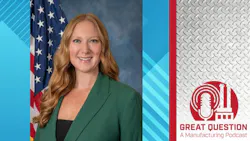




In this episode of Great Question: A Manufacturing Podcast, IndustryWeek's Laura Putre speaks with Emily Domenech, Executive Director of the Federal Permitting Improvement Steering Council, about efforts to streamline federal permitting for large manufacturing and critical minerals projects. They discuss how the Fast-41 program coordinates agencies to reduce project delays, improve transparency, and accelerate approvals while maintaining environmental and safety standards. The conversation also explores critical minerals processing, domestic supply chain resilience, and the growing role of AI and digital tools in modernizing the permitting process.
Below is an excerpt from the podcast:
Laura Putre: Hello and welcome to Great Question. I'm Laura Putre, Senior Editor at IndustryWeek. Speeding up the permitting process has been on the minds of many manufacturers. Getting approvals for large manufacturing and critical minerals projects involves approvals from federal, state, and local agencies that don't always work together. Sometimes this can take many years. Is there a faster way to coordinate approvals without compromising public and worker safety, environmental concerns, and quality of life? Today we're talking with Emily Domenech, executive director of the Federal Permitting Council, a Trump appointee who has spent much of her career in permitting and energy policy. Dominic oversees the Fast 41 program, a federal program designated by Congress in 2015 to speed up approval for infrastructure projects that has been a focus of this administration. Today, we're talking about Fast 41's two manufactured-related projects, a zinc smelter called Project Crucible in Tennessee and Riverview East Stack Extension in Florida. A project to add storage for fertilizer byproduct and increase fertilizer production. Welcome, Emily.
Tell me about the origins of the Fast 41 program, and why and how it was started, and why it was needed.
ED: We were established a little over 10 years ago in the Fast Act, established by Congress. We're an independent agency, so when you hear Fast 41, that comes from: we were established in Title 41 of the Fast Act by Congress, and we were really established to be a project manager for critical infrastructure projects that are navigating federal permitting. Very clear direction from Congress, and I was a longtime congressional staffer myself, and it's fair to say that legislation is not always clear about what an agency's goals or mission should be, but for us it is really straightforward.
We have a mission to support projects that meet a couple of key criteria: they have to be one of our 19 sectors, they have to trigger federal permitting, typically that's through NEPA, and they have to be an investment of at least $200 million
And if a project developer meets those standards, they get the support of the permitting council as they navigate the often complex and confusing federal permitting process. So, our process, we have to evaluate companies within 14 days, and then we have a 60-day period to do what I think is really the bulk of that project management work. Again, this is all spelled out in the statute that Congress wrote back in 2015 so we identify your lead permitting agency, we identify all the cooperating agencies, we identify any states or tribes that might have a permitting action for that project, and then we convene that whole group with the project developer to develop a permitting timetable for the project.
That meeting really allows us to do what I would say solves, reduces the timeframe for most of our projects—which is we build you a timetable that instead of one permit happening after another, we make it so everything happens in parallel. So we develop a permitting timetable that makes as many things happen simultaneously as possible, and then we have 60 days to post that on the permitting dashboard. And then for that developer, they can go and they can see exactly what's expected of them through every federal permit.
For the agencies, they know exactly what the agency or the developer is supposed to submit and when they're supposed to submit it, so we can track that a project is staying on time, and our projects end up going about 25% faster, simply because we coordinate them at the beginning and make as many things happen in parallel as possible.
If you pull up the permitting dashboard, all the timetables you see look like Gantt charts, not one line of things after another. So it allows us to really coordinate the process from the beginning, and then we have someone from our team who's assigned to every project that's on the dashboard to make sure everybody does what they said they would do at the beginning of the process, so we really are there every step of the way for a project developer.
It is transparent across the board, so you know the developer can't skip anything, and the agencies do their job on time, and it really allows us to move projects to the system much more quickly. It’s really a tool the president can use to move priority projects forward and ensure that they're really at the top of the pile when it comes to navigating federal permitting.
So that is our origin story. We've been around for a little bit over 10 years, and again, we're an independent agency, but really serve as sort of the executing arm for the president when it comes to getting big projects built.
LP: And how are you shaping the agency? You know, I hear a lot of you know about speeding up the process, you know, since Trump has been president. So, you know, what are you doing to shape the agency?
ED: I would say that we are really finally operating at the full potential of the permanent council. I think Congress had a really good vision for what we could accomplish, but it has, for many reasons, not really been used to the full extent that it could in previous administrations.
In the first Trump administration, it was a brand-new agency, and they had to build everything up from scratch. In the Biden administration, truthfully, they just weren't quite as interested in moving projects through permitting, and we have really taken advantage of this structure to get agencies to the table to better coordinate between folks to really identify priority sectors we wanted to focus on.
You see that with our mining portfolio, with our now-growing manufacturing portfolio, we're really focusing on those priority sectors out of the White House, and then I'm fortunate to have been appointed by a president who really wants to get things built and wants to use every tool in the toolbox to do that, so we've really been empowered to ensure agencies stay on time.
This system only works if you've got somebody in the White House who cares about getting things built, and if there's this thought that it isn't as important as it should be, then if we're not as effective. So, we've, for contrast, we've been able to, the Biden administration did 17 projects in the four years that they were in office. So far under the Trump administration, we finished 22 projects already and have added dozens more to the dashboard in a number of sectors. So we're really trying to take advantage of this structure and make it something that's lasting, even when a future president, you may not share our policy goals, comes into the White House.
LP: Okay, so two of the projects are manufacturing-related. Are any of those other 22 that you mentioned related to—would manufacturers care about those?
ED: They certainly should. So, the bulk of them are mining projects. There's a pipeline, a water project, a broadband project and then a number of mining projects in that number that we finished permitting on. But really, I would say we are taking this sort of whole of supply-chain approach to priority projects, and we started really the first year of the Trump administration really emphasizing the mining sector. We took our portfolio from one project to 57 in a year, so a huge growth, and really focused on sort of the first step of the supply chain.
But if you're going to be able to control a supply chain and ensure that you're not reliant on China or our other adversaries around the world, you have to control the manufacturing and processing for critical minerals, too. So I think we're really shifting this year to try to focus on bringing more of those critical mineral processing facilities online. We obviously won't have as many as we do in the mining sector, because they're really capital-intensive investments, but we're, you know, it is very much in our goal—our set of goals to grow the manufacturing sector across the board, not just in the mineral processing space, but also in other energy-intensive manufacturing industries. We were included in the pharmaceutical manufacturing EO [executive order]. We've been a part of efforts to talk about manufacturing of other heavy machinery that requires federal permits, so the sector itself, we have manufacturing, is one of our 19 sectors, is like the broadest one we have, because it's not limited to one particular type of manufacturing. It really is across the board.
LP: Okay, great, so the zinc refinery, smeltering.
ED: I think it's a smelter, that's how we would describe it. But it's okay, zinc processing.
LP: Yeah, so what's involved in getting that project up and running, and how is that going to help the manufacturing community?
ED: Yeah, so we're in the process of developing a timetable, the permitting timetable for Project Crucible, which is a Korea Zinc project in Tennessee. When we finish that timetable, it will include not just the permits from the federal side, so that's, you know, the Army Corps, your Endangered Species Act review, the Section 106 review, your NEPA environmental assessment, all of the things that go into supporting a large project with that size and scope, but it'll also include the state's permits that are delegated Clean Air Act authorities from the EPA.
So, we have a state that actually has, I believe, seven permits that it will have to list for Korea Zinc. for that project, and we have signed, we signed an agreement with the state to ensure the state would opt in and participate in Fast 41 It's not optional for federal agencies, but it is optional for states to participate in that timetable development. So we have been really working on signing agreements to get them to the table, but what that will do for the industry is one, it'll give the developer Korea Inc. a predictable timetable for when they can expect to begin construction and operations of that project.
For way too long, the permitting has been the biggest question mark for developers, and they really have no idea when they're going to get done. Our process is really designed to give them certainty on how long it will take. We also want to be able to provide them certainty with what work they need to do to comply with federal permitting requirements, so that shouldn't be a question mark. What you need to accomplish as a developer in order to get something permitted, you should know what's required for you, and you should be able to meet that standard. And we should hold every single developer to meeting those environmental standards, because they're very critically important as we develop these projects. But there shouldn't be any mystery in this process, so we're going to really get rid of all the question marks. We're going to develop this timetable, and then we're going to ensure everybody sticks to the timetable they set, so that we can make sure that this project can come online on time.
LP: Okay, what was delaying things in the past? Was it just a lack of coordination or lack of priorities?
ED: I'd say it's a little all of the above. So, one, I think prioritizing projects is really important to ensure they don't just get lost in the stack of paperwork from—you know, every field office has different priorities, and ensuring that critical projects are really moving through the system, it’s unfortunately not something that happens organically. It needs to have somebody along there to sort of sherpa you through the process.
The second thing I would say is that I think many of these delays come from lack of communication or lack of coordination between federal agencies and project sponsors. So our process, where we have this kickoff meeting, where we put everybody in the same room and say “you've got to work out what is required and get rid of all the question marks up front,” saves a ton of time because what tends to happen in projects that are not supported by Fast 41 is they sort of go along doing one set of expectations and then they find out they need another permit, and then they work on that one, and then they find out they need another thing, they work on that one. There's no coordination, and it wastes a lot of time that way.
So, our ability to really convene federal agencies and ensure they're talking to each other, ensure they're not doing redundant reviews, ensure it's clear who's in charge and who's the lead agency from the very beginning, they're all really common=sense solutions. None of this is rocket science. We're not changing policy in a really significant way, but what we are doing is saying “let's coordinate in the system we have, let's coordinate everybody from the very beginning, and then let's keep people accountable, so that we are really moving things through the system in a predictable way.”
So it's again, I think the delays can happen for lots and lots of reasons, but a huge force in what makes it difficult to get through federal permitting is simply that there was nobody saying, “Hey, did you do your job this week? Hey, did you get this project moving? Hey, are we on time?” There was no accountability to the system, and Fast 41 really does bring accountability to agencies that have participated in this process.
LP: How big is your staff and your budget?
ED: So we have about 25 staff. We've got a number of contractors who support our team as well. So it's a very small agency, but we accomplish a ton with that team. We have projects in 29 states. We have been able to continue to grow our portfolio again. It's more than double the size it's ever been in the agency's history. So it is, we are really robustly using this agency, and we have yet to run out of the ability to hire folks to come in and again provide that permitting expertise to our projects as they come through the system. We have received appropriations from Congress in a number of ways, sometimes through annual appropriations, sometimes through lump-sum appropriations that have allowed us to grow and make big investments. We did not get funding from Congress last year, but our budget request for FY 27 is $10 million, which is about our operating budget for the year.
LP: It sounds like the smelter will be producing different zinc alloys, different critical minerals, right? Is there a need for that right now?
ED: Yeah, I mean, certainly, this is going to be the first U.S.-based zinc refinery since the 1970s so we haven't built new capability in this space in a very, very long time. But it’s also going to produce 11 of the 16 critical minerals that were designated by the U.S. government in the past, so you know we're looking at technology, basically raw materials that are critical for all of these advanced technologies across the board. So it’s zinc, copper, antimony, gallium, germanium, etc. that are all really critical for defense industries, they're critical for, you know the semiconductor industry for high-tech investments, and we want to be able to control that supply chain here in the United States. We don't want to have to rely on China to be our source for those critical minerals because we haven't built processing capability in 40 years, 50 years. So it really is a, a investment by the President and by other leadership in this administration to say we're going to prioritize bringing some of that manufacturing capacity back to the United States.
LP: How important is it to get this up and running quickly? Are there shortages in the U.S., with U.S. manufacturers, of these minerals right now?
ED: So I don't work on the mineral supply side, I don’t have statistics on that, but I would say the what I do know is that 95% of the processing capability in the world is in or owned by China, and so while we may not have a shortage today, it's very clear that that supply chain is vulnerable to potential conflict in the future, and you know, this is a desire to ensure that we can control our own destiny when it comes to getting access to these critical minerals. If we bring that, that either reshore or rightshore that capability somewhere where you can ensure you can access it even in a future conflict, then you provide more security to American industry and make it easier for folks to make investments here.
So I do think, while I can't say if there are shortages at this time, I do know that our industries today are reliant on China for that supply chain, and even if we opened 15 zinc mines in the United States, it wouldn't matter if we had to ship it all to China to get processed, so really it's the natural next step to our investments in developing our natural resources.
LP: Yeah, that was one of my questions too. Where are the raw materials going to be coming from?
ED: So I will say I don't have a view into their business plan of like where their source mines are, but I know we have a number of zinc, potential zinc deposits that are going through permitting now on the permitting dashboard here in the United States. So we are not at all at risk of running low on natural resources in this country. We're really incredibly blessed, particularly in the West with sources of most of the critical minerals that have been identified by USGS (US Geological Services), we just have to develop them. We have to come up with a system that allows for those to move through permitting in a predictable way. So, while I'm very hopeful that Korea Zinc will use U.S. resources, I can't answer that.
LP: Why is a Korean company--they have 50% ownership—why are they on this project? Why are they taking ownership in a U.S. firm?
ED: So, I think they're making a huge investment. This company has. They have built zinc smelters in Korea more recently than we have in the United States, and I think it's a great example of the ingenuity of, particularly, our Department of Commerce and our White House teams to look for ways to partner with our allies to move things along faster.
If we were starting from scratch with a company that was learning to build a zinc smelter, as they go, it would almost certainly take longer, and this partnership is taking a company that has proven technology that can come and build it here in the United States. So, it's really a shared, it's a good interest, you know, it's a good investment for that company to come do business in the U.S., of course, but it's also a good investment for the U.S. government to partner with our allies who have maintained the processing technology in a more recent way than we have here in the United States.
We certainly have smelting capacity in the U.S., but it is old and we have not done it in a long time. So I think it's a really beneficial arrangement. You'll see a lot of those, and I refer you to the Department of Commerce to look into this more, but there is lots of cooperation between Commerce and our allied countries, Japan, Korea, particularly.
LP: Let's go to the Riverview East Extension Project. Why is that project important?
ED: So, that this one is, we can see it's been a lot of talk about making sure that American farmers can access fertilizer and the raw materials that go into fertilizer, and this facility, the Mosaic facility in Florida is one of the largest fertilizer production facilities. We have their sister mining project also on our dashboard, but the Riverview East Stack extension is going to allow them to expand and continue production of phosphate in Florida to ensure that they can produce, frankly, the fertilizer that is going to allow us to continue to grow our food all across this country.
I'd also say that, you know, the I had the opportunity to visit this project, and it is an incredibly environmentally responsible development. We are very strict about how we maintain phosphate-related production waste here in this country. The other places in the world that produce fertilizer that is shipped all over the world dump their waste products in the ocean. So, there's there's always a question of if you're going to have a processing facility in your backyard, is it bad for the environment? Well, I encourage folks to go and visit this facility, because it's incredible. It's some of the best technology you can have. It is going to allow us to be really responsible in developing our resources, and it's going to displace folks around the world who are being far less environmentally responsible than we are here in the United States.
There’s been lots of talk about ensuring that we had access to fertilizer with the Iran conflict over the last few months, and having a domestic source for it is a critical part of ensuring that we can maintain what America's, what our farmers need to keep producing food for the country.
LP: Where does the waste go?
ED: It goes in the facility they're building; what we are permitting is their storage facility. It has to be stored in completely water-tight containers that they build, and it's technology, frankly, that we've been using for 100 years. So it's not new, but it does work, and it is labor intensive and at cost to the company. They're competing with companies around the world that don't care at all, and I think that really does sort of bring us back to our, our core mission here, which is we want to produce resources and manufacture products here in the United States, because we do it cleaner and better than anyone in the world, and if you care about the environment and you care about being a good steward of resources you should want us to do things here.
LP: How much is that plant going to scale up fertilizer production?
ED: I’d have to get back to you with that fact. I don't know it off the top of my head, but I do know that they're, they're significantly expanding the life of production, so they've had an existing waste maintenance facility, and they're expanding that in order, so that they can keep producing phosphate, so really it's a way, the way to think about it is extending the life of that facility, as opposed to, “oh, we ran out of storage for waste, and we got to … it, even though we have lots of phosphate left that we could mine from this area.”
LP: Okay. Are there any other manufacturing projects that you have in the pipeline?
ED: I don't have any just yet. We’ve been meeting with who are in other heavy industries. Cement production is one. We've had some pharmaceutical industry folks reach out to us, so I have an expectation that we will have more. We will continue to grow this manufacturing portfolio and grow it really from lots of different sectors in the manufacturing space, but you know the beauty of Fast 41 program is it's voluntary. It doesn't cost a developer anything to participate, but they do have to come talk to us, and we're ready to support them with it.
LP: Are you working with the National Association of Manufacturers at all?
ED: Very much so. I have worked with them in my previous job as well. We're always looking for new projects. The thing about manufacturing is new-build investment doesn't happen that often because it's so expensive and labor-intensive to build new manufacturing, so the permitting piece is really a question of, like, okay, where are we going to see this big, big investment? I suspect we'll also see a good number, a growing number of mineral processing facilities because again, as we start to actually get mines through the permitting process in the United States, that material has to go somewhere. We don't want to ship it to China, so there's a market pull for that investment in a way that didn't exist before.
LP: Just as we wrap up, I just wanted to ask you about AI technology: How are you using it? I read that you were using AI to—maybe it's in the pilot phase—looking at speeding up application searches and things.
ED: Yeah, so I would say that's it's certainly a goal of ours to incorporate more technology in the permitting process across the board. You know, we say anytime we can use a technology tool to reduce time for the easy permits would be a way for us to prioritize our subject-matter experts to focus on the hard, complicated permits. YWE are mostly doing that by investing in permitting technology tools at other agencies. It's again really being coordinated by the Council on Environmental Quality, who came out with the President's Technology Action Plan for permitting and identified a bunch of data standards and other tools that agencies could and should use. We're really partnering with them to fund that work, so it's everything from helping the Department of Energy expand their permit AI tools, so that it can be used at other agencies besides DOE to helping the—I just looked at it, a document from the Coast Guard the other day, where they're, we're helping them deal with a certain type of permitting that they do for bridge crossings. So we're looking for places where we can fund and develop technology tools that will make the process more transparent or speed the review, or frankly, free up our permitting experts to do the complicated stuff.
If we're going to assign a categorical exclusion for a project, that should be a quick review, and we want our permitting experts to have their time for the more complicated environmental-impact statements. So we really see it not as a way to replace our federal workforce, but to augment the work that they are doing to make them faster, more efficient and more transparent.
LP: And just one last thing, like, how much bipartisan support do you have, and do you see any, like, legis? Are you looking to change any legislation to make the process faster?
ED: Yeah, I mean, there's obviously the big picture. There is lots of interest in permitting reform on Capitol Hill, but for Fast 41 we're sort of a program that exists inside of that existing framework. We're trying to make things faster. We were established with a bipartisan vote of Congress, we've had long, positive relationships with Democrats and Republicans on Capitol Hill, with the work we've done to really grow and utilize the Council in the last year.
I think you know it's really hard to be opposed to transparency and coordination. Most people agree that we can make the process go faster, so we've been very fortunate to have bipartisan support. As far as legislation is concerned, we, the Council was authorized a decade ago. There's lots of things we could tweak and perhaps improve in our underlying statute, but we are, we don't have anything in the, in the pipeline that we're pushing on Capitol Hill today. We're, we're focused on doing the job that we've been given by the President and by Congress, and doing it effectively, and we're very, again, very grateful for the bipartisan support that we've received for the work we've done so far in all the sectors we represent.
About the Podcast
Great Question: A Manufacturing Podcast offers news and information for the people who make, store and move things and those who manage and maintain the facilities where that work gets done. Manufacturers from chemical producers to automakers to machine shops can listen for critical insights into the technologies, economic conditions and best practices that can influence how to best run facilities to reach operational excellence.
Listen to another episode and subscribe on your favorite podcast app
About the Author
Laura Putre
Senior Editor Laura Putre manages IW contributors and covers leadership as it applies to executive best practices, corporate culture, corporate responsibility, growth strategies, managing and training talent, and strategic planning. A former newspaper journalist, Laura has written for Slate, The Root, the Chicago Tribune, the Guardian and many other publications.