Podcast: How to get smart about manufacturing
Key Highlights
-
Start smart manufacturing with clear goals and existing plant data; focus on solving specific operational problems first.
-
Digital tools and AI-driven insights can help bridge the manufacturing skills gap with real-time guidance and training.
-
Contextualized and clean data are essential for effective analytics and accurate root-cause analysis.
-
SMEs should take a step-by-step digital approach while prioritizing cybersecurity and leveraging existing automation assets.
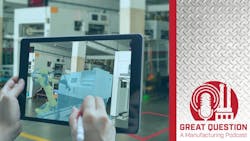




Smart Manufacturing is the label that has emerged to describe production systems that incorporate digital technologies, real-time data, and interconnected systems to make manufacturing processes more automated, adaptive, and efficient. It involves sensors, data analytics, artificial intelligence, and connected machines that monitor, optimize, and automate manufacturing processes in real time.
In this episode of Great Question: A Manufacturing Podcast, and prompted by the developer’s recent State of Smart Manufacturing report, American Machinist's Robert Brooks asks Evan Kaiser, Rockwell Automation vice president for Global OEM and Emerging Industries to tailor the insights there for small and midsized manufacturers, to help them understand the smart manufacturing investments, practices, and strategies, that will help them get connected and stay competitive.
Below is an excerpt from the podcast:
RB: Smart manufacturing is a very broad label for production systems that incorporate digital technologies and real-time data and interconnected systems to make manufacturing more automated, more adaptive, more efficient in a general sense. It's not a new topic, of course, but it grows more intensive as technology advances. And my ongoing interest is in the role and contributions in the industrial supply chain for small and mid-sized manufacturing businesses, which includes most metal casting and machining operations, usually categorized among SMEs. So that is what I've asked you to discuss in relation to the new report. And I proceed from a general sense that these types of operations have a little bit of difficulty adopting or embracing smart manufacturing. So will you tell us, tell me the best way for these types of operations to latch on to smart manufacturing to improve their efficiency and to improve product quality?
EK: Yeah, I appreciate the question. Again, thanks for having me here. I think maybe it's a bit of a misconception that, smart manufacturing isn't for everybody. I think it is for everybody. To be honest, I think some of the big brand owners and logos that we all know, maybe they can move a little faster. But I actually think the small and medium-sized companies have an equal opportunity.
I think to answer your question more directly, all of smart manufacturing is a great concept, but where the rubber meets the road is where the value comes. And so whether it is small, medium, or large, you have to declare a bit about what your stated goals are and how you want to achieve them through the smart manufacturing journey. And I believe that, again, whether you're small, medium, or large, you still have some infrastructure that can be leveraged. And I think that's the starting point. The starting point of smart manufacturing is to start understanding the data sets and information sets that you have inside your own operation. So they can be either modeled or analyzed or leveraged or optimized, whatever it might be, through a pretty focused lens.
And again, I don't think the size of the company matters. I think each company knows their own problems. Each company knows where their opportunities are. I think digital solutions and smart manufacturing, they lay across most of them. And so just finding the right problem set and problem statement, and then working with the right partner. Hopefully Rockwell Automation's in the discussion there, but ultimately it's a combination of those things that I think helps enable everybody. I don't think it is unique to just the large global brands that have maybe a little bit more CapEx and momentum behind it. I think everybody can leverage it.
RB: OK, there's a parallel issue for a lot of SMEs, which is shortage of skilled labor. And this is highlighted in the report. So what strategies should these types of operations, these SMEs emphasize in order to prepare and retain their skilled workers for smart manufacturing?
EK: Yeah, I mean, I think it is one of the kind of critical axes of what's going on in manufacturing in general. And I think smart manufacturing, if you start distilling smart manufacturing down to some of its core elements, yes, some of it is in like productivity analytics and, you know, how are we going to become, you know, at an enterprise, a higher efficient operation. But as you start even going deeper into that, you find that efficiency is derived, again, from people, certainly is one of those. And if you cannot retain people, that's certainly one problem. You get a big churn.
But even the people that you retain, one of the problems or challenges of today is they tend to not have the right skill sets. And so, you know, there's a double whammy hitting most end users is, do I even have the right staff? And if I have the right staff, do they have the right competencies? I think if you take then one vein of smart manufacturing, which is digital enablement, digital enablement is a wonderful way to kind of solve that problem.
It comes in a couple of flavors, in my opinion. One is you get, I think, the opportunity to have very real-time, I'll just call it just-in-time training for an operator or a maintenance person. So a self-diagnosis of the problem, a recommended path forward can be digitally generated based on the information set that's provided into some logical engine that can answer questions. You know, it can be as fundamental as I have a product and it has fault 72 on it. What do I do about it? That can be presented autonomously or automatically. That's smart manufacturing, in my opinion. But probably more importantly is, you know, at a higher level, when you start getting into systematic problem solving, having, you know, just the foundations of a little bit of AI, a little bit of kind of machine learning or, you know, large language model analysis that can, take, again, a maintenance person or an operator to an immediate conclusion. I recommend that you do this based on what you've told me. Systems are getting smart that way. And so I think that used to be like this like fantasy world that people thought we'd never get there. I think it's happening right now. And so I think that's a nice path for kind of employee enablement is to give them a digital tool set that answers some immediate questions and maybe solves a few problems that either they haven't been trained for Or even if they've been trained for it, they haven't done it in so long, they've forgotten some of the nuances to it. And so, these digital tools help kind of remind them of the proper processes so you get the best efficiency out of that workforce.
RB: Very good. You veered onto the subject of analytics there. So tell us, where should SMEs put their emphasis their with analytics in order to optimize operations and improve their decision-making and become more competitive?
EK: I think it gets back to a earlier comment I made, which is analytics just broadly doesn't solve any problem. You got to state the problem that you're trying to analyze and then get after it. So still focus, I think, is critical. But in general, one of the things that I think Rockwell has learned as a big unlock in the analytics space is digital modeling matters. So you can't just take metadata and think some magic is going to come from it. You have to intelligently model the processes that you have and broadly incorporate a bunch of upstream and downstream things that might impact the result.
In the end, if you stay too focused on a narrow set of equipment or a small sub-process that might be going on, you might miss the larger impact of the analysis that would pay the biggest dividends. And so one of the things that we advocate at our customers is to think more broadly about a digital model that can then be kind of exercised and tested to find the optimum answer. And you're doing it all in a virtual world. There's no CapEx spend required. The digital tools that are available today, man, they're really good. Like high fidelity modeling can be done. But the good news is so can low-fidelity modeling.
That's one of the aspects of this analytic journey that people get on, is sometimes they dive so deep into the weeds because they're trying to build the perfect model. You don't need to do that all the time. Sometimes you just need a high-level model that starts honing in on the right answer, and then later on, you invest in a more detailed model, but now in a very focused way. So I think digital modeling is one of those unlocks that I don't think people are thinking about so deeply today. And then I think the other thing about analytics is, to me, as I said, I've talked to so many customers that have immense amounts of data, immense, but they can't do anything with it because it's not contextualized. And I know that's a bit of an overused term, but it's actually very real.
If you think about cause and effect of an analytic, if I have an event that causes downtime, and that's what I want to analyze, What really caused it? If you have four different systems that are either alarming or going through some sequential like shutdown of the system, you need to know what caused it. And if subsystems are not tied together, there's no context between them, you don't know whether it was subsystem A or subsystem B that did it. So contextualizing the data set to have a common operating model of the data a common timing of the data, people discount that as being like, I don't know if I really need to worry about that. Man, you need to worry about that. You need to get the data contextualized and you need to get it harmonized around time stamping and also around common definitions of what things mean. And when you do that, man, you are so well prepared then for the analytic journey that you're on, because you don't have to worry about whether the data set is clean or dirty, because dirty data gives you dirty results. You need clean data to get the clean results. Sorry, a little bit long-winded there, but hopefully...
RB: No, it's a very, very clever insight. Modeling is context, and I think a lot of people may never make that association. I'm glad you did. Tell me, what can what steps can operations SME operations take to reduce? manufacturing waste, and in parallel with that, improve energy efficiency. There's a different type of waste, but what are the steps for that?
EK: Well, I mean, I think a little bit of it comes back to this analytic work that's going on that we were talking about earlier, you're pointing it now at waste, you're pointing it now at kind of power efficiency or whatever. But I will tell you, I don't think that, at least in my experience, power management, if I start with power management to start with, that is a more difficult thing to optimize if you don't have a holistic data set. Like, to me, the running of a conveyor that has a 2 hp motor and it's going to have a box that's, you know, 20 lb on it, it's going to consume that energy. You can't change that. You can't make that more efficient very easily.
Power management is more about can you intelligently map your power consumption to your power bill? Like that's where data analytics starts coming in, because if I'm going to run certain times, certain peak demands, the power company has certain pricing models that matter to them. And so shedding energy at the right place, that's a different way to optimize, I'll say, energy management. so that you optimize your power bill. Now, at the same time, you're also making your process more sustainable because you're probably using energy more wisely. But I do think at the end of the day, customers are also seeking a financial benefit. And I think it comes with both when you do a proper analysis of your energy footprint and how you consume it and how the power company charges for it.
Now, when it comes to waste, man, waste is a pretty broad thing because waste comes in terms of like scrap, it comes in terms of just the excess materials that might come off as either overflow or necessary trimming of product to get flashing off of a casting or get whatever it could be. Each one of those, I think, requires then a more specific approach. And when I say specific, I mean, again, a bit of a model to how scrap is created, understanding the root of that scrap, and then putting together a plan that says what could mitigate that. And again, if you think about analytics, a lot of times analytics have a data set that is more broad than just the machine or operation itself.
Maybe the reason you're having scrap, and again, I'm going to use an example that maybe is less relevant to a machinist, but may be very clear in terms of how it could manifest itself. If I'm making, again, I'm going to make a box. I have a box, it's cardboard. If I have a flaw in that box, it's not perfectly square. When I try and make a box perfectly square, it's not going to work because I have a poor source piece of material that I'm ingesting into my process. That's going to create scrap because that box isn't going to work out, and I'm going to end up with a bad, I'd say, output on the creation of a box. The same thing is true in all manufacturing processes. A lot of upstream things actually result in a poor quality on the back end. And so my advice would be look upstream, figure out the larger end-to-end processes that are contributing to that scrap, and then do that digital analytic work on top of them to see what could be done about it and then get after it. Like in the end, all analytics does is tell you like where the problems are and maybe a potentially recommended path. At the very least, it's a good compass to follow to maybe get to a better scrap point.
RB: Okay, you've given very strong arguments in favor of smart manufacturing, but how can SMEs avoid technology paralysis and ensure that they're making the right investments for their specific needs in smart manufacturing.
EK: I see it all the time, the paralysis of Industry 4.0 and the digital journey or whatever. I mean, I think a couple of missteps we've seen in the market is you try and go after the world. You're solving world hunger. on your first project, that is a bad path to take. I think we're much better served, or everybody is much better served with a more contained approach. So a step-by-step approach, I think helps a lot in terms of the digital journey. That's number one.
I think number two, people underestimate what's already in their infrastructure that is enabling the digital journey. If you have automated equipment on your floor, even if it's islands of automation, maybe they're not connected today, they're easily connected. Like in the end, the step forward to get to a larger enterprise or plant view of what's going on, it's not that far away if you just kind of build the right pipelines of data between the operational work cells that you have.
And I think people underestimate what they've already got, because in the end, most of the OT, the operational technology, not IT, IT is a different world, but OT, if you live in that world, which most of the customer base for industrial automation does, the keys to the kingdom are sitting inside the PLCs and sitting inside the controllers that they have already purchased. They already own the data and they just haven't extracted it in a meaningful way to get after, you know, kind of the start of this digital journey. And so what ends up is like, oh, I'm going to go put a bunch of things in the cloud and I'm going to do who knows what up there. Like, I don't think that's necessary. As a matter of fact, I think the Rockwell perspective is, I think there's a bunch of things that can be done right on-prem or on the edge is what we call it, where, you know, data sets are then provided to a mid-layer analytic engine that can do real-time analysis. It's a very quick, it's very light touch. It doesn't cost you a bunch of money to put stuff into the cloud, petabytes of data that are never used. Like, that's a big, I think, trend that we saw early on.
I think people are getting smarter about it, but for sure the Rockwell perspective is use what you've got and then lever your partner. Like in the end, again, I hope Rockwell is in this conversation, but even if it's not, whoever it is, like customers need help. And the vendors who have provided that automation, they should be able to help you. So the machine builders know their machine the best. The automation suppliers know their automation platforms the best. Have a discussion with them, learn what is unlockable inside that architecture, and go to that next step. Because I think once you start getting into the next step, it becomes more apparent what you can do with it. But left to your own devices, if you haven't really dug into what you already have, you might end up spending money on things you don't need. You know, to me, I've seen a lot of customers go down that path.
RB: A subject raised in the State of Smart Manufacturing report is cybersecurity, sort of a tangential issue to interconnected systems. So what are the right tactics for SMEs to resist ransomware attacks?
EK: Such an important part of this whole digital journey, and I probably, I'm remiss in not having talked about it already, but yeah, we see that as critical path as well. If you're going to be digitally enabled, obviously the connected infrastructure that you have also introduces maybe some accelerated risk to your enterprise if you don't protect it. And protection comes in a bunch of ways, like the automation system itself can be protected. The infrastructure itself can be protected. But there are standards out there, NIST standards for defense in depth.
Really what it boils down to, though, is it starts with a verification of risk. And this is very analogous to what I think happened in safety a while back. Machine safety was not in vogue 25 years ago, and then people started figuring out like, hey, that's pretty important. And the first thing that happened was people did safety analysis of the machine design and how do I make it safer and where are my risks? I think cyber is in the exact same kind of framework where you have to know what your connected inventory of assets are that would be at risk. And you need to take an inventory of that and understand and triage where the risk points are the deepest. And again, there are tools out there. And again, I'm Rockwell Automation, so I have to at least say a little bit about what Rockwell does here.
But in reality, there are software tools that you can plug in. They can crawl the network. They can tell you everything that's connected. They can tell you what firmware it's at. They can tell you what risk vectors are attached to each of those firmwares. That is a wonderful starting point for everybody who needs to figure out their cyber journey Because you need to start with what do you have? And then the next step is how do you mitigate it? And some things need to be mitigated immediately, others maybe over a longer period of time. And the mitigation strategies are multiple. Some of them you need to be partnered up with IT, some of them can happen right in the OT space. But again, I think most end users, they are ill-prepared for the cyber journey.
And I think, again, I don't want to discount like the real world because it's hard to deal with all this stuff, but you can't put your head in the sand on this topic. Like ransomware and cyber and dark actors, they are everywhere. And they're AI agents, they don't care whether you're big, small, you're in this industry or that industry. They're going to go after every vulnerability they can. And if you've got it, you're going to be a victim of it. And so I think there are very, very good solid practices that you can do to protect your infrastructure. And again, find partners like Rockwell Automation, find tools that start assessing the risk and then get after it. Because in the end, it's not going to solve itself. The world is changing. I mean, what's interesting about this safety analogy is once a machine is safe, it's pretty much safe. But you can't say that about cyber. There's always new stuff coming, new vulnerabilities. So it needs to be an active kind of living practice inside every end user. And now every machine builder needs to be supplying cyber resilient machines.
All those things, you should start caring about that and telling people, when I buy a machine, I want it to look like this. I want it to have this cyber protection. I think that's okay to ask that because I think the maturity is there now.
RB: Excellent. Well, that seems like a good place to wrap this discussion. And to say thank you to Evan Kaiser of Rockwell Automation for your time and your insights.
About the Podcast
Great Question: A Manufacturing Podcast offers news and information for the people who make, store and move things and those who manage and maintain the facilities where that work gets done. Manufacturers from chemical producers to automakers to machine shops can listen for critical insights into the technologies, economic conditions and best practices that can influence how to best run facilities to reach operational excellence.
Listen to another episode and subscribe on your favorite podcast app
About the Author
Robert Brooks
Robert Brooks has been a business-to-business reporter, writer, editor, and columnist for more than 20 years, specializing in the primary metal and basic manufacturing industries. His work has covered a wide range of topics, including process technology, resource development, material selection, product design, workforce development, and industrial market strategies, among others. Currently, he specializes in subjects related to metal component and product design, development, and manufacturing — including castings, forgings, machined parts, and fabrications.
Brooks is a graduate of Kenyon College (B.A. English, Political Science) and Emory University (M.A. English.)