Podcast: AI, automation, supply chain, and vending machines - Grainger officials talk manufacturing trends
Key Highlights
- Poor inventory management leads to major waste, with up to 30% of stocked items never used.
- Clean, structured data is essential for scaling AI and improving supply chain visibility.
- Manufacturers prioritize service continuity over cost amid tariffs and disruptions.
- Automation growth increases demand for skilled maintenance and smarter inventory systems.




Most grownup professionals are smart people, but that doesn't mean we don't do some really stupid things from time to time. Think about your last expense report. Between filling out the forms, supervisors checking them, accounting reviewing them again (and sending them back five times because you used the wrong code for the rental car company), companies spend vast sums of money every year in hopes of preventing someone charging a bottle of cold medication back to their employer.
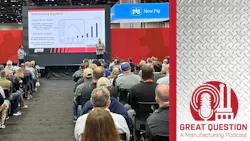
Procurement in manufacturing is similarly penny wise and pound foolish. At the Grainger Show in Florida in March, one poster showed how the average company uses seven people and $100 in approvals and management time to buy a $17 hammer. Sound familiar?
In this episode of Great Question: A Manufacturing Podcast, IndustryWeek's Robert Schoenberger and New Equipment Digest's Laura Davis had a series of wide ranging conversations at the show, includng:
- Sam Johnson, group vice president for Customer Solutions at Grainger
- Barry Greenhouse, senior vice president of Merchandising and Supplier Management
- Rick Sigler, vice president of Onsite Services
- Stan Solowski, vice president of Value-Added Solutions
- Derek Hamilton, vice president of Onsite Operations
Full disclosure, Grainger did not sponsor this episode, but the company did cover travel costs for editors to attend their customer event.
Below is an excerpt from the podcast:
Sam Johnson: Up to 30% of the products that a customer will buy and put on their shelf actually never gets used. It gets lost, it gets damaged, it goes obsolete. And that's a crazy amount of lost productivity and lost capital if you think about it over a large business enterprise.
Robert Schoenberger: This is Robert Schoenberger with Industry Week. And in March, I visited the Grainger Show in Florida, along with several of my colleagues from Endeavor Business Media. And we spoke to quite a few executives within the company about how that supply chain management company is working with manufacturers these days. Full disclosure, Grainger did not provide any compensation for this podcast entry, but they did cover some of our travel expenses to attend their customer event. You just heard Sam Johnson, Vice President for Customer Solutions at Grainger, talking about some of the challenges that they help manufacturers face. And here's a little bit more from Sam.
Sam Johnson: When a maintenance individual will go into a storeroom, about 18% of the time, they walk away without the product that they actually went in to get.
Robert Schoenberger: During several wide-ranging conversations, we spoke with Grainger officials about how they're dealing with the world around us these days, which of course means speaking about tariffs. Here's Barry Greenhouse, Senior Vice President of Merchandising and Supplier Management.
Barry Greenhouse: All of our suppliers, and we are as well, are looking at other countries and where's the best service cost trade-offs of where to land production. It's quite challenging, given the somewhat unilateral application of tariffs to multiple countries concurrently, like the ability to arbitrage or remove product, there's not a lot of separation, honestly, at this point. So folks, either us or other manufacturers are choosing to move production are doing it.
I think now from a diversification risk mitigation standpoint, but from a pure cost play standpoint, the arbitrage isn't significant, right now. If I go all the way back to the 2008, 2009 kind of recession, and then even during COVID, what held true during that time was protect service. Secure inventory, protect service, worry about everything else afterwards, but protect service. And that helped. But I think the disruptions now are slightly different with the tariff environment.
And so in a somewhat fortunate way, if I go all the way back to like 2017, 2018, we had looked at our portfolio of products before the tariffs, or during the first round of tariffs back in that first administration. And we had done quite a bit of work that prepared us for this landscape now that we're in with tariffs. And is probably like glass half full in many ways, but what we've seen in this instance here is we're not uniquely exposed for most of our products.
So with our national brands, we definitely partner with our national brands to secure supply, but even with our own private brand portfolio, typically, we feel like we're either diversified or our exposure is coincidental with everybody else's exposure, i.e. certain products get made in certain parts of the world and centers of excellence. And so that whole commodity is exposed, but we don't have any unique specific exposure to that. And so that is something we are always trying to manage and mitigate, "where do we, how do we mitigate the downside risk first?" and then "how do we protect service?" I think is the way we look at it. And then figure it out from there. I think it really depends on what the context is. Like the tariff context is so different than the COVID context.
Robert Schoenberger: And of course, no 2026 manufacturing conversation would be complete without discussing data management and AI. Here is Rick Sigler, vice president of an on-site services at Granger, talking about data management.
Rick Sigler: It starts with having really, really great bulletproof data first, and then for our customers, they're looking for a lot more visibility and transparency around data that we can provide to them that they actually can't easily get themselves. And you think about our products, right? The MRO products in many cases are not in a system. They're usually managed in expense. So they don't have a lot of visibility around what's on the shelf, how often is it moving, who's using it.
And then when you, I would say the complexity comes in when you want to see that in a useful way at an enterprise level. So think of a customer that has 100 plants and they want to see information broad, but they also want to be able to dig in deep and understand site level stuff too. That's extremely challenging for any supplier right now. I don't think anybody's doing it particularly well is what I would say. And part of it is because of the challenge of having good data, having systems that allow you to get the data and then actually do something useful with it. That's been a theme across pretty much every category, every director of category or procurement, supply chain in many cases, that is sort of top of mind for them as they try to get a little more sophisticated about indirect spend.
Robert Schoenberger: And here's Stan Solowski, vice president of value-added solutions at Grainger.
Stan Solowski: One of the things that our consulting team does a lot of is what's called data quality, where we'll sit there and actually understand the data that these customers have and actually help them clean it. Because there is a lot of, I would say, junk in there. There's a lot of duplication. There's a lot of obsolete arts. And that just grows over time. The amount of vendors grow over time. There's vendors that they cut out on the books for like 20 years that maybe gets used once or twice by someone who picks it up and notices it's there. They might not even know that's still on their books. So Part of the data transparency is actually showing the customer what they actually have, because a lot of times they're so decentralized, they don't know themselves.
Robert Schoenberger: And data quality obviously is critical for supporting artificial intelligence applications. Here are Rick Sigler again and Derek Hamilton, vice president of on-site operations at Grainger.
Rick Sigler: I would say a very small percentage are in a position to leverage AI in its current state. They just don't have good information in general. which is why they're leaning on suppliers more to bring that to them. On your AI question, the only place that I know we've leveraged an AI agent is in our contact centers. So we have an AI agent that assists our phone agents with product identification, with making sure that they have the best information access in a very timely manner. It's not a direct AI agent to a customer. It's more of a, enhances the experience for a phone person. So it makes them, it makes it easier for them to ask, in some cases, more technical questions.
Derek Hamilton: I think that's where a lot of people are starting, team member documentation, and then you know that can evolve very quickly into what's actually presented, potentially. But I agree with Rick on your question. I think just historically, companies have an approach kind of structuring process, structuring technology, and structuring data in a way that actually gives you kind of an interview of your operation to leverage some of the technology. So I think that's, you know, some of the advantage that we will bring. And certainly what we're aimed at is how do we help customers in that Ave. create, curate, use data in a way that makes it more conducive with some of these emerging technologies for sure.
Robert Schoenberger: And David and I obviously tie right back to another major trend in manufacturing, automation. Here again is Barry Greenhouse, Senior Vice President of Merchandising and Supplier Management at Grainger.
Barry Greenhouse: We're about two years into one of our strategic initiatives on improving our factory automation assortment, as well as our raw materials assortment. And so I would say raw materials is a reboot of an initial initiative we took 10 years ago and probably missed the mark a little bit on it, honestly.
But so we've seen really high growth on the raw material side and pretty good traction on the factory automation side. And what is interesting with the factory automation pieces, I think we've now gotten to the point with our assortment that it is credible, is what I'd kind of position it as is like we can at least play in before our offer wasn't credible enough to even be thought of as a credible participant in that space. And so now we're using that kind of foundation to then now further expand the product and kind of push the envelope to the edge.
Now we won't probably get into like very, very technical product, but if you take something like a... We're looking at variable frequency drives or VFDs the other day, like our variable frequency drive offer is actually quite compelling at brand specific levels now, whereas before that was something we couldn't really play in. And so like for those who aren't familiar with VFDs, it's a device that you can use to control like say the speed on a conveyor to throttle a conveyor up with packages on the line and slow it down. So if you've ever done a little as a... people movers, that looks like it stopped and you approach it and it starts moving again. That's probably a UFD that's making that thing kind of throttle up and throttle down. But essentially, we sell those now and we couldn't have played in that space two years ago. And so we think there's a lot more opportunity there.
We've probably got another two to three years of runway there to kind of continue to push the envelope on what the assortment is. And along with that, we'll have to probably evolve how we present product on our website, because it's probably maybe not what we fully need to present more complex goods like that. And then getting seller content and whatnot, so sellers in the right application can then thoughtfully provide responses to customers. It's hard for a seller to, we can't expect the seller to understand every single product out there, right? And so we'll have to know how to provide content to sellers so that they can access it at the right moment, kind of thing. The real challenge is going to be ongoing maintenance of all of these facilities as people automate, not just from a part standpoint, but honestly, I think the technicians to maintain these places are going to be interesting. So I think that the maintenance of the automation, that industry is going to be fascinating what happens and how much of that is in-house versus outsourced honestly?
Sam Johnson: In addition to the direct maintenance products and that evolution, I was in a conversation this morning, I can't name any names, but we have customers that are starting to think about as they automate more, how do they manage the human automation interaction, right? So as things become more automated, more autonomous, you're starting to think through how do you keep that environment safe, not only for the equipment, but also for the people that have to operate it, maintain it. So it's going to continue to evolve, and we're obviously staying close with where customers are going with that.
Robert Schoenberger: As is typical with manufacturing, the goal here is efficiency, getting as much done as quickly as possible with limited resources. Speaking about these topics again are Sam Johnson, Rick Sigler, and Stan Selowski.
Sam Johnson: We really think about working with customers, helping them think about how to be more productive in the work that they do, how to drive out waste, and ultimately reduce their total cost of operations, which is a big win for them and ultimately a big win for us. I mean, we talk to customers about the fact that we actually want you to buy less in total, but buy more from the Ranger.
And one of the ways that we do that is by showing them ways to take more cost out of their business versus just thinking about the price of a product. The way we organize the teams are really around kind of five business issues that we see most of our customers having. and ways that we can really step in and help them think about driving that cost down. First one's their procurement process. Pretty straightforward. Everybody does it, but it's amazing how inefficient and ineffective a lot of folks are in doing it.
If you guys happen to be in the procurement booth out there, was a big poster hanging on the wall that said, it took these seven people and $100 to buy. I think it was a $17 hammer, if I'm generally correct. We find that a lot, and it's amazing. When we're able to go in and sit down with customers and literally process map all the steps that they go through, all the people that get involved, and then quantify the amount of cost it takes to generate a purchase order, and then show them a different way to think about doing that, huge savings. If they connect with us electronically, it's kind of like a multiplier.
You take an improved process and then you digitize it, either through Grainger.com, through some kind of a third-party service provider, or a direct connection with Grainger. Really good things happen in terms of productivity and waste elimination. Kind of the second big area that we work with customers on is inventory management, which is really core to what we do as a business. It's not typically where our customers focus. It's not how they create value for their customers. And therefore, you find a lot of times where they don't have the right labor or the right labor with the right kind of background and skills and the right tools to actually be really effective in managing inventory. So we help them think about, what is the right amount of the right products and the right place to keep inventory in their facility to make sure that folks can get to it when and where they need.
Rick Sigler: It's all about now being on site, helping them manage their inventory, being a part of their team. It is about them taking that cost out of their business. So it is directly like a labor cost thing for them. They do not want people that make a lot of money maintaining their facility, keeping their machines running, looking for products or buying products. They want someone else to do that so they can focus that very expensive and skilled resource on what they need to be making.
Along with that I think what's also changing is the dynamic of there's a lot more third party people coming into this because many of these folks are outsourcing the facilities maintenance part of their business to other companies. So you see some large companies now coming in and doing that at some pretty big scale. Again, that's just a sign of number one, the shortage in trades is a big problem. I mean, every customer I talk to that still has trades, they're short. They can't find good people. They're competing with everyone else. And I think third parties is definitely another dynamic that we partner with some of those folks to help supply them while they supply the labor side.
Derek Hamilton: Yeah, I think the way that starts to show up is suppliers willing to give us more responsibility, frankly, right? And take over, not only additional parts of categories that are logical for Grainger, but even more responsibility within their building. I think to Rick's point, obviously, our team members that are going on site can provide some of that. But even within that, right, some of the solutions that we provide, storage solutions can offset the need for people to physically hand out product. You know, building on the data, I think that is a core piece of all the conversations we're having right now. But it goes beyond just providing visibility to what's happening across the organization. What do I have? What am I buying? They're now asking, I also want you to interpret that data for me and point me directly to the opportunities that I have on site to really drive costs out or drive efficiency. So there's this trend of giving suppliers more responsibility within their operation over power.
Stan Solowski: Taking something that off our plate is actually kind of fixing some of their processes and making them a lot more streamlined so they don't need as many people to complete some of the tasks that they're doing today. So to give you an example, manufacturing company, they make outdoor appliances, and usually, when do they make those? Usually near the end of the year, they're seasonal, they ramp up with a lot of people during that time, and then they kind of fall off, right? So there's a lot of temp workers in there that they bring in and out.
We'll go in, we had one where they had an issue with a specific kind of grinding wheel. They're using four different grinding wheels to get this finish on their product. We bring in our specialists that would come in and actually look at the process they were doing, use it products that they were using to suggest something different. We were able to collapse down to one. So it did a couple of things. Number one, it was a lot easier to understand one product, how much I need to buy, how often I need to buy it. But you think about training temp workers and getting them up to speed. It cut their process time in half and the training time in half. So they were able to get a lot more output.
Rick Sigler: I'll give you an example from a conversation I had two hours ago with a large customer. And their ultimate goal across all their sites was to drive compliance. And compliance for them means I want to make sure the products I buy are the right products from a safety perspective, right? And I also want to make sure that I buy products that are on my contract. And most customers can't drive compliance very effectively across lots of sites.
So what happens is, like in this example, they're buying 60 different manufacturers' safety glasses across their sites. And they want to reduce that down to, say, 4, because that allows them to get volume discounts. It allows them to control what people are using, takes the rogue spending out. You know, a supplier's ability to easily show them, hey, at your 100 sites, you're buying 65 different pairs of safety glasses. It's part of the data of transparency. It's not enough just to say, you know, here's what the data shows. You got to take it to the next level and say, here's what we'd recommend. And in some cases, that allows us to leverage like this, the great supplier base that we have that's out here on the floor.
You know, sometimes like we don't exactly know just the right glove for the application, but we can bring in a glove specialist. We can bring our safety specialists and they can evaluate the work and they can make recommendations and then help the customer narrow that list down to just the ones that are specific to that job, to that individual. And then you throw them in vending and that's the ultimate compliance because they have to scan their badge. It's only going to give them the products that is for their job, right? Because you can control that in vending. That assures them that people have the right product for the job and it's the right safety, cut level for gloves or whatever that case may be.
Robert Schoenberger: And as long as we're already talking about vending, let's close this out with some conversations with Stan Selowski and Rick Sigler on that topic.
Stan Solowski: Instead of just saying, hey, we're going to put 50 vending machines there. We're putting this here because it takes you 20 minutes to walk to the store. I'm going to pick up this. You can walk here within 5 minutes, you're back on your tool. That just saved me a good 15 minutes of productivity there, which I can get my production a little bit quicker.
Rick Sigler: 24-7 access, close to the job. I mean, it takes labor, cost out for sure. I would say manufacturing can be challenging. Floor space is a premium, but generally we can find space for vending. I mean, if you go in a manufacturing plant, which I'm sure all of you do, You'll usually see them like where the employees enter is a good place for them, right? It's like, it's a common place. And then more and more, it's vending machines in different parts of the plants that support different parts of their manufacturing process. Or if it's a distribution center, it's, you know, machines maybe in shipping and receiving, and then also, you know, close to where the team members come in. I think it is premium floor space, but I think if a customer is, it truly understands the use and the value of it, it's pretty easy to get connections there. I mean, you got to have electrical, you got to have some type of connection, more and more it's cellular because people don't want anything on their networks anymore because it's obvious reason. But yeah, it's, And sometimes we have to fight for space, I would say, but generally not. Many of them have used vending before.
Derek Hamilton: The typical vending machines like 10 square feet is an unusually fine space. I will say that we continue to invest in different form factors that are smaller, that are larger. We want to ensure that we can fit to the customer space, but also support the type of product that we're managing with it. So that is an area that we're actively investing in, is making sure that we have the right configuration, the right type of vending machine for in customer environment.
Rick Sigler: And it's definitely more of a thing in manufacturing just because they're always fighting for space. But again, I think if you have the right conversation, if they have the right buy-in, if they truly understand the value of vending and just how much it can reduce your spend and also put things closer to the work. Generally, we find a way. I mean, we've had to put vending machines in very odd places at times. We've got them on boats. We've got them in break rooms. I mean, they don't fit easily through a door, as you can imagine. So there's all kinds of things we do to get them in the right spot. But if the customer's committed, we find a way.
Stan Solowski: And a lot of the time when we do that, we do space optimization, right? We'll actually look at their entire layout of what they have. If we're doing the inventory plan right, they shouldn't need as much there. And there's a lot of stuff that is dead stock, obsolete that they've had on the shelves for a year and they have three or four of them, right? We actually usually can gain a lot of space back in other areas to help us actually put the products where they need it and a little bit better space for them to access.
About the Podcast
Great Question: A Manufacturing Podcast offers news and information for the people who make, store and move things and those who manage and maintain the facilities where that work gets done. Manufacturers from chemical producers to automakers to machine shops can listen for critical insights into the technologies, economic conditions and best practices that can influence how to best run facilities to reach operational excellence.
Listen to another episode and subscribe on your favorite podcast app
About the Author
Laura Davis
Laura Davis is the editor in chief of New Equipment Digest (NED), a brand part of the Manufacturing Group at Endeavor Business Media. NED covers all products, equipment, solutions, and technology related to the broad scope of manufacturing, from mops and buckets to robots and automation. Laura has been a manufacturing product writer for six years, knowledgeable about the ins and outs of the industry along with what readers are looking for when wanting to learn about the latest products on the market.
Robert Schoenberger
Robert Schoenberger has been writing about manufacturing technology in one form or another since the late 1990s. He began his career in newspapers in South Texas and has worked for The Clarion-Ledger in Jackson, Mississippi; The Courier-Journal in Louisville, Kentucky; and The Plain Dealer in Cleveland where he spent more than six years as the automotive reporter. In 2013, he launched Today's Motor Vehicles, a magazine focusing on design and manufacturing topics within the automotive and commercial truck worlds. He joined IndustryWeek in late 2021.