The Industrial Science Report: Supply chain risk, geopolitics, and AI reshape manufacturing networks and sourcing strategies
Key Highlights
- Artificial intelligence is being used to predict disruptions, optimize sourcing, and improve supply chain visibility across complex networks.
- Companies are investing in regional manufacturing and domestic resource processing to reduce reliance on globalization.
- New collaborations between tech firms, universities, and government agencies aim to enhance supplier intelligence and supply chain risk management.
- The shift toward a more resilient supply chain involves integrating digital tools into engineering, procurement, and manufacturing processes to anticipate and mitigate disruptions.
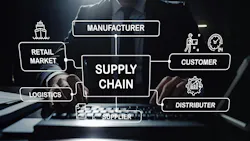
Did regular Americans ever talk about the supply chain before COVID-19? Remember, before we hoarded toilet paper and hand sanitizer and couldn’t get our shiny new SUVs on demand? The pandemic put a microscope on our global supply chain, and the close-up wasn’t pretty. Industry has largely recovered from pandemic-induced supply chain issues, but companies remain focused on reducing globalization in favor of a more robust domestic supply chain. In certain industries, it’s a matter of national security.
I’d argue that the American public is more acutely aware of the supply chain now. Our gotta-have-it, supersized, consumerism culture realized America’s abundance does have limits. Similarly, the pandemic forced many manufacturers to question just-in-time manufacturing and inventory strategies, and tariffs pushed facilities further into stockpiling to ward off price hikes.
Our thirst for endless data and energy continues to expose fragile supply chains. The current AI gold rush is straining semiconductor, data center, and electrical infrastructure supply networks as demand for chips, power equipment, and critical materials accelerates.
Recent geopolitical tensions have reminded industrial economies how dependent they are on a handful of global trade corridors. The ongoing disruption of shipping through the Strait of Hormuz—a route that normally carries roughly one-fifth of the world's oil supply and a significant share of global liquefied natural gas—has increased energy price volatility and transportation costs. Everyone feels the effects of higher fuel prices.
Supply chains do not exist in isolation. They are shaped by pandemics, wars, trade policy, energy markets, labor availability, infrastructure capacity, and the countless decisions made by suppliers, logistics providers, governments, and customers. Manufacturers are increasingly investing in supply chain visibility and data-driven decision-making because resilience now depends on understanding the entire system, not just the facilities they control. Supply chain vulnerabilities often emerge far from the factory floor.
Earlier this year in The Industrial Science Report, I explored battery manufacturing and power generation research focused on improving manufacturing competitiveness and access to critical minerals, reliable power infrastructure, and domestic processing capacity. We’ll touch on that topic again this week, as building domestic capacity for battery manufacturing requires securing the raw materials, power resources, and industrial ecosystems that support production.
The frustration for manufacturers is that supply chain problems or solutions are often outside the plant fence line. For maintenance and reliability teams, that pushes downtime risk upstream, where wrench time does not reach. Reliability depends on both the health of the physical assets and the resilience of the supply networks that support them.
Manufacturers and suppliers are reconsidering how resilience is engineered and how to account for external disruptions. Artificial intelligence is being used to interpret supply chain behavior the same way condition monitoring systems interpret asset behavior. Engineering software is beginning to factor in material sourcing before designs are released. Governments and institutions are funding domestic material pathways to reduce exposure to upstream bottlenecks. At the same time, manufacturers are moving production closer to demand centers to reduce the distance between disruption and recovery.
Ultimately, supply chain resilience is still judged at the consumer level. Most Americans don't spend much time thinking about supply chains until fuel prices spike, or they can't buy what they want, when they want it, for the price they expect. The stories this week are evidence that research and investment in the industrial supply chain are focused on intercepting disruptions before they cascade through production systems and eventually to the consumer.
Chinese researchers report AI strengthens manufacturing supply chain resilience
Technology context: Manufacturers are managing risks that extend far beyond the factory floor, from supplier disruptions and transportation constraints to geopolitical volatility and material shortages. Where cost, quality, and throughput have ruled, supply chain resilience is now getting a seat at the table.
Artificial intelligence is being applied as a systems-level diagnostic tool, extending predictive analytics beyond equipment health to supplier networks, logistics constraints, and material flows. The challenge is less about predicting individual disruptions and more about understanding how industrial networks respond when disruptions occur.
Innovation news: Chinese researchers from the Harbin University of Commerce published a report in Scientific Reports that examines the relationship between artificial intelligence and manufacturing supply chain resilience, using empirical analysis of Chinese manufacturers from 2011 to 2024. The research evaluates how AI adoption influences resilience outcomes across manufacturing networks and identifies both direct and indirect mechanisms through which AI affects industrial stability. The findings suggest that AI contributes to improved supply chain performance, not only through operational optimization, but also through indirect effects on alleviating financing constraints and reducing market competition intensity. The paper highlights that the impact of AI varies depending on facilities' underlying data infrastructure and regional or systemic conditions. Digital transformation is more pronounced in high-tech, low-pollution, and highly competitive industries, and negligible in traditional, heavily polluting and non-competitive sectors.
Siemens and Xometry bring sourcing intelligence into engineering workflows
Technology context: For decades, product design and supply chain management have operated as largely separate functions. Engineers developed products based on performance requirements, while sourcing teams addressed supplier availability and procurement challenges later in the process. That works fine when supply chains are stable, and component availability is predictable.
Recent disruptions have clearly exposed the limitations of that approach. Now, manufacturers need visibility into sourcing risks, supplier capacity, and lead times, while products are still being designed. The ability to connect engineering decisions directly to supply chain realities has become an important competitive advantage, particularly in industries with complex supply chains and long product lifecycles.
Innovation news: Xometry and Siemens formed a strategic partnership that embeds Xometry's AI-native manufacturability, pricing, sourcing, and production marketplace into Siemens Xcelerator software. Siemens is also making an approximately $50 million investment in Xometry as part of the agreement. The partnership integrates Siemens Designcenter software, Xometry's manufacturing marketplace, the Thomas industrial sourcing network, and Siemens' Supplyframe platform to provide sourcing and component intelligence directly within engineering workflows. The companies said the integration is intended to create a continuous digital thread that links product design decisions to sourcing, manufacturing, and delivery execution.
University of New Haven supply chain resiliency hub targets supplier visibility and risk management
Technology context: Many manufacturers continue to struggle with supplier visibility despite significant investments in enterprise software and supply chain management systems. Identifying qualified suppliers, evaluating alternative sources, and understanding supplier risk often remains a labor-intensive process.
As manufacturers pursue reshoring strategies and seek to diversify supplier networks, that challenge grows. Finding domestic suppliers is often easier than determining whether those suppliers have the capabilities, capacity, certifications, and operational stability required for long-term manufacturing relationships. As a result, supplier intelligence is becoming an important component of supply chain resilience planning.
Innovation news: The University of New Haven's Elevation Center and i5 Services signed a memorandum of understanding to establish a National Supply Chain Resiliency Hub in Connecticut. The initiative combines faculty expertise and student resources from the University of New Haven with i5 Services' CONNEX Marketplace platform, which connects U.S. manufacturers, buyers, and industry partners and provides digital supply chain tools. The hub will help manufacturers identify suppliers, assess supply chain risks, support reshoring initiatives, and strengthen both domestic and international supply chain strategies. The collaboration is intended to serve manufacturers across multiple sectors through data-driven supplier discovery and risk assessment capabilities.
Industrial trends: The industrial supply chain has a data problem
Manufacturers are addressing supply chain resilience through data infrastructure rather than inventory buffers alone. Whether it is research about the relationship between AI and industrial resilience, software providers embedding sourcing intelligence into engineering tools, or universities developing supplier intelligence hubs, the common objective is improving supply visibility across complex manufacturing ecosystems.
Traditional supply chain logistics and systems were designed to maximize efficiency under stable conditions. Manufacturers once addressed uncertainty primarily by carrying additional inventory, qualifying multiple suppliers, or building larger safety margins into schedules, but those might not be options anymore.
Supply chain management can’t be reactive anymore, and industry is investing in systems that provide earlier insight into supplier risk, sourcing constraints, and material vulnerabilities.
AI, digital engineering platforms, and supplier intelligence networks help organizations identify problems before they affect production and maintenance schedules, capital projects, or customer deliveries. The real value of AI is in helping manufacturers understand how industrial networks respond in unstable conditions. The more complex the supply chain, and the more it is exposed to geopolitical, environmental, and economic pressures, the more sensitive it becomes to disruption.
Similar to earlier coverage in The Industrial Science Report about AI-ready networks, autonomous laboratories, and AI-driven manufacturing platforms, these supply chain initiatives depend on reliable data architectures capable of connecting decisions across organizations, facilities, and suppliers. Artificial intelligence is guiding a tighter connection between engineering, manufacturing, procurement, and supply management.
Volvo CE expands U.S. manufacturing to strengthen regional supply chains
Technology context: Events of the 2020s have prompted many manufacturers to reevaluate the balance between global efficiency and regional resilience. Extended supply chains can lower production costs, but they also introduce transportation risks, longer lead times, and greater exposure to all the disruptions we’ve already talked about.
Heavy equipment manufacturers face additional challenges because large machines are costly to transport and often require extensive service and support networks. For these industries, manufacturing footprint decisions increasingly influence customer responsiveness, supply chain performance, and operational flexibility.
Innovation news: At CONEXPO-CON/AGG 2026 earlier this year, Volvo Construction Equipment (Volvo CE) said it is making strategic North American investments to strengthen manufacturing capacity, regionalize supply chains, and support next-generation equipment technologies. That includes a $40 million investment in its Shippensburg, Pennsylvania, manufacturing facility. Beginning in early 2026, the site began adding the production of excavators and four large wheel loader models for North American markets. Volvo said the investment is intended to strengthen local manufacturing capacity, improve responsiveness to customers, and increase supply chain resilience. The expansion as part of a broader strategy that committed $1.2 billion in strategic investment to align manufacturing operations more closely with regional market requirements while supporting next-generation equipment development. Volvo CE has also been committed to expanding its crawler excavator footprint globally since mid-2025.
DOE funds critical minerals technologies to support domestic manufacturing
Technology context: As manufacturers expand production of batteries, electrified equipment, advanced electronics, and energy technologies, access to critical materials is of concern. Many essential materials and processes remain concentrated in a small number of countries, namely China.
Building domestic manufacturing capacity requires more than assembling finished products. It also requires reliable access to the materials and processing capabilities that support that industrial production. Increasingly, policymakers and manufacturers are examining upstream supply chains, particularly for the critical minerals and rare earth elements needed for advanced energy manufacturing technologies.
Innovation news: The U.S. Department of Energy's Office of Critical Minerals and Energy Innovation will invest $45.7 million in 19 projects focused on strengthening domestic critical mineral and material supply chains through new processing, extraction, recycling, and manufacturing technologies. Participating organizations include USA Rare Earth, Big Blue Technologies, Southwest Research Institute, Battelle Memorial Institute, Princeton University, Idaho National Laboratory, Argonne National Laboratory, Columbia University, Ohio University, University of North Dakota, Savannah River National Laboratory, Ames National Laboratory, Michigan Technological University, University of Idaho, Texas A&M University, Vanderbilt University, and Lawrence Livermore National Laboratory. The projects focus on technologies for rare earth processing, lithium extraction, graphite production, battery recycling, cobalt-nickel separation, magnesium manufacturing, and recovery of critical minerals from waste streams. The funding supports pilot-scale facilities and research programs designed to reduce reliance on foreign sources of critical materials used in advanced manufacturing, energy technologies, mobility, defense, and battery production.
Industrial trends: Supply chain resilience extends upstream
Volvo CE’s manufacturing expansion and the Department of Energy's critical minerals investments tackle different parts of the supply chain, but with a similar strategic objective: reducing dependence on external sources of risk. Volvo is investing in regional production capacity closer to end markets, while DOE-funded projects focus on strengthening access to the materials that feed advanced manufacturing sectors.
Manufacturers, policymakers, and technology developers are increasingly focused on controlling critical portions of the value chain, from raw material processing to final equipment assembly. Battery production, advanced electronics, electrified equipment, and energy technologies all depend on materials whose extraction, processing, and refinement often occur outside of the U.S.
The thread that connects all these efforts is about supply security, but also about the need for visibility into how materials, energy, and production systems interact across the entire value chain. Most Americans aren’t concerned about supply chain strategy. They care about whether the store has it, whether it ships on time, and whether it costs more than it did last year. Sitting in the middle of all of that are manufacturers, working to make sure global disruption doesn’t show up as out of stock.
About the Author
 Anna Townshend
Anna Townshend
head of content
Anna Townshend is the chief editor and head of content for Plant Services. She has been a journalist and editor for more than 20 years and joined Plant Services and Control Design as managing editor in June 2020. Previously, for more than 10 years, she was the chief editor of Marina Dock Age and International Dredging Review. In addition to writing and editing thousands of articles in her career, she has been an active speaker on industry panels and presentations, as well as host for Great Question: A Manufacturing Podcast. Email her at [email protected].