The Industrial Science Report: L3Harris Technologies upgrades legacy RS-25 engines for Artemis II missions
Key Highlights
- The Artemis II RS-25 engine, evolved from the Space Shuttle Main Engines.
- L3Harris has produced four RS-25 engines for the SLS core stage, with plans to manufacture additional engines for future missions using simplified designs and advanced technologies.
- The engines operate on a staged combustion cycle using liquid hydrogen and oxygen, producing more than 500,000 pounds of thrust.
- Hot-fire testing at Stennis Space Center validated the upgrades, including digital controllers and higher thrust levels.
- The new RS-25 engines are expendable, designed for a single lifecycle, and incorporate innovative manufacturing processes like selective laser melting to streamline production and improve reliability.
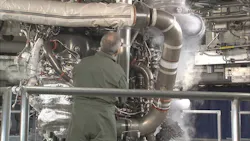
NASA’s Artemis II mission marks the first crewed journey beyond low-Earth orbit in more than 50 years. At the heart of the rocket’s performance is a finely tuned liquid propulsion system, where efficiency, thermal management, and precision control must combine in perfect harmony to launch and return the astronauts safely.
In part one of this series, we examined the core stage built by Boeing, and in part two, the solid rocket boosters from Northop Grumman that deliver the majority of the thrust at liftoff during the first two minutes of ascent. Part three turns to the liquid engines developed by L3Harris Technologies.
L3Harris Technologies’ RS-25 & RL10 engines
L3Harris Technologies is a U.S. aerospace and defense contractor, specializing in advanced communications, sensing, space, and missile systems for military and government customers. It was formed in 2019 via a merger between L3 Technologies and Harris Corporation. In 2023, L3Harris Technologies acquired Aerojet Rocketdyne, expanding into propulsion and missile systems and inheriting the Artemis project.
L3Harris Technologies built four RS-25 engines for the Space Launch System (SLS) core stage. The hybrid liquid hydrogen and liquid oxygen engines propelled the heavy-lift launch vehicle on its 8.5-minute climb to space, providing more than 2 million pounds of thrust. The manufacturer also built four RL10 engines for the upper stage, called the Interim Cryogenic Propulsion Stage, built by Boeing and United Launch Alliance, which delivers 59,500 pounds to the moon and will propel the Orion spacecraft, once the rocket boosters separate after launch.
The RS-25 is an efficient, high-performance liquid rocket engine, evolved from Space Shuttle Main Engine (SSME) that successfully powered 135 flights of the space shuttle. Combined with modern upgrades, the new RS-25 combines legacy hardware with additive manufacturing and digital controls for higher thrusting capability.
Innovations in industrial science: Liquid oxygen/hydrogen propelled engine, selective laser melting, and hot-fire testing
The RS-25 is a staged-combustion engine cycle powered by liquid hydrogen and liquid oxygen, making it one of highest performing engines the U.S. has ever made, producing approximately 500,000 pounds of thrust.
The SSME engines on the shuttle typically operated at 491,000 pounds of vacuum thrust (104.5-percent of rated power level). The required power level for the RS-25 engines on SLS is 512,000 pounds vacuum thrust (109 percent of rated power level). L3Harris says future evolutions will have even higher thrust capabilities. New RS-25 engines now in production will be available for the fifth mission and beyond.
RS-25 engine facts
- Each engine is roughly 14 ft. (4.3 m) tall, 8 ft. (2 m) in diameter, and weighs approximately 7,750 lbs. (3.52 t).
- Turbine blades power the RS-25’s high-pressure fuel turbopump, which produces more than a Corvette ZR1’s 618 horsepower, with an airfoil the size of a quarter.
- The thrust provided by the SLS RS-25 engines could keep eight Boeing 747s aloft.
- The RS-25 is so powerful that it could power 846,591 mi. (1,362,456 km) of residential streetlights.
- In the RS-25, coolant travels through the main combustion chamber in two milliseconds, increasing its temperature by 400 degrees Fahrenheit.
- Together, the SLS’s four RS-25 engines gobble propellant at the rate of 1,500 gallons per second during their eight minutes of operation.
- Hot gases exit the RS-25’s nozzle at 9,600 mph.
The initial Artemis missions will use a Block 1 SLS configuration, which can send more than 27 metric tons to the Moon and beyond. As SLS missions evolve, they will get more lift capability, up to 46 metric tons to go further into deep space. Starting with Artemis V, SLS will use a new RS-25 engine that will cost 30% less than past shuttle program engines through manufacturing process changes, design simplification, and supply chain modernization.
Previous RS-25 engines were reused, requiring teardown, inspection, and requalification steps for each flight, whereas the newest RS-25s are expendable and engineered for one lifecycle.
The most impactful process change is the addition of additive manufacturing. L3Harris has two decades of experience with advanced additive manufacturing technology for rocket engine and defense systems applications. The company says 3D printing can significantly reduce lead times on components, which makes products more affordable and opens the door for new design approaches.
NASA says one of the most promising additive manufacturing technologies used for the new engines is selective laser melting (SLM). It uses a high-energy laser and metal powder to produce parts quicker and at a lower cost than conventional manufacturing methods. The use of fewer separate parts simplifies the engine design, reducing overall manufacturing time and cost.
Test your Artemis II manufacturer knowledge.
Quiz: How propulsion manufacturing and safety systems support Artemis II
Need to study first? Read the article:
Between 2015 and 2019, NASA and L3Harris Technologies conducted a series of hot-fire tests at Stennis Space Center in Mississippi to validate upgrades, including new digital engine controllers, enhanced insulation, and operation at higher thrust levels—up to 109% for early Artemis missions and as high as 113% during testing to establish safety margins.
The engines exceeded their shuttle-era performance, culminating in the successful Artemis I flight in 2022, where four RS-25 engines delivered more than 2 million pounds of thrust with tight control tolerances and flawless command execution. By 2024, the remaining shuttle-era engines had been upgraded for upcoming missions, alongside the certification of the newly manufactured RS-25 engines following a final round of hot-fire testing, bringing total SLS-related engine testing to tens of thousands of seconds of validated operational runtime.
Read more about the manufacturers building the misison:
How Northrop Grumman advances propulsion manufacturing and safety systems for Artemis II
Inside NASA and Boeing’s SLS core stage build for Artemis II
About the Author

Anna Townshend
managing editor
Anna Townshend has been a journalist and editor for almost 20 years. She joined Control Design and Plant Services as managing editor in June 2020. Previously, for more than 10 years, she was the editor of Marina Dock Age and International Dredging Review. In addition to writing and editing thousands of articles in her career, she has been an active speaker on industry panels and presentations, as well as host for the Tool Belt and Control Intelligence podcasts. Email her at [email protected].