Predictive maintenance strategies can extend bearing life and catch problems before failure
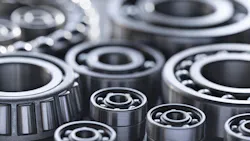
Bearing failure can cause costly downtime. In order to avoid this, bearings must be properly lubricated and free of contamination. Replacing them can be a challenge, especially if your maintenance techs work on older machines that may not have needed new bearings in a long time. Predictive maintenance can reduce that downtime. Plant Services spoke to Alex Thompson, director of product management at SKF, about how predictive maintenance can extend bearings’ lives.
Many organizations have a “fix and replace” attitude toward maintenance, says Thompson. This reactive maintenance is a habit that needs to be changed in order to improve bearing life.
Instead of handling each problem as it comes up, get into a habit of relying on equipment and regular inspection.“Let's install some equipment that's going to monitor it for me, instead [of] doing additional spot checks,” Thompson said. “A lot of times, we need to identify what is the most critical piece of equipment, because those are really the things that that we can't allow to fail in a plant.”
The most common causes of bearing failure are:
- lubrication issues
- contamination issues
- poor installation
- poor handling
- damage during transit.
Predictive maintenance prevents small problems from becoming large problems
Keeping those critical pieces of equipment running could mean adding sensors or setting a new maintenance or inspection schedule. Inspecting a bearing every two weeks is a good starting point to reduce downtime in the future.
Changing habits also requires time and support from facility leaders. How should maintenance managers present process changes that may look as if they take more time to do, with less tangible benefit?
Often the decision comes down to costs or efficiency. In order to push back on the economic factor, present data about the benefits of predictive maintenance.
“It can be a little bit about risk mitigation, too,” Thompson says. “What is the worst case and how to pitch that case, or [it] could be a supply chain risk that you could take a different angle from.”
For example, organizations could de-risk their supply chain by adding more vendors.
Manufacturers often don’t like hearing the advice to de-risk the supply chain with other vendors, Thompson says, but it could take “creative ideas with original equipment manufacturers” to avoid inventory economic pressure.
Increasing monitoring cycles and installing higher-quality bearings and seals could also address the problem of equipment downtime. In general, he says, companies should iterate on their reliability plans and improve them based on real data.
Predictive maintenance has long been helping manufacturers use equipment data to improve performance. SKF installed some of its own condition monitoring equipment in its main bearing manufacturing center in Flowery Branch, Georgia.
“It's caught spindles that were going bad before we even realized that we were going to have bad product going out of our door,” Thompson says.
Afterward, SKF workers sent the faulty spindle to get repaired and installed a spare spindle.
“The quality of our bearings and product that we're making never dropped because we caught [the] high vibration reading. We caught noise early in the process,” he says.
Ceramic and hybrid bearings offer “self-healing” benefits
Switching the type of bearing may also make a difference. Ceramic bearings are more expensive than their steel counterparts, and not necessary for all applications. However, they can make a difference in conditions where bearings may suffer electrical damage. If a motor often needs repair due to electrical damage, a hybrid bearing may cost five times as much but allow that motor to run for five or ten years without issue.
Ceramic-coated or hybrid ceramic bearings prevent electrical discharge because they’re insulators. Therefore, they won’t fail if they experience electrical arcing from a variable frequency drive.
Ceramic also has a “self-healing” property, Thompson says.
“It’ll roll over a piece of dirt particle and crush it and keep moving on, and it'll actually create an almost meteorite stripe into the steel bearing rings,” he says, “and because of how hard the ball is, it'll actually smooth it back out.”
As for lubrication, it’s an important part of keeping a bearing performing as long as possible and depends on many variables.
Different operations may manage those variables in different ways. Some might run a circuit to grease bearings once a month. Some like to squeeze the grease guns until clean grease comes out of the seals, although that can cause other issues, such as the seals might come off, exposing the bearing to a higher chance of failure in the long run.
If your operation uses oil to grease bearings, you should consider what filtration system is being used and how the fluid is kept clean.
In the paper printing press industry, for example, spherical roller bearings are the product of choice. Filling the lubrication hole is an important part of the maintenance cycle in heavy industries like mining or pulp and paper.
SKF is developing fiber optic sensors within bearings
A relatively new solution is fiber optic sensors placed inside the bearings themselves. Fiber optic sensing bearings from SKF have fiber optic cables embedded inside them.
“As things are rotating, loading, we are getting data, and we have proprietary software that will read these sensors,” Thompson says.
The sensor inside the bearing can take measurements that aren’t possible with farther removed sensors. The fiber optic sensing bearings can display temperature gradient measurement or clearance development (changes in the radial clearance, or the gap between rolling elements and the raceways) over time, and they can also help reliability professionals make predictions.
For example, they can predict what changes might occur in the next three years depending on the production schedule.
"[Let's say] I want to run this at 120 percent, and you can actually see, at a bearing level, what is the performance or what is the damage you are doing?” Thompson says. “Can I sustain this? Can I do this? Do I need to get something else in here in the next six months?’”
Fiber optic sensing bearings could also be used for determining the cause of a fault after a problem, which is useful for determining whether a certain situation voided a machine’s warranty.
There is a size limitation on fiber optic sensing bearings; they can’t be used in bearings smaller than 130mm in outer diameter, or 6 inches, Thompson says, because of the cables’ tolerances for bending. However, SKF has found success with fiber optic sensing bearings in larger use cases in prototype trials. Thompson expects the fiber optic sensing bearings to start sending back data from some manufacturers partnering with SKF on an initial run in October or November.
Bearings are tough; SKF found “90% of bearings typically outlive their actual equipment,” Thompson says. However, it’s proper maintenance that ensures that long time, and predictive maintenance can further improve bearing life and prevent more complicated repairs later.
About the Author
Megan Crouse
Megan Crouse has a decade of experience in business-to-business news and feature writing, including as first a writer and then the editor of Manufacturing.net. Her news and feature stories have appeared in Military & Aerospace Electronics, Fierce Wireless, TechRepublic, and eWeek. She copyedited cybersecurity news and features at Security Intelligence. She holds a degree in English Literature and minored in Creative Writing at Fairleigh Dickinson University.