Reducing energy risk in manufacturing: Low-energy strategies for critical minerals processing and industrial resilience
Key Highlights
- American Resources uses patented low-energy chromatography to reduce energy consumption in mineral separation, lowering operational risks and costs.
- Recycling end-of-life wind turbines and batteries helps recover valuable rare earths and battery materials, strengthening domestic supply chains and sustainability.
- Modular processing technology allows incremental capacity expansion, avoiding overinvestment and reducing idle energy use.
- Locating refining facilities near mines or end users cuts transportation energy, costs, and supply chain risks.
- Industry-wide energy resilience depends on collaboration and transparent communication among all stakeholders to align demand and supply effectively.

Energy resilience sits at the center of how American Resources Corporation (NASDAQ: AREC) designs operations, manages costs, and competes in energy-intensive industrial markets. The Indianapolis-based company, co-founded by CFO Kirk Taylor, operates across mining, recycling, and critical materials refinement, producing rare earth and battery metals essential to electrification and infrastructure. Its newest subsidiary, ReElement Technologies, specializes in refining and recycling critical minerals, including rare earths and battery-grade materials, using innovative, low-energy processes.
In industries where power availability and reliability are increasingly constrained, reducing energy intensity, designing scalable operations, and optimizing the supply chain are central to maintaining production continuity and protecting assets. ReElement Technologies is helping to rethink mineral processing, facility design, and supply chain strategy to lower energy risk, reduce costs, and strengthen domestic industrial resilience.
Low-energy processing as an energy risk strategy
One of the most effective ways to manage energy risk is to reduce dependence on energy-intensive processes in the first place. For American Resources and its affiliate, ReElement Technologies, that meant rethinking how critical materials are refined.
“The status quo in the industry is using high energy, high heat, high chemical concentrations to perform mineral separation,” Taylor says. “Our patented chromatography platform uses ambient temperature, low flow rates, and low chemical concentrations to perform physical mineral separation.” The result is lower energy usage and a fundamentally different risk profile.
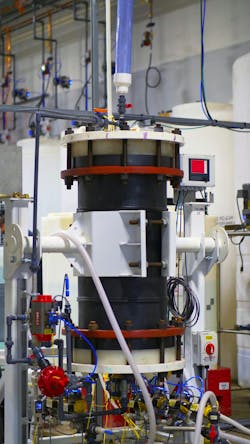
“We're using technology instead of resources to do the separation,” he says. “We chose a low impact technology on purpose because we saw the risks associated with rising energy costs and energy scarcity.”
Energy use in the process is also an important part, Taylor says. “If our energy input costs are artificially high, then it is going to make our output cost more. And so that's why we've chosen states to operate in that have relatively low costs,” he adds.
For manufacturers, the takeaway is clear: facility and process design have long-term implications for energy exposure and maintenance burden.
Recycling critical materials to reduce energy and supply chain risk: Why location matters in energy refinement
Ninety percent of battery and magnet-grade rare earths and critical materials are processed out of China, Taylor says. “China is a long way from the United States, and inherently, you're going to have a high cost transporting minerals all across the globe to China and then back here for use,” he says. It's also a challenge of supply chain and pricing consistency.
These critical materials are mined and recycled all over the globe, but very few outside of China refine it, Taylor says, and that’s where ReElement Technologies is working to close the local supply chain gap. “We focused on a cost that is at or below China prices, because we understood that no one in their own supply chains could really take a price shock of double the price of a raw input,” Taylor says.
Energy resilience is also tightly linked to material availability, particularly for rare earth elements and battery materials essential to electrification and energy storage.
“The rare earth oxides we're producing today actually come from end-of-life wind turbine magnets,” Taylor says. “Before we stepped into the recycling supply chain, those turbines were recycled solely for copper and iron for steel, and the magnet component was lost in the slag. That high value rare earth material was completely lost in the recycling process before we stepped into it.” This could ultimately make wind energy lower cost and more sustainable.
By recovering materials that were previously discarded, the company strengthens domestic supply chains while reducing the energy and environmental cost of mining new material.

Battery recycling as a supply chain and energy storage enabler
The same logic applies to battery materials and recycling. Taylor notes that the company recently completed a year-long validation process to recycle lithium iron phosphate (LFP) batteries—the chemistry widely used in energy storage systems.
“If I can take your end-of-life energy storage units and recycle them back to battery-grade materials, it’s strengthening the supply chain and probably lowering the cost,” he says.
To install a microgrid or use any transmission of solar or wind power, the facility will likely need integrated energy storage for those variable power sources. For manufacturers deploying on-site energy storage, recycling closes the loop and improves the long-term economics of resilience strategies.
“I’m not only strengthening the supply chain for critical materials, but I’m also lowering the cost because it’s cheaper to recycle than to go mine it all again,” Taylor says. “Things really start to stack up, and you start to build a lower cost, more sustainable supply chain.”
Modular processing and smarter capacity planning makes strong supply chains
Energy efficiency is not only about how processes run, but how facilities scale, especially in burgeoning U.S. industries. “One of the challenges with large industrial processes is you normally have to build to nameplate capacity,” Taylor says. “So you're incurring holding costs and energy costs for underutilized assets.”
ReElement’s modular technology approach allows capacity to be added incrementally, aligning production with actual demand. “Our technology allows you to incrementally add production without overpaying for capacity when it’s not used,” Taylor explains. “That way we're scaling smartly and not adding redundant cost.”
For plant leaders, modularity reduces both idle energy consumption and the reliability risks associated with oversized, underutilized systems. The modularity of the technology helps scale globally too, depending on where material is mined. For example, when working with a lithium miner in South Africa, does it make sense to ship mined rock across the Atlantic? Or does it make more sense to take the technology there? “Now, I’m only shipping pure lithium carbonate across to battery manufacturers,” Taylor adds. “Now I’m reducing the cost and energy usage of the transportation stage of the supply chain.”
ReElement Technologies interacts the same way with customers. Transportation and logistics represent a significant energy cost in global supply chains, particularly when raw materials are shipped long distances for processing. “If we can co-locate with a magnet producer or battery producer, there’s optionality to fully integrate into their production line, so I don’t have the energy cost and the labor costs of shipping material, packing material, unpacking material. I take out all those costs,” Taylor says. “Now I’ve started to build a more resilient, lower cost supply chain that can compete globally.”
Co-locating refining operations near mines, or near end users like battery and magnet manufacturers, can dramatically reduce transportation energy, handling costs, and supply chain risk.
Collaboration and transparency will align energy demand and supply
Taylor emphasizes that none of these strategies succeed in isolation. Energy resilience depends on collaboration across utilities, manufacturers, material suppliers, and recyclers. “Production needs to match up with demand, and that only works if everybody’s transparent,” he says. “It needs to be a collaborative approach.”
Clear communication about demand profiles, expansion plans, and energy needs enables smarter infrastructure and investment decisions across the ecosystem.
About the Author

Anna Townshend
managing editor
Anna Townshend has been a journalist and editor for almost 20 years. She joined Control Design and Plant Services as managing editor in June 2020. Previously, for more than 10 years, she was the editor of Marina Dock Age and International Dredging Review. In addition to writing and editing thousands of articles in her career, she has been an active speaker on industry panels and presentations, as well as host for the Tool Belt and Control Intelligence podcasts. Email her at [email protected].