Podcast: AI adoption in manufacturing maintenance - stories from the field
Key Highlights
-
Supply chain volatility is forcing manufacturers to rethink MRO planning, prioritize critical assets, and adjust inventory strategies.
-
Standardizing spare parts data and naming conventions improves visibility, reduces downtime, and strengthens purchasing leverage.
-
Leadership during volatility requires maintaining continuous improvement processes instead of reverting to reactive maintenance.
-
Strong culture and frontline engagement help maintenance teams identify operational issues before they reach executive levels.
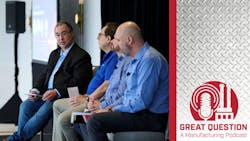



In this episode of Great Question: A Manufacturing Podcast, IndustryWeek's Dennis Scimeca hosts a roundtable discussion on the impact of AI on supply chains, maintenance and production.
The discussion was held as a panel at the annual Fluke Xcelerate conference, an event centered around industrial maintenance and asset protection. Joining Dennis were three professionals from three very different industries:
Below is an excerpt from the podcast:
Dennis Scimeca
So let's start with introductions. Jason, right, you have a look for us. Tell us a little bit about yourself, your background, and how long have you been using eMaint?
Jason Hahn
Okay. Well, I'm Jason Hahn. I work for an advanced engineering small group. In that role, I'm the global reliability and systems manager. So I'm basically put together all the processes for our maintenance groups. Within Amsted Industries, this is on the automotive group of that, which brings up about 14 different locations throughout the kind of globally. Spent a lot of time in Mexico. I've been with eMaint since about 2019. So I was the first pilot site there at the time, and all this had up kind of near that time. But I've been in industry since I was 19 years old, so I've been doing asset landed away for a while.
Nathan Kibert
My name is Nathan Kibert, I'm from Eaton Corporation. Been in maintenance, I started out as a maintenance guy probably 25 years, so I'm one of the guys that has worked my way up to the field when it's supervision and the management and didn't realize how the inadequacies of maintenance systems affected my ability to be able to manage business. And so I became a little more shifted and managed that as I transitioned from tier 1 automotive from Michigan. So, and transferred into Eaton's mobility function there. Eaton has a lot of different divisions from electrical to aerospace to mobility group and the e-mobility group as well. And so they both won (with some evaluation) eMaint in 2022. at our facility at our grounds in Marshall, MI, between research and development there.
Lee McClish
My name is Lee McClish. I'm the director of maintenance liability for NTT Global Data Centers. It's like the Japanese AT&T. So we have like 21 data centers in the U.S., over 155 globally. So we use eMaint primarily in the United States. We started it in the summer of 2017 and I've done a lot with it. We've enjoyed it. It's a great program and we've done a lot to try to make them more reliability friendly over the years and whatnot. So that's neat.
Dennis Scimeca
First question, Jason, I'm going to keep starting with you because I know you. Supply chain volatility looks different in all of your industries. What are three things that draw supply chain issues?
Jason Hahn
So COVID seems to be like this weird thing we talk about in your industry a lot in the on-load manufacturing industry. Pre-COVID, you can set up a system set up min-maxes, and feel pretty comfortable with lead time & pricing, it would go up to 3% per year. And that was pretty much an expectation. Post-COVID, and then we got into the chip shortage. Right now, the price of our steel, the price of some of our tooling, and in some instances, I'm seeing things increasing 40, 50, 60% on some, and lead times are just literally all over the place. So all of our expectations for managing like a parts credit for MRO, good luck with that. It's a huge challenge for us right now. Essentially what it forces us into doing is any PIR he's written for expectations of pricing or even people who still distribute those items you basically have to start over post-COVID is what we're seeing. And so, don't exactly staff up or we don't have a plan for what that is. So we're basically taking and, you know, look at your critical equipment list. So you both sewn the most critical parts burst and trickle your way down.
Dennis Scimeca
All right, Nathan, you're up. What are three things, 3 main supply chain challenges. Anything in common with Jason?
Nathan Kibert
Believe it or not, as large as a company we are, we have 90,000 employees, what we're finding going into clients, if we do not have a robust MRO system at all, not standardized, that's not, in fact, we're seeing Excel spreadsheets, we're giving up and we're contracting out to vendors like Ballin and Motion. If you haven't dealt with them, it comes at a high premium. So we add those staff your crib and they'll charge you 30% and you'll buy all of their spare parts. So they happen as a captive audience at that point. So that's probably the weakest part is not adding the system.
One of the things that actually attracted us to the eMaint system is that ability and that ability to do it in the mobile function and for cycle counting. Because we want to create, our goal is we really love the global function on spare parts, but where it really pushed us is we don't have a standard naming convention for parts and a standard way to purchase. If you go to Germany, you buy direct from the manufacturer. If you buy from the US, you have to buy from the supplier. right? And we don't have a standard part number. So we saw a different supplier part number. Grainger might change their part number. McMaster-Carr might change their part number. Some, maybe to keep you as a captive audience, I would know that for sure. But what we're finding is we needed to come up with a standard mainly convention for spare parts. And so that global list meant something because We feel like that we can then leverage our buying power, then leverage downtime, then leverage stock quantities that we have to carry on hand because we will have the visibility of where those are. And the new functions where in MRO, where you're able to transfer site to site is big for us as well. But it just takes that next step, that next question we were going to ask and answered it in advance. but he maintenance.
So MRO is big for us. In fact, we see, I think when we looked at it, the industry average, if you don't do MRO, you're going to save 38%. And so even in our less aggressive model, we're planning on saving point percent off our MRO just by not doing it and doing it with the system and cycle counting. So that's what I, our biggest thing we see from that.
Dennis Scimeca
All right, Lee.
Lee McClish
Hey, in fact, I heard about the big boom in data centers. So we're going to add six more data centers in the United States just this year. And when you got like Microsoft, Google, Amazon, all these big players, it's really a chore for people. They get our name in the loop there somewhere. You know, so we're looking out a couple years, you know, planning on what markets we're going to break into. So it's just a challenge just for that, to go buy generators and UPSs and batteries and all that stuff. So much, at least like in one site, we ended up splitting, we got half Cummins generators and half Kohler generators. Sort of liability point of view that you got to have double spare parts, you know, you got different skill sets, people learning two different things. So even though we met the need, you know, the impact on our liability isn't always seen by folks.
Another thing in data centers, there's a lot of electrical equipment, right? So obsolescence is a big deal. You look at PLCs, VFDs, you know, power supplies, make it 10, 15 years. Our oldest data center is 25 years old now, and you can't go in and like just change all the UPSs in one year. Because you have, well, some of our newer sites, we have like 45 generators, UPSs, a lineup, so you get up to 100 megawatts of power. So you got to really plan all that out. So that's another big supply chain thing that we deal with.
Dennis Scimeca
What's the trade-off you're most frequently forced to make right now? Cost versus reliability? Speed versus safety? or standardization versus flexibility?
Jason Hahn
No, I'm good to go. Cost versus reliability in the automotive industry. When you're a manufacturer of automotive, it's easily tough. I mean, you take safety critics that are manufacturing plans, so the cost of reliability. We target a five-year plan with capital, and that's typically, we'll just save for easy math, it's 3% of top line. downloaded and she does back in the capital. The problem is, that let's say you're a typical factory and you're looking at about a 1.7 to $2 million CapEx spend for the year with that 3% at a smaller facility, that used to go a lot further than it does today. Like I'd mentioned with EMRO, same thing's happening with, you know, equipment rebills. So if I'm forecasting, rebriefing the furnace, or doing a slide job on one of our coal farmers, those costs used to be $300,000 pre-COVID. Post-COVID, those same costs now 3/4 of $1,000,000, do the same project. So what we're finding ourselves right now in the industry doing is a lot of our redundant systems where you knew we had a backup machine, we're finding ourselves relying on a single asset and the other one's part because now we're having to push off a lot of those rebuilds. And a lot of you got to. So cost over liability is a huge one.
Nathan Kibert
Eaton has always swung to the end where we want to be unreliability. We are, you know, I don't know if you bought any of our Cummins enduring transmissions or if you're bought any of our electrical switch geared, we don't claim to be the cheapest. You try to order a transformer, you're going to wait 60 weeks, but people will wait 60 weeks. We have the fastest technology hung a switch gear for a transfer switch, and there's a reason why people wait for quality. So we always choose reliability over cost.
Big thing in our facility, because we are, we're in research and development. You know, if you buy one of our Cummins, Eaton transmissions, you're going to get a 750,000, a million mile warranty on it. But it's not the cheapest one out there. So cost versus reliability there.
Standardization versus globalization, like we talked on MRO, how our pursuit there that is, we feel like it's going to make us better on engineering standards, and Eaton is heavily engineered based, finding the most reliable, the best thing out there, that's our goal. But we feel inside of maintenance systems that we even saw it if we tried to standardize maintenance best practices. I mean, we're going to take a huge swing with eMaint because we were seeing we didn't have standardized maintenance practices. We didn't have robust engineering standards. And so we are going to even do that all through our eMaint system where we're standardizing globalized reports by grouping for business functions. And we're going to allow that customizability at the plant level to let them manage the business. So it's a little excited.
I got here early last night and walked around and we talked. There's an AI booth and I was excited that you're starting with reporting on that because to me, that means that when I'm watching my plants, that the plant can use AI to design a report to manage their business level better. Like we have a filtration plant in Germany that does stuff differently even than an electrical transfer switch program in Nacogdoches, Texas. So they need to be able to manage their business better and that was foundational when we were choosing e-maintenance, right? I mean, the work order generation part was the best, but like the customized ability was good, but we need to have standards too. So It's a tricky, tricky thing at first, and we wanted to lock them down on the globalization.
Lee McClish
The big thing in data centers is time to market, meaning we pre-sell buildings. You know, we got it down to nine months. Once we start, you know, digging dirt, you know, until you get the first customer on. And we may have 6 vaults, we have 10 vaults. So we always get a customer in one of them. We keep progressing through. So part of that's design. So one thing they've done is they take these CONEX boxes, we call them electrical modules, and they build them in a factory with batteries and UPSs, ship them in, we set them down, run wires into the building. Takes a lot less time. building all inside the four walls. So that was a big thing for us. And then you got all of them, getting all the asset information and create PMs and get contracts and all that. So a lot of work. We keep adding six buildings a year.
Dennis Scimeca
Well, this is a leadership conference. Let's focus on some leadership programs. Jason, what leadership habit has become non-negotiable for you in high volatility environments?
Jason Hahn
For me, it's encouraging initiative or encouraging continuous improvement. What happens when things start to, when the wheels start to fall off the bus, I guess, or there's a positive as you're saying that. What I have a tendency to do is kind of abandon all of the work we've done with putting in technology and putting in our sustainable processes. And we just have a tendency to slide back a little bit and just go fix the machine and turn back into those, firefighting modes real quick. And so when things start to get a little hairy and money gets tight and downtime, you start to, there's problems.
Encouraging your team to stick with the continuous improvement initiatives and stick with the process, stick with the technology, continue to drive root cause corrective actions. Get that data and keep your work order, you know, entirely clean. Don't abandon everything you've worked for up to this point because that data during those weeks and longs for how long that train's going to be. That information for me and my role is more important than any other time. And so learning from those situations is the most important. Sticking to the program and not sliding back into continuous improvement continuum.
Nathan Kibert
Probably a little more, probably, I think, transformational leadership. I think, but the first thing to me is that I need to be present, right? I mean, even If I'm out of the hands-on day-to-day, just your presence there to be to begin with, but then an awesome training thing, and we talked, Jay had some good points. It had some, good points about people buying in and not showing, or where they show up to work, it's they won the lottery. A big part of that is in those trying times, it's just asking your maintenance guy, what do you think that we ship it here? Rather than being traditional, more transactional, you know, coming down and telling them how to do it.
And they'll be muttering, you know, that this machine kept going down for three weeks and wanted me to do the same thing, but I'll do the same thing because you're my boss. Or if you ask them, what do you think needs to be done to fix it, right? And they might get it back up and running, but they're going to have some thoughts. And they're going to start taking that ownership. And they're going to start wanting to show up to work, you know, even if they win the lottery. And I think that Eaton has done good on that in their modeling when we talk about that. And I would show up for work if I won the lottery because I've been passionate about maintenance and maintenance systems because I was a maintenance guy, because I struggled at the maintenance manager.
There's that age-old production says that what's downtime and maintenance says what's downtime. And these are tools to help maintenance managers. The mobiles are to help the guys on the shop floor because guess what? They see these things before part of the digital fluency that they will have is they see these things before the plant manager sees them in the KPI reports. You know, how many times you've been in them Gemma locks, the plant manager is walked around asking questions of why these machines been down. And they said, this maintenance guys told me that this has been doing this for three weeks. You know, so the maintenance guys will know when you let them take ownership of it. then I think that's part of moving towards transformational leadership there, away from transactional.
Lee McClish
Yeah, I'm in more of a strategic role now than I used to be. And so what I think of is the long term, like, okay, I'm set up this reliability program, you know, I need to know like meantime between failure and all these different liability things. And I get questions like, well, why don't we add this? Why don't we add that? So take an example of PMs, overdue PMs is a thing that you should track. Well, when we first got to the company, there was like, no due date. I'm like, well, you kind of need a due date. You know, what was this thing to do? So we added that. We set all that up. And the next challenge was setting the time frames, right?
So I go to all my directors and operations. They, you know, these are the time frames. And normally it's 10%, right, is the range. So you take an annual PM, you have a 36-day window to get that done. And I wasn't going to cut it. So the one thing, a lot of people in my company were in the Navy, and they'd say, well, you go to NASC and they give you 180 days. And so I told them, I said, well, data centers don't go out to sea. We don't need 180 days. We can schedule this stuff. And so we end up landing on like a 90 day window. I'm like, okay, I'll compromise. We'll cut it in half. And even doing that like a monthly PM, when you get that done, well, they think, well, I have three days. You go, yeah, and you do it on the 29th, and then the next month you do it on the 1st. It's not a monthly PM anymore. And I even have my boss come to me like, you know, we really need to look at this and come up with some compromise. I said, no, I can't do it. a monthly PM is a monthly PM, and you got to have a certain space between it. And so we had KPIs that started that. It was like almost all red in the beginning. But within a year, we're almost all green. So it just took a while to explain it to people and do that kind of a thing. So that's the kind of long-term vision I want to maintain in some of our programs.
Dennis Scimeca
Before a disruption becomes visible at the executive level, what are the first signals your frontline teams notice?
Jason Hahn
Usually when it gets up to that level, a lot of, we've gone over by that time. And so, what we end up saying in the automotive industry is we say the cornerstone of manufacturing is following processes. And so, when the systems start to break down and communication breaks down, And all of a sudden we don't have, when you start seeing systems literally shutting, like your spare parts programs, your CAM programs, all of a sudden aren't being followed. Maybe you're pencil whipping with PMs and now it's, when the systems start to break down, your maintenance guys know it, they feel it, they're part of that. And when the communication isn't there and whatever it is. So short answer is, when your system, when you start seeing systematic systems showing failures within your systems, not necessarily on your equipment, but on the processes that you have in place, that's usually your opportunity to grab onto that before it gets the executive team is to get those things back into place. And then you're usually able to either communicate or to address it ahead of time. But yeah, usually when they, when my frontline guys start noticing, the process is breaking down. That's when we get in a lot of trouble.
Nathan Kibert
I think that your frontline notice your culture fit first. Now, whether it be in a good way or a bad way, they notice the culture shift first. You can preach culture like they talk about, Jay talked about, that it's on a sign on the wall when you come in and teamwork is, and transparency is, and, you know, your team will see that culture shift and then they will start, you know, inadvertently at first pulling away from buying in to what you have for, you know, as far as being more transformational in the leadership portion. So they see the culture shift first. And so then before he gets the KPIs, because sometimes leadership is focused on dollars, we realize that that's what pays the bills. But if you don't take care of culture first on there, then I think that that's, it's going to hurt you in the end and that's what becomes visible first. They see it.
Lee McClish
I think what's visible, the first thing is at what level did this become known? It's a director level, manager level, is it the VP, the CEO? That's the first thing that gets their attention. Then it may be I've been telling them about this for a month. this has been a problem. So I think it's a kind of a latency mode, like what are they really going to do to correct this and take care of whether just immediate or the long term and kind of put it to bed?
Dennis Scimeca
Time for one more. What question should frontline leaders be asking their teams right now, but often aren't?
Jason Hahn
So one of my favorite questions, my guys, typically it would be around their you times, things like that, is for those of us who've all been to a leadership training, our mission or part of what you're supposed to do is to seek feedback. And one of my favorite ways of seeking feedback is I would look at a team member and I'd say, okay, tomorrow morning when you come in this work, this is your department, you have my job, you're the boss. What is the first thing you're going to change? That way I'm not trying to silo them to one. Just look, what is the number one thing you're going to change tomorrow when you come in tomorrow? And it's your department. Usually the first time I ask them that, they a little like, they don't really know how to answer that question the first time. But I ask them again the next preview. And now they've had time to soak on it and think about it a little bit. And I do generally get really good feedback from my guys on things I could do better as their manager, their leader, or things in the shop that we've neglected that weren't maybe a priority for me. And they made their job much harder than it should be. And so that's my favorite question now.
Nathan Kibert
I think for us, and it is asking your associates, quite often we get into these plans where we do these reviews and we tell them what we want them to do and not listen to what they want to do. I think that even as a culture shift, we're going to try to change the paradigm on. And again, I'll refer to Jay. I like his speech there. is that we're going to try on the other, especially on the skilled trades division, is we're going to try to hire for culture fit first. And then we're going to be able to train them. You know, if I get a young kid out of this tech center that wants to be a maintenance guy, you know, I'm going to be able to see in the first couple of years that he's a year, even if I do them internships, which I think are valuable in the college and the summers of high schools to sort of get, is this a kid, first of all, in this culture, and I might be over generalizing, are they going to show up for work right now? Are they going to show up for work and are they going to be invested? And you'll be able to tell if their culture fit, and then we're going to train to the skill, right? Because if we need to be adapted for AI, then we need to be, like he said, the job description's been changed. If I need his job description to change, he's got to be a cultural fit already. And so I can train him and I can let him be invested into where he wants to go, where he sees himself moving, if he's a culture fit first. If we try to be the highest bidder, especially on skilled trades, right now you're going to get probably 70% of what you need. And that guy's on the market for a reason. you're not getting the best of the best out there, and then you're going to be the highest bidder. You can compete with another company that's $2 or $3 an hour difference from you if it's a better culture fit, if you'll show up for work when you win the lottery, right? So we're going with culture fit first, then we're going to train for it because then we're more adaptable moving forward into the future.
Lee McClish
I always ask myself, what can I do to make you more successful? And it really starts in a good dialogue. I learn what their priorities are. Is it training? Is it being part of a team? Just the company culture and whatnot. Then I ask, what do you think we should be doing differently? So it just really kind of opens up a whole conversation. I always learn something from them and I take notes.
Dennis Scimeca
That is time. Jason, Nathan, Lee, thank you very much.
About the Podcast
Great Question: A Manufacturing Podcast offers news and information for the people who make, store and move things and those who manage and maintain the facilities where that work gets done. Manufacturers from chemical producers to automakers to machine shops can listen for critical insights into the technologies, economic conditions and best practices that can influence how to best run facilities to reach operational excellence.
Listen to another episode and subscribe on your favorite podcast app
About the Author
Dennis Scimeca
Dennis Scimeca is a veteran technology journalist with particular experience in vision system technology, machine learning/artificial intelligence, and augmented/mixed/virtual reality (XR), with bylines in consumer, developer, and B2B outlets. At IndustryWeek, he covers the competitive advantages gained by manufacturers that deploy proven technologies. If you would like to share your story with IndustryWeek, please contact Dennis at [email protected].