Podcast: The impact of footwear on managing workplace heat, fatigue, and safety
Key Highlights
- Hydration, scheduled breaks and environmental controls remain the foundation of effective industrial heat-safety programs.
- Properly fitted footwear reduces fatigue, supports whole-body health and helps workers perform safely in demanding conditions.
- Smart PPE and wearable sensors can identify heat stress early, enabling proactive intervention before incidents occur.
- Strong safety culture, training and coworker awareness help prevent heat-related incidents during peak summer operations.
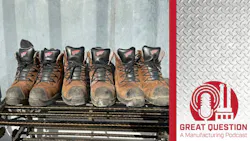




In this episode of Great Question: A Manufacturing Podcast, Plant Services chief editor Thomas Wilk talks with Tito Warren of Red Wing Shoes about the challenges industrial facilities face in protecting workers from heat stress during the summer months. Their conversation explores the role of hydration, environmental controls, PPE, and emerging wearable technologies in supporting worker health and safety. They also discuss how footwear affects fatigue, endurance, and overall physical performance, while highlighting the importance of training, teamwork, and proactive safety cultures. The episode offers practical insights for manufacturers seeking to improve worker well-being and operational performance in demanding environments.
Below is an excerpt from the podcast:
Thomas Wilk, Plant Services: Hi everyone and welcome to a new episode of Great Question: A Manufacturing Podcast, brought to you by Endeavor Business Media's Manufacturing Group. I am Tom Wilk, the chief editor of Plant Services, and with us today for a special summer episode is Tito Warren and he's the president of Global Industrial at Red Wing Shoe Company. I've been observing Red Wing shoes for a long, long time. I wore them when I was a cart pusher back in one of my first jobs out of high school. Our managing editor uses them, her husband uses them on the job, he's a carpenter. And today we're going to talk with Tito about overcoming gaps in warm weather safety strategy for industrial workers, and it's not just about the shoes. So Tito, welcome to the podcast.
Tito Warren: Thank you very much. It's a pleasure to be here.
PS: So here we are. As we record this, it's May 19th here in Chicago. We just had a couple of 80+ ºF days, and it's going to be even hotter anywhere south of here.
TW: Here it comes!
PS: We were talking before we pressed the record button about the fact that Red Wing's got facilities all over the world, not even just the U.S., and that heat in the summer is a real situation to be dealt with, accommodated, and managed, right?
TW: It is. In so many of the areas that we work in the world, high heat / high humidity is kind of our nemesis. And so when we are designing and developing solutions for industrial workers –
industrial athletes – it's really around how do you mitigate that kind of pressure, that kind of environment so that people can perform to their best ability? And it is a never-ending quest because there are so many things that go into it from environment, from materials, from the solutions that you develop. There's so much that goes into it.
PS: As a former educator, I was always taught to say three nice things before you start criticizing what people might be doing. So let's start with the positive when it comes to how plants handle heat in the summertime. In your opinion, you mentioned that heat is more complicated than it looks. What are the things that plants in your experience tend to get right about managing the summer heat?
TW: I think that there's been a great shift, let's say over the last 10, 20 years, where it's important to hydrate. I mean, that's the big one, right? It's hydration, hydration, hydration. You've got a lot of focus now on ambient control where it's possible. If you're working inside, how do you manage ambient control? And then obviously there's that piece around scheduled breaks, inside or outside, and being able to make sure that people are taking appropriate breaks when necessary and that monitoring, right? I think that those three things that they've done really well has moved the needle into a lot of other aspects on how do you build on those, right? How do you build on the big three?
PS: That's interesting. I'm living this right now. I've got three boys at home now, two in middle school, one in high school. I swear, I'm tripping over water bottles everywhere, and that was not the case when I was their age. I don't think in the professional world either. So it's good to hear that hydration is really caught on as a necessity.
TW: Yeah, it's true. And again, I think it migrates from professional sports or just athletics in general. The hydration piece, when we were growing up, it was, oh, you know, consume a bit of water, get some Gatorade on board and you'll be fine, throw them back out there. And now, the technology in just how do you prep the body for, pre-, during, and post-athletics or work, it's all part of a strategy, right? There's been a lot of work done in the physiology side, the biomechanics side on how to prep the body. It's a tool, it's a machine, and so you've got to train that body to be able to withstand the rigors of whatever it's going to be put in front of.
PS: I noticed in the list of things you mentioned that you see plants doing correctly, one of the things that wasn't on the list was everyday gear and the way people can prepare based on what they're wearing to manage the heat. Let's talk about that. What are some of the gaps that you're seeing in the strategies that plants deploy when it comes to the gear they're wearing? What stuff is easily missed, or things that you think can be improved?
TW: Well, I think that you've had an evolution, specifically in gear, and that's in clothing and footwear, general PPE in all aspects. I think that's evolving, this aspect of your approach to high heat, high humidity areas has really has really changed dramatically in five or 10 years and it's accelerating because of the use of lightweight materials, synthetic materials for clothing, the importance of making sure that the body is actually cooling itself. You have to be able to prepare and facilitate the body's natural ability to regulate temperature.
And so how is science now developing things that enhance the body's natural ability? When you think about gear, we see so many great things that are coming out and even the advent of smart gear, where gear is being hooked up to the body to monitor how somebody is performing. So biomechanics, you kind of get into this discussion now where, is it Big Brother watching you and all of that kind of stuff. And it's an interesting environment where you're trying to balance the good of the employee versus the overwatch and the things that they get into that. But society is wrestling with that, and smart gear or biomechanic monitoring is a frontier, a new frontier.
PS: I’m glad you brought up the biomechanical gear because there were some sensors that I had seen a couple of years ago where they were asking some workers in the field to wear them just to make sure that no one had, say, fully collapsed out in the heat. And it was a challenge because depending on what kind of environment you were in at the plant – was it union, was it non-union? Were people in the legal team, no matter what the union status was, were they aware of possible HIPAA violations and did IT know the security protocols? It's complicated.
TW: It's really complicated, right? And if you can just go back and anchor to the point of health and safety, and you can focus on that and then I guess let the let the lawyers of the world try to figure out the rest of it, hopefully we'll land in a good spot. But there's so much great technology out there today. I mean, we've seen things that have migrated from hospitals, remote sensing where you can monitor somebody when they're when they're beginning to show fatigue, beginning to show stress. So it's a proactive approach rather than a reactive “hey, John just collapsed and his heart rate is X on the floor” to “hey, John is starting to fatigue, let's get him some water or let's get him into a cool spot” so that you're being proactive and you're monitoring the situation. And again, I recognize it's a balancing act, because everybody's different, everybody performs differently, so how do you make sure that you're not stepping on people's rights and impacting their individualism as a worker, right? You’ve got to protect both sides.
PS: You do. That proactive approach, I think that's going to register with a lot of our asset management professionals who are being introduced to a lot of technologies which can help more proactively manage machine health. Why wouldn't you want to proactively manage human health, as long as you can solve those privacy issues and cover yourself there too?
TW: Exactly right. It's the new frontier, it really is. It'll be really interesting to see how society embraces that and where it goes and the technology that comes out of it. It's very exciting stuff.
PS: We're talking about smart tech as one of those issues which isn't specifically environmental. Are there environmental factors out there which can surprise plant teams by causing gaps that some other plant teams would otherwise see?
TW: Yeah, there's lots of stuff that's out there. When you're depending on the facility that you're in and it's, you have machinery that's working, that's throwing off heat, you've got the ambient temperature in the facility, you've got airflow, all of these different kinds of things that will impact somebody's ability to, for the lack of a better term, just stay performing, right, and be able to recover from stress or from fatigue. There's a lot that goes into it, it's not just “well it's hot in the facility,” there's lots of things that are generating heat. Is it a high humidity facility? Is it a is it a dry facility? All of these things go into, fundamentally, is your body able to use its natural ability to cool down? That's what it is: how do you facilitate your own capability to react to that environment?
PS: Let's talk about the shoes specifically. My buddy Bob had a saying, and he always said, “you always want to go as deluxe as you can on two things in your life: a bed & mattress, and your shoes, because you're either in one or the other your whole life.”
TW: Your whole life. That is true.
PS: That stuck with me for 40 years. And so let's talk about the connections that you see as a shoe professional between footwear and human health, issues like heat retention, comfort, endurance for workers. What are some of the connections you're seeing between how shoes themselves can really make a difference?
TW: Footwear in general, is the foundation of what you're on all day. It's your foundation. And that foundation really enables the rest of your body to do whatever it's supposed to be doing. So when that foundation starts to fatigue – and that can be by heat, that can be by load stress, that can be by a variety of things – that base, if that base starts to weaken, then the rest of the core begins to weaken.
You think about footwear as always that, okay, we're going to start at the base and build from there. Again, it boils down to fatigue. When people are fatigued, that's when things happen, that's when you have situations that you just don't want to happen. And so if the body is fatigued, whether your feet are hot or they're tired, more than anything it will radiate through the rest of your body, and that's where we're going to run into problems, right? Because your body's fighting against all these different things to try to regulate. It's one more thing it has to try to regulate, which is at the base.
PS: Yeah. I'm a long distance runner, or used to be before my knees got too old for it, but I remember clearly halfway through a long race, if your shoes start giving up, if you start feeling the heat of the pavement, you're really in trouble. And that's for fun – I can't even imagine you're out there for six to eight hours in a day working and you start feeling the heat of the pavement or the field you're in.
TW: Well, again, industrial workers are athletes, right? That's how I connect the dots with them. When you look at high-end sports or rigorous sports, those same things apply to the industrial environment. If you've got great footwear, then your base is solid and you can begin to work on everything else. But without that base, you got a problem, right? It's so important to have great footwear because the rest of your body is so impacted by what happens at your feet – your knees, your hips, your back. It radiates throughout your entire body.
PS: That is really insightful. I'm thinking too, in a very different context, the moment when you're at a trade show and you step on one of the areas that's carpeted with upholstery underneath and with a little foam, you feel it right away. And this is in a comfortable air conditioned environment and your body feels it right away after walking on the hard cement or a thin carpet for a long time.
TW: Well, you go to these trade shows for a day, (as someone who works) in an office environment, it is probably the closest that I get to understanding the rigor of industrial work because when you stand on concrete all day and that shock and that constant grind on your feet, I can be at a show for 10 hours and the rest of my body's okay, but man, if I'm just not in the right footwear, my feet, that's the first place it hurts. It's just going to radiate from there, and it will drain your body. It fatigues you for the rest of the day or the cycle that you're on.
PS: Just to underscore what you're saying for everyone who's listening, don't overlook the power of shoes clearly to build the foundation of effective safety wear, PPE wear during especially the summer turnaround season we're all facing right now.
TW: The footwear that you have, number one, it has to be the right fit, right? Fit is critical. And then the materials, you know, we talk about fit, form, and function, right, and fit, form, and function when you are picking your gear, your PPE, is it the right thing for the right environment that you're in, whether it's you know hot, cold, humid, whatever that environment is, do you have the right gear for your body to be able to function correctly in that environment? There's a lot that goes into footwear, making footwear, to withstand those rigors. The engineering behind that is all around making sure that you're not going to fatigue and that the rest of your body is going to be able to function as well as your feet are if you've got the right gear on.
PS: Tito, we'll get you out of here on this one. What other advice would you give to maintenance crews, especially the asset managers of the world who will be working out under hot summer conditions, whether outdoors or indoors, especially entering the July turnaround season. Any advice you give them on apparel and working with the heat to help keep the machines going under these conditions?
TW: In general, making sure that your body is able to function correctly, everybody talks about lightweight clothing, you have these synthetic materials and all of this that are actually, they do the exact opposite of what you think that they're going to do. So making sure that you have clothing that is actually wicking moisture and ventilating your body effectively is critical. Cotton or cotton type products are just so fundamental in making sure that the body is able to naturally cool itself with moisture. That ability is critical.
The other piece that I kind of rely on is team, right? I mean, we talk about that industrial workers are athletes and making sure as a team, I think that this is something that's really coming to pass now is that teams are watching each other and supervisors are involved. So if you see a partner fatiguing, if you see a coworker fatiguing, don't just let it happen. Fatigue is something that gradually comes on, right? And so making sure that people are watching each other, watching each other's back, it's a team and making sure that you're covering your partner's back is an important aspect of this. I think that's fundamental.
And you know, the other piece I think is just training, making sure that people understand what heat exhaustion actually what it means and how it comes on and how do you proactively manage that, making sure that there is a good rigor or regime around training people about the environment that they're in, the things that they're going to be exposed to, how to mitigate heat stress. It's critical in the training or onboarding of a new employee, acclimatizing people is really important as well. And I think that that acclimatization training, bringing that person on to the environment that they're in, is really critical.
PS: I appreciate all that, but especially the culture aspect, because if you can set that cultural tone to where you don't have to be a hero out there in the heat or a survivor in the heat, if you're encouraged from the jump to watch out for each other, that's going to make a huge difference.
TW: Yeah, yeah. It's not about being the rock star, right? Everybody wants to be that guy or that person. It's how do you make sure that the team, everybody around you, because if you have an incident, then everybody goes down, right? No matter what happens, now you have a lost time incident, and so you’ve got to deal with that. So the team aspect of this I think is really important. It's appropriate.
PS: Excellent. Tito, thank you so much for being with us today. I appreciate your insights not only into apparel and shoes, but into health and safety in general. Thank you.
TW: The pleasure is mine and I look forward to catching up with you soon.
About the Podcast
Great Question: A Manufacturing Podcast offers news and information for the people who make, store and move things and those who manage and maintain the facilities where that work gets done. Manufacturers from chemical producers to automakers to machine shops can listen for critical insights into the technologies, economic conditions and best practices that can influence how to best run facilities to reach operational excellence.
Listen to another episode and subscribe on your favorite podcast app
About the Author
 Thomas Wilk
Thomas Wilk
editor in chief
Thomas Wilk joined Plant Services as editor in chief in 2014. Previously, Wilk was content strategist / mobile media manager at Panduit. Prior to Panduit, Tom was lead editor for Battelle Memorial Institute's Environmental Restoration team, and taught business and technical writing at Ohio State University for eight years. Tom holds a BA from the University of Illinois and an MA from Ohio State University