Podcast: A psychologist’s reflections on workplace safety
Key Highlights
- Workers closest to the job often know the biggest safety risks and best practical fixes.
- Corrective feedback works best when delivered with empathy, trust and clear communication.
- Compliance may meet rules, but commitment builds stronger long-term safety cultures.
- Technology can improve safety, but human interaction remains critical to workplace trust.
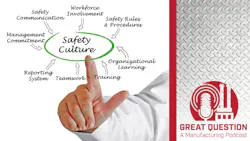




In this episode of Great Question: A Manufacturing Podcast, Nicole Stempak of EHS Today speaks with Virginia Tech's E. Scott Geller about the evolution of workplace safety culture and the human factors shaping modern manufacturing environments. Their conversation explores behavior-based safety, psychological safety, worker engagement, and the growing challenge of maintaining trust and communication in increasingly technology-driven workplaces. Together, they examine how organizations can create more connected and committed teams across the industrial sector.
Below is an excerpt from the podcast:
Nicole Stempak: Congratulations, firstly, on what I'll call your official retirement, since I know you still keep quite busy. And you taught for 56 years as a professor and researcher at the Department of Psychology at Virginia Tech. That's just incredible. So I just wanted to know what are you up to these days?
Scott Geller: Well, I still volunteer my time. We have a Center for Applied Behavior Systems where we involve undergraduate students in doing research, which is very rare, by the way, at universities. Undergraduates don't get the opportunity to actually do research. And then they present this research at professional conferences. And I should say that all of our research focuses on improving human welfare by changing behavior. And it includes the field of positive psychology, which of course talks about how do we influence behavior in positive ways.
One of the concepts we're working on right now, which I think is incredibly important, is the simple word, gratitude. Giving gratitude and feeling gratitude is good for everyone. And again, my observations are, there's not so much gratitude around. In fact, we measured how many pedestrians thank a driver who has stopped for them at a crosswalk. And on our university campus, we watched hundreds of pedestrians. And by the way, less than 10% of the pedestrians wave their hand and say thank you to the driver.
So we talk about our culture and what's happening in our culture. I do think we can talk more about this, but I do think we have a relatively self-serving, independent culture rather than interdependent, rather than collectivistic, we are now seemingly individualistic.
NS: In addition to teaching, you've authored books, you've consulted companies, you've written articles, and I'm sure the list can go on. But what contributions to workplace safety are you most proud of?
SG: Oh, I'm most proud of, behavior-based safety, which I had to change to people-based safety. In fact, I wrote a book about that because the consultants who were teaching and selling behavior-based safety were not doing it correctly. And so I say we have to focus more on behavior, but also on attitudes and feelings. The concept I use in all of our current research is humanistic behaviorism, combining humanistic psychology with behavioral psychology.
NS: For our listeners who may not be well-versed in psychology and may not be, you know, our listeners are in the broader manufacturing and operations ecosystem. So if they haven't heard of behavior-based safety, could you share a little bit about how your ideas initially coalesced for that and what role that theory has in workplace safety for today and possibly for tomorrow?
SG: Wow, that's a great question. Well, we started in 1979 and we called it behavior-based safety. And the concept was basically this: coworkers know more than anybody else what's safe and what's not safe in the workplace. So what if we developed a behavioral checklist with the workers? What if they came up with a list of what is safe and what is at risk on our job? And then we have a checklist. That's the first challenge: Come up with a checklist of behaviors that are safe and not safe. And of course, along with that, what are the conditions that influence safe or unsafe? Now we have a checklist, and now we use that checklist to observe each other.
Simply this: you take the checklist and with the other person's permission, you ask, can I observe you? And of course, then when you're being observed, you're on your best behavior, but the observer is simply checking safe and at risk. Notice I don't say, we didn't say unsafe. That sounds too, you know, negative. Just at risk. And we list those things. And then we come up with a percent safe. What was the percent safe for this?
But here's the bottom line. The next point is to communicate to that worker what you found. We call that feedback. Supportive feedback means telling people what they did well, what they did right. Corrective feedback, that's a difficult one for many people.
Tell them what was not the best it could be. And then, by the way, we can summarize the whole thing by the letters of COACH. It's amazing how the letters of coach say it all. And I'm claiming this because we all should be willing and able to coach each other. Parents to child, child to child, child to parents. Students to teachers, and vice versa.
What's the C? The first C in coach is care. Know that I care and you'll care what I know. So I am making these observations because I care about your safety. And I care so much, I'm willing to -- the next letter: O, observe your behavior. And by the way, if you do behavior-based safety, we've developed a checklist of what we've found, what we determined as a group, what is safe and what is risky.
Now I I'm observing you. And while I'm observing you, the next letter of coach is Analyze. I'm analyzing the conditions that might be influencing at risk or safe behavior.
The next letter of coach is what? C. This is the one that people miss when they really implement behavior-based safety. C is communicate. You communicate what you determine, what you found, what you saw to the other person.
And if you do that correctly, the last letter of coach, and I love it, is H for help. I will have helped you perform more safely in your situation.
I think whether it's athletic coaching or parenting or what, those letters are wonderful. But here's what we found. So that's what we did in 1979 and started a company, by the way, called Safety Performance Solutions, traveled around the world teaching this and it became a worldwide thing. Everybody knew behavior-based safety.
But here's the issue. What they did is...watched with a checklist, recorded on a checklist, and then recorded the data on the computer. And then they gave everybody feedback, percent safe. They didn't do the coaching, the C part, the communication part. Why not? Why didn't they communicate one-on-one with the other individual? Well, we know why. They didn't know how. They didn't feel confident, comfortable in giving corrective feedback.
And by the way, we're talking 1979. I claim that today that's even more difficult. We have a very independent, self-serving, cell phone culture, you know? And so it's tough to walk up to a person, even in the workplace, and give them feedback. By the way, I'm not just saying this, we've seen it on our campus. We've been studying coaching and giving feedback on our campus. The word we've been studying specifically recently is gratitude. As I mentioned earlier, not many pedestrians thank drivers who have stopped for them at the crosswalk. So the term gratitude is becoming seemingly less used, less significant in our culture, and that's very disappointing because, again, when somebody thanks you and you thank them, it increases our self-esteem.
NS: I was going to ask you a question, but I think you just answered it, which was if some aspect of safety has worsened in the past 50 years. And it sounds like for you, the answer is not specific to safety, but is a reflection of a change in culture. Did I hear that right?
SG: Oh, that's beautiful. The word I would use today is social support. Research shows that the perception of social support improves physical wellness and psychological wellness. And that's what we have to ask ourselves. Do we have a lower perception of social support? What do I mean by that? I mean, people around us who know us, who would look out for our safety, who would be willing to give us feedback even when it's not correct, not supportive feedback. By the way, a very important concept to teach is behavioral feedback and the difference between supportive feedback and corrective feedback. Many people use the word positive feedback, but here's my response to that. Any feedback that's given correctly is positive. Any feedback that helps the person improve is positive.
But when you're supporting good stuff, it's supportive feedback. And when you're trying to correct or improve behavior, it's corrective feedback. And again, repeating myself, giving corrective feedback is easier said than done because you have to be, here's a word again, empathic. You have to take the time to listen to the other person's perspective. Now, I ask you, in today's culture, there's very little of that, even with physicians, for example. Everybody wants to get the job done as quickly as they can, looking at their cell phone, to give you the time for empathy. And again, I'm finding that in the medical profession. You know, I've gone to several different doctors and they just want to tell you, they take the physical result and then they give you your symptoms and tell you what to do without asking you, how do you feel? How have you been? What do you think about this? That takes time, and we seemingly don't have time. Everybody's in a hurry. So we are efficient, but not effective. Because effective takes time, and I claim requires empathy.
NS: You keep touching on so many things I want to talk about. But one thing that I think I'm hearing is that culture like safety doesn't happen in a vacuum and that they co-mingle and co-influence one another. So something that you're seeing on the manufacturing floor is probably something you're going to be seeing in another personal context, maybe if it's something that you're seeing while coaching your kids' sports league or at a faith service or something like that. The idea being that these things are part and parcel of your entire existence. They're not isolated. And that they help to shape the way we see and navigate the world in many ways.
SG: That, Nicole, is excellent. What you're saying is the context changes, the situation changes, but the principles remain the same. Again, back to coaching. We need to coach in every situation. Parents to child, ministers to congregation. I mean, athletes, coaches to athlete, and vice versa. Apply that coach, care, observe, analyze, communicate, and help. But that requires a sense of, here's a big word again, interdependency. We're all in this together. We live in a system. But I must tell you, I don't know about you, but I don't trust as much as I used to. We get so much scamming happening. Who do you trust? If somebody tells me something, do you believe it? Again, it's a shame because our culture now, on the internet, I don't know about you, but I can get lost in the internet just reading my messages. And some of those messages are absolutely scam. They're fake. And so people are trying to get to us by lying to us. And in that context, how do we get people to accept the truth? How do we get people to trust another person to give us feedback?
Again, it's tough. But we need to fight it. We need to fight this thing. And a lot of it, I think that means we need to talk about it more. We need to interact. They say, don't interact about politics. Don't discuss politics. And I want to say, why not? Why not find out the other person's opinion? You don't have to believe them, but why do they think it that way? Say that. And how does that compare with what you believe? All I'm saying is becoming more interdependent, more I would say, empathic. By the way, Stephen Covey told us that compassion is empathy in action. So you cannot really be compassionate without understanding where the other person is coming from. So that takes time. And we need to kind of slow down sometime, put down our cell phone, and have a real conversation with another person.
We hear stories where even families sitting around the table are looking at their cell phones rather than each other and having a conversation. When I was years ago with my kids, we used to have the TV on, and that was a mistake because we were watching TV instead of interacting. But today, we all have our own TV, our own personal cell phone, and that, quite frankly, is taking us away from appreciating each other and recognizing each other. And one more time, expressing gratitude and feeling gratitude.
NS: You haven't used these words exactly, but I feel like everything that we're talking about goes back to two concepts that are very similar but have different names, one being total worker health and another being psychological safety.
SG: Oh, absolutely. In fact, we're studying psychological safety in the classroom right now. And so what does psychological safety mean? It simply means that we feel comfortable in our environment, whether it's home, workplace, school, we feel comfortable. We feel that we're contributing and we feel that we can challenge the status quo, that we can challenge the status quo or ask the teacher a question, or our mom or our dad a question, or the safety person a question, that we can challenge a safety directive, for example. Why are you telling us to do it this way? Common answer, because I told you, because OSHA says it that way. No, that's not being empathic. It's getting down and being, here's a word, I'm going to say it again, be humanistic. Reflect each other's feelings. Learn about each other. And we can only do that by listening with empathy.
NS: I think this also speaks to another conversation in safety as far as compliance being the bare minimum, right? Like if the answer is, why do I have to do it this way? Because OSHA tells me, that is how you achieve compliance. That's not how you create –
Geller: Commitment.
NS: I was going to say world class safety culture, but yeah, and both of those things are the same, right? You're making a commitment to yourself, to your coworkers, to your employer that you will do everything possible to make sure that not only does the work get done, but that it gets done safely.
Geller: And we're in this together. In fact, I must say the word compliance is very unfortunate. In compliance, we suggest that I don't have choice. Just do it. And by the way, I do have a TED Talk on self-motivation. And it's been posted almost over a decade, but it does have over 12 million views. But the reason I bring it up is... what does it take to be self-motivated? There are three C words. The first one we just mentioned, choice. When I believe I have some choice, I'm more likely to be self-directed or self-motivated. And part of our challenge in safety is to help people feel self-directed. I want you to do it, it's your way, but there are certain rules we need to follow. So we comply, of course, but we want to learn from you how to get those rules followed the best way. So that would be choice.
And then the next C word is competence. When people believe that they are competent at doing something well, they’re more likely to be self-motivated. Think about that. Now I'm back to gratitude. When we thank a person for setting the right example, when we recognize or give them supportive feedback, we're increasing their gratitude. We need that to build the kind of culture we need people to feel competent at doing the right thing.
And again, the last third C word, it's the big one. We talked about it this whole time, community. A sense of relatedness, a sense of community, a sense of interdependence. It should be the declaration of interdependence. We're all in this together.
And by the way, can I just say quickly, most of your listeners have heard of Maslow's hierarchy of needs, right? 1950s, it was a hierarchy. By the way, Abraham Maslow never talked about it in terms of hierarchy, but that's how we translated it. We satisfy our biological needs, then we move up the ladder and we satisfy our safe and secure safety needs. And then our social relationship, our social needs. And then we get to self-esteem. We feel good about ourselves. And the top of Maslow's hierarchy. When I ask my students or I ask a group, what's the top of Maslow's hierarchy? Everybody seems to know Self-actualization. Self-actualization, to become self-actualized, and Maslow meant that to believe that you've achieved. But guess what? In 1970 he said he was wrong. And this is the important one that people have missed. The top of Maslow is not about self. It's not self-actualization. It's self-transcendence. It's going beyond yourself for somebody else. So Maslow ended up saying, the best you could be is going beyond yourself to help someone else.
And isn't that what safety is all about? Looking out for others is looking out for somebody else. Sure, your own safety, but you're concerned about somebody else's safety. And by the way, that was the mission of behavior-based safety. You get people to look out for each other, and then, here's that word again, give them feedback correctly, so they accept that feedback.
NS: So talking about culture, I just want to ask, how would you describe the state of workplace culture, and how or where does safety fit into that?
SG: I must admit, I haven't been to a workplace very often. My daughter now, who has a PhD, and she's now traveling around, she has the same issues that I've experienced years ago, but it's more difficult today. The workplace culture is people are doing their job independently. I'm doing my job, I'm following the rules for me, but I'm not necessarily looking out for the other person. And that's what we need if we want safety.
By the way, one thing I think we have to admit, even safety managers need to admit that they do not know everything about safety in their workplace. The best way to learn about safety in the workplace is from the workers. They know where the at-risk behavior is occurring. They know where there's pressure to do it quickly rather than safely. I mean, they're the ones we need to talk to.
And so it's not about compliance. It's about a commitment to learn from each other. Developing, here's that word again, community. A psychological safe community where people are willing to communicate and give corrective feedback with empathy. That's all easier said than done. And I say one more time, I think it's more difficult today than it was even 20 years ago.
NS: Do you have an ideal vision of what a safe workplace would look like? Like in your mind, how could this be?
SG: I think the ideal safe workplace is a workplace where there is psychological safety. For example, a safety suggestion box. They used to be very popular. What is a safety suggestion box? Oh, we have it on the internet now. No, I mean a safety suggestion box where people can write notes about what needs to be improved, what suggestions do they have to make the place safer. And they put that in a certain place.
But here's the important part. Those suggestions need to be read, and they need to receive feedback. Somebody from management has to read that and give the workers feedback with regard to their suggestion, whether it's appropriate, whether they thank them, or maybe they can't do it completely, but the bottom line is feedback. I've seen so many safety suggestion processes dwindle because of no feedback. So again, it's a process. It's a process that requires behavior and a consequence to keep it going.
NS: I feel like I would be remiss if I didn't at least ask about technology, since there's so much emphasis on, you know, wearable devices, cloud-based tools, or things you can do from a mobile or tablet with AI. How do you think technology is changing safety and changing the culture, for better or for worse?
SG: That's a heavy question. I mean, let's face it, it should be for better. We should use AI to improve things. But unfortunately, at least from my perspective, sometimes AI takes the place of human interaction. You call somebody on the phone, you're not talking to a real person. You're talking to AI. You're talking to a recording. And so again, we're getting less personal. We've become an impersonal culture. So that's what the technology is doing on the negative side. Of course, it has many advantages, but I think it's driving us away from personal interaction.
In fact, people will say, I don't need others anymore. I can do it myself. I don't need you to tell me what I should do right or wrong or how I can do things better. I've got my cell phone. I've got ChatGPT. I mean, my point is, sometimes AI moves us from the human part of safety and the human part of living. And perhaps we fail to recognize what people do for us. I hope people will at least think of gratitude. When's the last time you, and I regret that I didn't do this, that you thanked your mom or your dad? I just want to thank you, Mom, Dad. For what? And then you specify the things that you're grateful for. I mean, that's what we're missing. We're missing expressions of gratitude. We call that interpersonal gratitude.
We're also missing feeling gratitude. We call that intra, inside personal gratitude. And so I think all of us could benefit by just sitting back and reflect, what am I grateful for?
What are the good things that have happened to me that I'm grateful for? And who has helped me get to there? And again, if we start doing that, maybe we'll become more of a human culture, a psychologically safe culture, rather than a compliant culture, an AI culture.
NS: So many things to think about. But I did want to ask you one thing, just because you are an educator and you've been teaching for a long time, you know, you've taught thousands of Gen X, millennial and Gen Z students over the years. But as an educator who has taught multiple generations, what have you seen or what have you learned or gained an appreciation for from the annual crop of students that you've had?
SG: Wow. First, I must say that I don't think about different generations, but I have seen massive differences. Today, the students just want words. They don't want to interact. Again, I'll say it again. We're losing the best way to learn, experiential learning through discussion, learning through interacting. We're not doing that. It was all about our cell phones and our, you know, I use the word individualism rather than collectivism. And so I think that's what's happening to our culture as a result of AI.
In the internet, people can spend hours just looking at messages that came to them or reading the internet. And of course, that could be very educational, but it can take us away from appreciating the bigger picture, becoming systems thinkers, realizing that we're all in this together. Let's help each other.
But the word I use too often these days, who can you trust? Who can you trust? The fact that I would even say that and think that is very depressing, very discouraging, but because of the scamming and the internet culture that's happening where people will just say things with no data and which one do you believe? It puts us in a very awkward situation, and, question, do we mistrust other people? You know, behavior-based safety requires psychological safety, which means trusting each other, trusting that you're going to watch my behavior, you're going to give me feedback, you're going to record that behavior on the chart, and it's going to be fair and it's going to be anonymous, we’re not out to blame anybody, we're out to helping everybody. Again, that term everybody. I wonder if that term is losing its significance. It's me rather than us, rather than we. Just a thought.
About the Podcast
Great Question: A Manufacturing Podcast offers news and information for the people who make, store and move things and those who manage and maintain the facilities where that work gets done. Manufacturers from chemical producers to automakers to machine shops can listen for critical insights into the technologies, economic conditions and best practices that can influence how to best run facilities to reach operational excellence.
Listen to another episode and subscribe on your favorite podcast app
About the Author
Nicole Stempak
Nicole Stempak is managing editor of EHS Today and conference content manager of the Safety Leadership Conference.