Podcast: Weathering the storm... or hurricane, or tornado, or heat wave
Key Highlights
- Extreme weather trends: longer heat waves, heavier rain, faster storms. Plan for higher disruption risk, not just frequency changes.
- Proactive prep beats reaction: Use forecasts, alerts, and AI tools to act days ahead and reduce operational and safety impacts.
- Tailor plans by location: Align procedures to local risks (tornado, wildfire, heat) with clear triggers and shelter protocols.
- Make plans that are living systems: Run drills, update seasonally, and review events to improve response, communication, and worker safety.
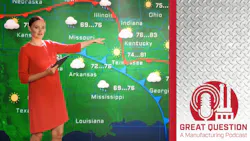



In this episode of Great Question: A Manufacturing Podcast, Jason Moreland of AlertMedia talk with Nicole Stempak of EHS Today how changing weather patterns and climate trends increase risks for workers and organizations, and explains why proactive planning, communication and training are vital to mitigate impacts of extreme weather events across seasons.
In sum, weather affects just about every aspect of our lives, and American workers are simultaneously facing a wide variety of weather extremes. If you aren’t already updating emergency planning materials or running drills, now’s the time to start.
Below is an except from the podcast:
Nicole Stempak: It's a pleasure to have you here today, Jason. I think we when we last spoke, I bombarded you with questions because it feels like the weather has just gone from this idle icebreaker before meetings to really intense ongoing weather disasters.
And I wanted to know what's important for safety professionals and other manufacturing and operations professionals to understand, you know, about climate change, extreme weather conditions and natural disasters.
Jason Moreland: First of all, thank you so much for inviting me to this important conversation. And, you know, I really think that weather in recent years has become a controversial topic when it really doesn't have to be. So people tend to want to pick a side about, you know, are these events really happening more often? Is it more common? Are the extremes truly becoming more extreme, but the reality is the answer can be a little bit more in the middle. That's a little bit more of a nuanced answer.
So severe weather has always been a real threat. Let's just get that out of the way right now. I mean, for thousands of years and longer, we've always dealt with severe storms, hurricanes, tornadoes and so on.
Not every major storm or wildfire can be blamed solely on climate change, but at the same time, we're seeing clear trends in certain types of extreme weather. Things like more severe heat waves or the run-of-the-mill heat waves that happen every single summer, but they're lasting for a longer duration and therefore have greater overall impact. Then there's heavier rainfall events that can lead to flash flooding. And then we're seeing a trend, especially within some of the more recent hurricane seasons of the number of storms is still about the same. And then also there's the fact that we're getting better at identifying the weaker systems with more advanced radar, satellite, hurricane hunter data coming from the aircraft and so on.
But the data is pretty clear that we're seeing more rapidly intensifying storms, especially within one to three days of making landfall, which can really make messaging difficult because people, no matter how much you say that there is going to be a threat several days in advance, they may not take it seriously until they really see that well-defined hurricane on satellite. People are very visual when it comes to threats, but all that to say we are seeing more rapidly intensifying hurricanes.
And then there's the other part of the story, which is there's more people in harm's way. There's also more assets. You know, just within recent decades, there's been tens of millions more Americans that now live in flood prone areas like the Eastern Seaboard, the Gulf Coast.
And then when you think about the California wildfires, we've added tens of millions of people within the wildland urban interface. And that's just a fancy scientific term for people living in areas that are very vulnerable to wildfires from a natural standpoint, but when you add inflation, population growth along with more of these long-term severe weather trends, I think each and every one of these is a big factor as to why it feels like severe weather is on the increase.
NS: I can remember as a child seeing, when it comes to hurricanes, the plywood being boarded up over the windows and the shutters being folded. And there were several days, it felt like before a storm hit landfall. Now, yeah, like you're saying, it's a lot faster. And that gets to something else I wanted to ask about. Talk about these extreme weather conditions and climate change. The discussions are important, but sometimes our brain just can't process it. It feels a little nebulous. What do these things mean on like a more of a daily or seasonal basis for what people might be experiencing, whether or not they realize it?
JM: It's a great question because really the biggest difference between the definitions of weather and climate is weather is more of the day-to-day, whereas climate is long-term averages that happen over monthly, annual or century long time scales [and] even longer than that when it comes to comparing us to prior times within the climate period, like the Ice Age and so on. So when we start talking about climate change, it can sound a bit abstract for the general consumer out there and people don't necessarily feel it every single day in their everyday lives, these little nuanced changes that we're seeing over larger time frames.
So the truth is, most people still experience weather as extremes that swing in both directions. So for example, earlier this year, especially during the month of January across the eastern US, we saw what felt like one major winter storm after another. Arctic shots of cold air coming in from eastern Canada and the Great Lakes. We had over a foot of snowfall within places like Charlotte, NC. Over 1,000,000 people lost power with ice going into places like Arkansas, Mississippi, Alabama and so on. So even though long-term, we are still seeing a trend towards warming, we're still a long way from ever becoming fully removed from major winter storms. But at the same time, when we talk about climate change and global warming in months like January, it kind of becomes a bit of a running joke when we bring up global warming and climate change.
But what's important to understand is that climate trends can show up very differently depending on the region that we're discussing. So while those winter storms were happening in the eastern US, one lesser known fact is that much of the western United States was experiencing record warmth and in fact the winter season of 2025 and 2026 ended up being the second warmest US winter on record, and this is with records going back to 1895. Several of the western states saw their warmest November through January period ever, and that warmth also contributed to a much lower mountain snowpack in parts of the West. And here's another crazy stat.
A lot of the audience may think of Salt Lake City as this cold weather city that gets snow, you know, every day of the week during the winter months. It took until February for Salt Lake City to have their first measurable snow event of the season. So while we were digging out of the snow in the east, a good chunk of the country was at all-time highs for temperature.
NS: Wow, I did not realize that. Yeah, we had a heavier than normal and I guess normal relative snowfall. But for me, it just reminded me of my childhood. Like I hadn't seen this much snow since I was younger, so it felt like a return almost, if you will.
JM: I know a lot of residents in the Northeast would also say, hey, you know, we were in a snow drought for all these years. There's been big cities like DC and New York. You could go almost like half a decade now without any kind of big winter storm. And the research, it's still a little anecdotal and in the mix, but at the same time it does make sense from a climate standpoint where maybe we're above freezing on average more in the winter months than we used to be. So therefore the total frequency of snow events is on the decrease. But at the same time there will still be periods in which below freezing temperatures and winter storm ingredients overlap. So then when you do get a snowfall event there's a lot more precipitation and moisture stemming from the atmosphere because overall a warmer climate can handle more water vapor. So all that to say, when the conditions do become favorable for a big precipitation event, if your temperatures are still below freezing, you can end up with higher snow amounts than you would have maybe gotten from the same storm system 20 or 30 years ago, so maybe less frequency of snowstorms, but when you do get that big one of the year, it could still be all time or top five.
NS: We're talking in the spring and you know, the potential for extreme weather events is quickly escalating. You know, you've got tornado, flooding, monsoon, wildfire, hurricane seasons, probably something else I'm forgetting. And then, of course, we've got summer heat waves and droughts just around the corner. So what do listeners need to keep in mind as they're planning for the rest of 2026?
JM: You're exactly right because I would just say speaking on behalf of the entire weather team here at Alert Media, we definitely feel like the activity for us picks up from a kinetic news or impact standpoint going into the spring and the summer months, not just across the US but also Canada, much of Central America, eastward through Europe and so on.
So right on cue, just as we entered the spring, we saw a big uptick in tornado activity across the US already. In recent weeks there have been tornadoes that have caused significant damage across parts of the Midwest with a lot of fatalities. This is the time of the year in which these things happen and this is going to continue through much of the month of May. May is the climatological peak of severe weather season when it comes to damaging winds, hail and tornadoes across the US, and this can very well continue with a little bit more of a northward advance as you get into June and July across the Upper Midwest, the Northern Plains, the Great Lakes.
And then one thing that maybe a lot of the general viewer may not even fully respect 100% is that even southern Canada gets a pretty good severe weather season going into mid to late summer. This doesn't stop with the US. Once the jet stream focuses farther north, you can still get severe weather outbreaks from Alberta eastward all the way into the bigger population centers of Eastern Canada, across Toronto and so on. So this isn't just a U.S.-focused threat and this is something that people and businesses alike should really factor in when it comes to having a severe weather and a tornado action plan. I know that oftentimes people get sick of the false alerts, the number of tornado warnings can really spike this time of the year, but especially when it's the ones that say confirmed tornado, that's when it really means business. And the truth of the matter is that you should really respect every tornado warning. If you're in a Polygon, you need to go to shelter immediately.
And when you think about the amount of time that you spend under a tornado warning each and every year, even if you're in the heart of Tornado Alley, it's just a small, small fraction of a percentage of that total time. So I know that no one is a big fan of the false alarms, but the accuracy of these warnings is improving as the years go on and again. And time is of the essence when you do get under one of these, so definitely respect all of these warnings.
NS: It seems like more areas are being affected by tornadoes or weather patterns that haven't been before. So that being said, what are you tracking? Is there anything you're concerned about?
JM: Yeah, there's quite a number of longer-term trends that do have our eye and we do have quite a bit of concerns going into the mid to latter portions of the year. So kind of starting off with what's been a relatively dry first quarter of 2026 for the U.S. as of mid-March, about 55% of the country was experiencing moderate drought or worse, and this does have implications for the wildfire risk. You know, usually it's a bit early in the season for us to be talking about major fires this early on in the year, but this is going to have consequences as we get deeper into the spring and the summer. We could also have some increasing water concern, lack of water resources in parts of the Southwest. So parts of the central U.S. are starting to just now turn wetter. But when you combine the ongoing drought with expectations of a hotter than average summer across much of the country, that's already leading to above normal wildfire risk projections across portions of the Southeast, the South Central Plains and the Four Corners region. So states like New Mexico, Arizona, Colorado, Utah.
What's particularly interesting is what's happening in the West. California, of all states, has actually done relatively well when it comes to receiving adequate winter rainfall. And currently, out of all the states, California is doing some of the best when it comes to staying outside of the drought areas.
But a bigger concern across the Intermountain West of the US is that the Sierra Nevada mountains, much of Colorado, Utah and so on, their snowpack is at record low levels. So this is going to have two big impacts. #1, the Colorado River basin that this is another area that has well below average snowpack. This snowpack is going to quickly erode within the matter of the next couple of weeks. And so we're going to have record low potentially water supply going into the peak of the summer. So this is going to have downstream consequences for much of the southern states that rely on this area for their water resources. Even as early as mid-March, big cities like Phoenix were approaching 103 degrees, which is their all-time highest temperature ever recorded for the month of March, and this is even higher than what they would normally see for the month of April. So the heat really set in early on this year for much of the western US, basically a continuation of what they had experienced during the winter months.
So for even states like California that didn't have the major drought, we're seeing the vegetative fuels really rapidly dry and they're going to become increasingly susceptible to new fire ignitions, rapid fire spread as we get deeper into the warm season. So you don't always need to be entering summer to have a bad wildfire season in terms of entering with a drought, but these rapid heat waves that have already become established months before the peak of summer is a concern for much of the western US.
Another thing that I'm monitoring is that, you know, it's not always a bad bit of news when it comes to weather. And for the second-half of 2026, there is a growing potential for a strong El Nino to develop within the Pacific. And while the El Nino can produce its own set of threats for anyone that has their biggest concerns focused around Gulf, Caribbean, Atlantic hurricane activity, if we do get this strong El Nino for the second-half of the summer, it could highly restrict the total number of named storms and hurricanes that could threaten the Southeast.
So when we get these more detailed seasonal hurricane forecasts later into May and then we're going to get more updates during June, July and so on, the numbers are likely going to reflect below average activity, at least compared to what we've become used to over the past 20 to 30 years. Now having said that, there's always a caveat when it comes to these long-range seasonal forecasts, and really all it takes is one bad hurricane to make it a bad and memorable hurricane season. And you know, it's always kind of cliche to bring up Hurricane Andrew from 1992 because that was one of the more historic hurricanes that ever struck south Florida, Miami-Dade County. But that was a strong El Nino year and they had a well below normal count of total named storms in 92. But that was a Cat 5 that slammed in South Florida and they haven't had anything quite like that ever since. So fortunately, not saying anything like that is going to happen this year, but again, all it takes is one bad storm to make it memorable.
Now on the flip side, if anyone has interest along the Pacific side of Mexico, maybe even westward towards Hawaii, we do see a very general uptick in tropical activity during El Nino years. So while the Gulf, Caribbean and Atlantic cool down to some degree, we could see a bit of an uptick in other hurricane basins. So East Pacific, westward through the Central Pacific and even to an extent out there across different parts of the of the West Pacific, we could see some increased typhoon activity there as well.
NS: It just is a good reminder of why weather is important, right? Like we know weather is important and it's more than just like whether or not you have to pack your umbrella. You're talking about snowfall and water sources for the Colorado River, which has been facing drought for a while and it's causing problems as population is moving out West and is growing there, if people can sustain their way of life. And then talking about you know how people are surviving in areas where it's getting even hotter like Phoenix because we know that the cold kills but heat kills too and then even just again about agriculture that you need so much water to grow the food that we eat and if you get too much or too little, then you don't get a good crop and then you know prices at the grocery store can respond accordingly. Weather is so important to our way of life, but unfortunately we can't control it. So what are some things that our listeners can control?
JM: I think the first is situational awareness. Having reliable monitoring of forecasts and early warning systems allows organizations to see potential disruptions nowadays, oftentimes days in advance instead of being so reactive when a warning is already issued in. By the time we get to the warning phase, your options to react to that situation become a lot more restricted. And so some of the best preparations can be made when you have that advanced lead time. And I know that there's always the running joke that the weatherman is always wrong, but for those that really closely monitor the stats year over year, we're getting better and better when it comes to forecasting. And I suspect that this might be one of the questions that would come up in this podcast. But there's also the question of what is the influence of AI on weather and messaging, and it's kind of like a two-fold answer to that.
So AI is really advancing the state of forecast models. Up until the last couple of years, all the traditional models that we think of when it comes to forecasting the weather, they were based purely on these very dynamic physics and calculus based equations, differential equations that basically explain how physics work and the state of the atmosphere, but they really didn't factor in overall pattern recognition well. If you see the same patterns that have happened in the past, they tend to recur over and over, and you can glean a lot of good information from those past events and kind of project those into the future. But that was kind of one of the sticky points that the more traditional physics based models struggle to incorporate into the forecast and the calculations.
So nowadays these AI models are coming onboard and we're kind of combining the the better attributes of both the physics-based models and these more machine learning pattern recognition capabilities, and we're seeing that the models are improving with this new AI dynamic in the mix. And so just last year, for example, when it came to Hurricane Melissa that threatened Jamaica, we saw the AI models outperform some of the more traditional models when it came to the early signal of there could be a major hurricane in the Caribbean in roughly five to seven days. So that's the positive impact that AI is having on this work field.
Now there is going to be the negative and we're seeing this more commonly on social media, but it's really more to do with the whole communication stages of forecasting. Nowadays, every single thing that you see on social media is being weaponized to generate as many mouse clicks as possible. There's a lot of revenue to be made on social media if you have a big following. And with AI, that's arming a lot of amateur people to make really professional looking graphics. It could look just like a hurricane track forecast and all it takes is a basic prompt and you can tell it make this look really ominous for the southeast US with the hurricane headed your way in five days. And so now we're starting to compete for who is the real credible person when it comes to forecasting and the likes of NOAA, the different national weather service offices spread out around the country. They each have a social media profile because they know that nowadays most people are getting their information from the digital media that's now migrated to these different spaces. But for the general consumer out there, it's becoming increasingly difficult to sort between what is fact, what is fiction, what's noise, what's being exaggerated. And then I think another aspect of this is that some of the more exaggerated accounts, they start with a factual story, but then they add layers to it, which makes it even more difficult to diagnose between is this credible information or is this just falsified on top of what began as a true forecast?
NS: Knowing what you're like looking out for and what you're concerned about, what are some things that companies can do to protect people no matter the weather? Are there procedures that they can establish or, you know, plans that can be made?
JM: I think the first step is understanding that hazards can be different based on what part of the country you operate from. And this can become really complex for an organization that has a widespread geographic footprint. So you almost have to go down to that more local level and talk to people on the ground that have history in those areas. So a facility in Oklahoma, for example, needs a lot more tornado procedure than maybe a facility in California that may need their plans geared more towards wildfire risk and atmospheric river events, along with these extreme heat waves that are becoming more common out West.
Second, companies should establish clear action thresholds tied to the forecast or warning. So for example, when it comes to a tornado, if a tornado warning is issued for your area, everyone should know exactly where to shelter in advance. That way, when you only have five minutes to take shelter, there is no guessing game. Everyone is on the same page. Everyone knows where to go. When temperatures reach a certain level, outdoor work should be scheduled to adjust for those certain criteria.
And then finally it comes down to communication and training. Procedures only work if employees understand them. So regular drills and clear internal alerts are critical, and I think it's important to keep these on the calendar on a seasonal basis. We just talked about how we've entered spring, severe weather season. Hurricane season is right around the corner, and I find from my professional experience, there's a lot of focus on hurricane season for whatever reason, I'm not quite sure, but from my standpoint, weather is a year round exposure and it's increasingly year round. We've already talked about winter storms in the southern US shutting down facilities for several consecutive days. I think prior to this winter a lot of companies would have said the only thing that we're really worried about here in the South is hurricane activity. Well, they paid the price if they didn't prepare for significant winter storms this past winter, if that wasn't accounted for within their annual planning.
So no matter what season, there's at least something that should be in the mix when it comes to natural disasters, and that really applies for everyone, no matter where they're located.
So again, understanding communication and training, making sure that these things are not being siloed for months and years at a time, having frequent refreshers and checks. And then also once an event has come and gone, recap what measures were taken during that event. There's a lot of lessons to be learned from each and every one of these. And usually there's something that you can employ into the next storm threat the next time it does come up.
NS: All of what you're saying brings up these good points because I feel like emergency preparations or emergency preparedness gets this reputation for being some like a binder that's collecting dust on a shelf, but they really need to be a living and breathing plan, something that's easily accessible, frequently updated because like you said, minutes are the difference between life and death sometimes. So are there any other things that safety professionals can do to keep their emergency preparations fresh and top of mind?
JM: This goes back to just keeping everything seasonal, keeping all of the living documents fresh. I think people kind of start to glaze over when they see the same pages repeated. So, make sure to freshen up those playbooks every so many months. Safety teams should know exactly what they're gonna do, no matter if it's a hurricane, tornado, winter storm, or flood.
Another key is just regular drills, scenario discussions. Reach out to your peers and those that are at lesser positions because there might be something related to workflow that wasn't accounted for. So this needs to be a top down and vice versa approach.
I think it needs to really be the entire organization that needs to come together and that's the best effective plan is when we work together.
NS: Absolutely. You mentioned something else talking about emergency preparations and preparedness, about workers who work inside a plant or facility, because it's, I think, really easy to understand the risks for those who work outside. They're directly exposed to the sun's heat, but workers in plants and facilities, they can get quite hot too, and they need to make sure that they can take cover as well. You know, we saw a really devastating tornado in Kentucky a couple years ago where the workers were not allowed to stop the line and seek shelter. And so do you have any recommendations? I know that example was more of a reflection of a company policy, but do you have any recommendations on how to protect workers in a plant or facility from extreme weather?
JM: You raise a great point because I've seen this through different communications with different types of organizations and some just kind of assume that they're more brick and mortar based. And so they're not nearly as weather sensitive as those that have operations five or seven days a week. But the truth is when it's the most extreme situation and weather impacts every single one of us, whether it's indoor or out. And to your point, again, some of the biggest tornado impacts that I've seen in recent years have been to warehouses, things like Amazon distribution facilities and things like that. Those people need to have the same proper amount of warnings as those outdoors in situations that involve severe weather, whether it's damaging winds. And even when it comes to a severe thunderstorm warning, I think we often turn off those notifications because we assume that every severe thunderstorm warning is for 60 mile per hour sustained winds. So if you're in a well constructed business or shelter that you don't have to worry about that. I think one lesser known thing is that there's different levels to National Weather Service severe thunderstorm warnings and if you're a resident or business continuity person that's worried about severe storms in places like Iowa or Northern Illinois, there's been severe storm complexes that have generated wind gusts over 100 mph within recent years. We're getting to lower end tornado force wind speeds and that's enough to cause widespread destruction both inside and outside of your facility.
Another thing to consider is that, what about your personnel when they're commuting back and forth? Will they have an adequate way to get to their job on time if all the flooded roads are basically making conditions impassable? Or what if the temperature is set to a certain threshold if you happen to lose A/C or if there's rolling power cuts because of demand on the power grid? Or let's say there was an extremely critical fire weather day and there's PSPS [public safety power shutoff] outages, which are becoming more common in the western states, where the utility operators have to deenergize lines to reduce the risk of ignitions.
So what does that impact have on your business if you don't have power due to that potential? And that's without the wildfire ever being a direct threat. This is more indirect threat that I don't think we're accounting for quite as much yet.
NS: And so far we've only been discussing protections for employees, but not customers. You know, I know a lot of our listeners don't have a ton of customers in their facilities. But I remember a local coffee shop, in part of the region that doesn't experience tornadoes, there was a warning and so the manager on duty, I think he got some blowback for this, but he just told everyone in the coffee shop to go down to the basement where they kept like their patio furniture and whatnot because you need to make sure that people are safe and in emergency situations, it doesn't matter who those people are, right? You just need to make sure people are safe.
So, so yeah, there's so many things to consider when it comes to the weather.
JM: And if I can also add, travel risk management is a big component of this because I've heard so many stories after major tornadoes in the central US of people that are not familiar with the high end weather in that part of the country, but they're their own business in Dallas, Oklahoma City, Kansas City. And you know, they might just be getting a cup of coffee somewhere. They see the wireless emergency alert that shows up on the local TV monitor, tornado warning, seek shelter. And then they have to ask the general public around them, hey, is this legitimate? And you know, I think organizations need to start considering travel risk when it comes to severe weather as well. It might be great that you have warnings set up for your physical business location, but what about if they're traveling to Los Angeles during peak fire season? They need to be aware of these threats before they get there.
NS: And having signage outside the building or in visible places too, because if you work there, you know where to go. But if you're not there day in and day out, you won't know what to do. So yeah, just another layer to this really challenging issue.
But we've talked a lot. And so I always like to close by asking if there's anything else that we haven't touched on that you want to make sure our listeners know and can prepare for and what else they can do to keep folks safe.
JM: It's a great question. I think the main takeaway is that extreme weather is something organizations should expect and plan for and it shouldn't be anything that should catch us by surprise. As I mentioned earlier in this, forecasting is getting better every single year. We have the best technology, the best forecast models. AI is now really coming on board and assisting the professionals with better, more reliable information. So the companies that do this well aren't necessarily reacting faster though, but they're anticipating the risk earlier. They're having better communication before the event gets to them, making safety decisions before conditions become dangerous. And that proactive mindset makes a huge difference when severe weather inevitably does occur. Because, you know, you might go several months with benign weather, but it ultimately every single location in the country has at least some sort of big weather that they should probably focus on and prioritize when it comes to planning.
About the Podcast
Great Question: A Manufacturing Podcast offers news and information for the people who make, store and move things and those who manage and maintain the facilities where that work gets done. Manufacturers from chemical producers to automakers to machine shops can listen for critical insights into the technologies, economic conditions and best practices that can influence how to best run facilities to reach operational excellence.
Listen to another episode and subscribe on your favorite podcast app
About the Author
Nicole Stempak
Nicole Stempak is managing editor of EHS Today and conference content manager of the Safety Leadership Conference.