What Phase 2 of the UT-Knoxville student evaluation of AI-powered ergonomic safety tool reveals for reducing strain and overexertion in manufacturing
SoterGenius® is an AI-powered tool for industrial companies, which analyzes images and videos to make compliance and inspections easier for predicting and preventing workplace accidents. Specifically, it analyzes against OSHA guidelines to identify gaps in safety, allowing the user to take corrective actions.
Recently a Senior Design Project team at the University of Tennessee’s Reliability and Maintainability Training Factory set out to explore the technology’s capabilities. The team evaluated the SoterGenius tool in two phases:
- Phase 1 (1st Semester): Familiarization and preliminary test phase
- Phase 2 (2nd Semester): Utilize the technology in real-world application
An article summarizing the results of Phase 1 was published in October. The team’s Phase 1 task was to lift cases of water bottles from a pallet on the floor, relocate them ~20 ft, and stack them on an elevated shelf (30” high) for storage.
For Phase 2, the team explored SoterGenius® in two locations: Client 1 - Updated Workspace Design project, and Client 2 - Production Operations. This article summarizes the results of Phase 2 of the student evaluation project.
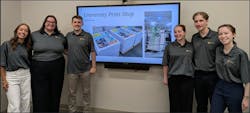
Client 1 - Updated Workspace Design
The goal in working with the Client 1 - Updated Workspace Design team was to bring SoterGenius® into a real-world environment. The team recorded multiple workers performing their daily tasks to gather insights and generate recommendations that could help prevent potential workplace accidents.
Initial findings identified two key concerns:. Below are The initial hazard assessments presented to the team by SoterGenius fell into two categories: posture and overreaching (see Figure 2).
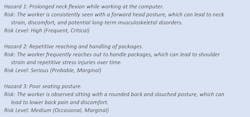
The Updated Workspace Design team effectively addressed overreaching by redesigning the workspace to help mitigate Hazards 1 and 2.
When it comes to Hazard 3, posture-related risks, Soter’s initial recommendation was to invest in chairs with improved lumbar support. While effective, this solution was considered potentially cost-prohibitive for this project and for the average company. As a lower-cost alternative, the team recommended introducing short stretching and mobility exercises at the beginning of each shift and intermittently throughout the day. While this might feel unusual at first, these exercises are quick (5 minutes or less), low-effort, and can significantly reduce fatigue and the risk of long-term injury.
These exercises consisted of the following: Neck & Shoulder Stretches, Arm & Wrist Stretches, and Back & Leg Stretches. These simple stretches are effective in reducing fatigue and improving posture. The team believes this approach complements the design team’s workspace improvements without placing additional economic strain on the company.
Client 2 - Production Operations
For the Client 2 part of the study, SoterGenius was used to evaluate 7 different tasks at 1 workplace. The review identified the hazards, the potential violations/gaps, the applicable codes, potential cost impacts, details of the regulatory requirements, and recommended corrective actions.
The tasks studied were as follows:
- Task 1: Pushing a pallet jack carrying over 1,320 lbs of paper
- Task 2: Loading paper into a machine
- Task 3: Unloading large metal sheets from the machine
- Task 4: Loading boxes of paper onto a cart
- Task 5: Processing a package
- Task 6: Light binding
- Task 7: Loading paper into a paper cutter
Each of the tasks were videoed and submitted to SoterGenius for evaluation. Each video was reviewed by the platform’s AI tools, which provided analysis based on motion capture data and OSHA safety guidelines. SoterGenius outputs included risk summaries, ergonomic warnings, and potential violations.
In addition to these individual tasks, the workplace environment surrounding the machine was submitted for evaluation as it appeared to present several hazards, including fast-moving mechanical components, an elevated platform with steps, and potential slip, trip, & fall (STL) hazards.
To maximize the capabilities of the SoterGenius AI system, video footage was recorded of employees performing various tasks across the facility. The footage was uploaded to the SoterGenius platform, which analyzed movements using motion tracking, OSHA guidelines, and AI-based risk assessments.
Overall, SoterGenius identified 2 Potential Violations and 7 Potential Warnings. Of the seven tasks reviewed, the team’s analysis focuses on Tasks 3, 4, and 6, as well as the machine workspace. These selections were made based on their demonstration of hazardous conditions, repetitive strain, and stationary work patterns:
- Task 3: The footage revealed that Employee 1 experienced strain each time a metal sheet was removed from the printer. This may be due to the awkward positioning of the sheet within the machine, or the manner in which Employee 1’s hands were placed to avoid cuts from potentially sharp edges. It is recommended to provide appropriate personal protective equipment (PPE), such as cut-resistant gloves, which would allow the employee to grip the sheet in a more comfortable manner without risk of cuts.
- Task 4: This task included two videos of Employee 2 loading boxes onto a cart from a pallet on ground level underneath a warehouse shelf. To avoid hitting their head, Employee 2 repeatedly bends their neck each time they reach for a box, which was flagged by the SoterGenius system. It also detected overextension when Employee 2 reached for a box of paper near the back of the pallet. Lifting this weight rapidly and awkwardly could increase the risk of back strain. It is recommended to reevaluate the workspace, including the height and positioning of the pallets and carts. Additionally, training on proper lifting techniques may also help mitigate risk.
- Task 6: This task involved light binding, where Employee 3 placed binding rings on stacks of paper. The task is low risk, but involves repetitive fine motor movements and requires static posture. The only notable issue occurred when Employee 3 repetitively reached over the top of the stack of finished products. This issue could be resolved by dividing the stack into smaller portions to eliminate the need for overhead reaching. Additionally, it may be beneficial to evaluate the need for adjustable tables and chairs to accommodate employees of different heights. Machine Workspace: This area was selected for evaluation based on previous safety insights and practical experience. Several potential hazards were identified that may lead to future incidents. A detailed list of these hazards, along with relevant OSHA codes and associated violation costs, and recommended corrective actions were provided to the client. Figure 3 below shows a portion of an Inspection Report issued from the Soter Hazard Identification Pro AI tool.

Figure 3. SoterGenius report on Client 2 - Production Operations.
Final results
In summary, SoterGenius provides valuable insights into strain-inducing tasks, identifies high-risk areas where accidents are more likely to occur, and points out potential regulatory concerns that can lead to violations, fines and injury. It is a highly adaptable AI-driven tool that aids in establishing a safe, compliant and efficient workplace. Adhering to regulatory guidelines and implementing ergonomic adjustments and workplace improvements help improve safety and thereby, reduce costs. Additionally, fostering safer work habits through a culture of awareness and professional training may reduce fatigue and improve productivity among employees.
About the Author
Stephen Mundy
Stephen Mundy is a consultant to the UT-Knoxville Reliability and Maintainability Center.
RMC-UTK Senior Design Project Team
The RMC-UTK Senior Design Project Team includes Autumn Erwin, Jacob Anderson, Lauren Haggerson, Emma Davis, Evan Ellison, and Danielle Tabar.