Maintenance Mindset: What WWII small arms can teach us about reliability
Key Highlights
- Reliability depends on alignment between system design and real operating conditions, both in a plant and on the battlefield.
- Systems built for worst-case conditions outperform high-performance designs in variable environments.
- Simplicity and scalability often deliver better results than complex, precision-engineered systems.
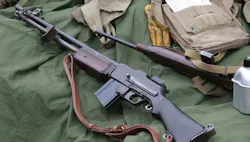
In earlier articles, I explored World War II tanks, then aircraft. In both cases, the same pattern emerged. The most sophisticated designs were not always the most effective. The winning systems were those that could be produced at scale, maintained in the field, and trusted under brutal, unpredictable conditions.
Now take that same lens and apply it to World War II's guns. This wasn’t a contest to design the most advanced weapon. It was a test of whether a system would function when subjected to cold, dirt, abuse, poor maintenance, and operation by someone who hadn’t slept in 36 hours.
That’s not very different from a plant.
Germany: High performance, conditional reliability
Germany produced some of the most advanced small arms of the war. The MG42 delivered an extremely high rate of fire. The StG 44 introduced a new category of weapon with controllable automatic fire. The Kar98k was accurate, durable, and precisely manufactured.
These were high-performance systems. Mechanically refined and engineered with tight tolerances. But there was a condition built into that performance. They performed best when the system around them was intact, and that means trained operators, consistent maintenance, stable supply, and controlled conditions. As those conditions degraded, which they inevitably do in prolonged operations, the margin of advantage narrowed.
This is a familiar pattern in industry. Equipment designed for optimal conditions is often placed into environments where contamination, variability, and inconsistent maintenance are the reality. The equipment does not fail because it is poorly designed. It fails because it is misaligned with the conditions it actually operates in.
The United States: Balanced performance that scales
The U.S. approach was different – not simplistic, but balanced. The M1 Garand gave infantry a major advantage with semi-automatic fire. The Browning Automatic Rifle provided mobile firepower. The Thompson was effective, though eventually supplemented by designs that were easier to produce and support.
These systems were not extreme in any single direction. What they achieved was something more valuable: consistent performance across a very large population of units. They worked well. They were maintainable. They could be produced in large numbers. And they performed reliably across a range of conditions and operators.
This is a critical lesson. You don’t need the highest-performing system in isolation. You need the system that delivers consistent results across your entire operation, not just under ideal conditions.
The Soviet Union: Reliability under worst-case conditions
The Soviet approach prioritized function under the most difficult conditions. The PPSh-41, the Mosin-Nagant, and the DP-28 were not refined systems. They were not designed for precision in the same way as some of their counterparts. But they worked and worked well. They worked in mud, in snow, and when maintenance was inconsistent and conditions were harsh. This was not accidental, it was intentional design. Build for the worst case, not the best case.
In industrial terms, this means systems that tolerate contamination, variable inputs, inconsistent lubrication, and uneven operator skill. They may not achieve peak performance, but they deliver reliable performance when conditions are degraded. Many operations struggle here. They optimize for best-case output, then operate in worst-case reality.
Britain: Practicality under constraint
The British approach reflected the realities of constraint and urgency. The Lee-Enfield rifle was fast and reliable. The Bren gun was accurate and effective. The Sten gun, by contrast, was extremely simple and could be produced quickly and in large quantities.
They were not elegant. That was not the objective. The objective was availability, simplicity, and function. This is a lesson in constraint-driven design. The best theoretical solution is not always the right solution. The right solution is the one that can be produced, deployed, and supported within the limits of time, cost, and capability.
Plants deal with this constantly – budget constraints, workforce variability, supply limitations. A design that cannot be implemented or sustained is not a solution.
Cross-System Comparison
|
Nation |
Representative Weapons |
Design Priority |
Performance |
Reliability (Degraded Conditions) |
Manufacturing Complexity |
|
Germany |
MG42, StG 44, Kar98k |
Maximum performance, precision engineering |
Very High |
Moderate (dependent on maintenance and conditions) |
High |
|
United States |
M1 Garand, BAR, Thompson |
Balanced performance and scalability |
High |
High |
Moderate |
|
Soviet Union |
PPSh-41, Mosin-Nagant, DP-28 |
Reliability under worst-case conditions |
Moderate |
Very High |
Low |
|
Britain |
Lee-Enfield, Bren, Sten |
Practicality under constraint |
Moderate–High |
Moderate–High |
Low–Moderate |
What this means for your plant
This article is not really about weapons. It’s about systems.
Most plants say they want reliability. What they often pursue is performance. You see it in specifications: tolerances tighter than necessary, speeds higher than sustainable, systems more complex than the organization can support. And then the system struggles, not because it is flawed, but because it was designed for conditions that do not exist in daily operation.
The most important lesson is this; systems do not fail because they are weak, they fail because they are misaligned with their operating environment:
- Equipment designed for clean conditions placed in contaminated environments
- Precision systems maintained inconsistently
- Advanced systems operated without sufficient training
- Data collected accurately and interpreted incorrectly
The system continues to run yet performance drifts, failures repeats, and metrics still suggest everything is acceptable. It’s not.
The “best” system is not the one with the highest capability on paper. It is the one that:
- Works when conditions are degraded
- Works when maintenance is imperfect
- Works across a range of operator skill levels
- Works consistently, not occasionally
That is not a wartime lesson. That is an operational reality and it is one that shows up every day on the plant floor.
About the Author
Michael D. Holloway
5th Order Industry
Michael D. Holloway is President of 5th Order Industry which provides training, failure analysis, and designed experiments. He has 40 years' experience in industry starting with research and product development for Olin Chemical and WR Grace, Rohm & Haas, GE Plastics, and reliability engineering and analysis for NCH, ALS, and SGS. He is a subject matter expert in Tribology, oil and failure analysis, reliability engineering, and designed experiments for science and engineering. He holds 16 professional certifications, a patent, a MS Polymer Engineering, BS Chemistry, BA Philosophy, authored 12 books, contributed to several others, cited in over 1000 manuscripts and several hundred master’s theses and doctoral dissertations.