The Industrial Science Report: How Northrop Grumman advances propulsion manufacturing and safety systems for Artemis II
Key Highlights
- Northrop Grumman's boosters generate 7.2 million pounds of thrust, powering the majority of Artemis II's launch.
- The twin boosters are precisely matched, ensuring balanced thrust and stability during liftoff.
- Innovative abort motors and attitude control systems enhance crew safety.
- The boosters are designed for single use, reducing costs and increasing payload capacity by removing recovery systems from the Shuttle legacy design.
- Key design upgrades include a larger nozzle, new avionics, and simplified insulation, all aimed at improving reliability and safety for crewed lunar missions.
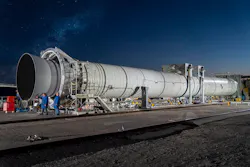
As NASA pushes forward with its Artemis missions, the focus in largely on getting to the Moon safely and reliably. The Space Launch System (SLS) for Artemis II, built by Boeing, represents the most powerful rocket ever built for human spaceflight. In part two of this series on the manufacturers of Artemis II, we shift the focus to the solid rocket boosters built by Northrop Grumman. These boosters are responsible for the majority of thrust at liftoff.
Northop Grumman’s role extends beyond thrust, including its work on the Orion spacecraft’s launch abort and attitude control motors, which reinforce the priority for safety, where the propulsion and safety systems balance raw power with precision and uncompromising reliability.
Northrop Grumman’s solid rocket boosters
Northrop Grumman is an aerospace and defense technology company headquartered in Falls Church, Virginia. The company designs and manufactures systems for space, air, land, sea, and cyber domains for government and commercial customers. The firm is a major contractor for the U.S. Department of Defense and NASA.
Northrop Grumman built two five-segment solid rocket boosters that provide the majority of thrust at liftoff. It also manufactured two rocket motors: the attitude control motor (ACM) and the abort motor for the Orion spacecraft’s launch abort system (LAS), a critical safety system that helps the crew module escape in the event of an emergency on the launch pad or during ascent, as well as the booster separation motors, which are critical for safely detaching the spent boosters.
At 7.2 million pounds of thrust, the boosters generate roughly 75% of the rocket’s thrust during the first two minutes of flight. The engines and two solid rocket boosters produce a combined thrust of 8.8 million pounds at liftoff.
Innovations in industrial science: Twin rocket boosters, abort motor design, lightning strike protection system
NASA says the rocket booster twins were the closest matched pair it has ever flown. The boosters hit peak thrust within 0.1 seconds of each other, performed within one-quarter of a percent of each other during ascent, and burnt out within 0.4 seconds of each other.
Northrop Grumman’s abort motor design reduces vibration and acoustic loads for the astronauts with reverse-flow technology that produces 400,000 pounds of thrust, reaching 500 mph in two seconds. During a critical, intense phase of space flight, the design also lowers structural stress on the Orion spacecraft. In the event the crew must separate from the vehicle, the attitude control motor has 7,000 pounds of steering force, if needed.
Solid Rocket Booster Facts
- The twin solid rocket boosters are 177 feet tall, taller than the Statue of Liberty from base to torch, 12 feet in diameter and weight 1.6 million pounds when filled.
- Each booster burns more than 11,023 pounds of propellant each second.
- At 17 stories tall, each booster generates more thrust than 14 four-engine jumbo commercial airliners.
- The two propellant tanks collectively hold more than 733,000 gallons of super-chilled liquid propellant.
- The propellant feeding the engines on the SLS Block 1 rocket boosters consists of polybutadiene acrylonitrile (PBAN), ammonium perchlorate, and aluminum powder and has a lowered burn rate than other shuttles.
- The weight of the entire 5.74-million-pound rocket rests on the booster aft skirts.
The abort motor also includes a safety feature that protects against direct lightning strikes. With controlled paths for lightning current, it shields the abort motor from damage. Adam Lyons, chief engineer for the LAS abort motor at Northrop Grumman, says the lightning strike protection system is already influencing other solid rocket motor designs across the company.
The boosters are derived and upgraded from NASA’s Space Shuttle rocket boosters, and for the first eight flights, will use repurposed hardware from the Space Shuttle program, including forward structures, metal cases, aft skirts, and thrust vector control elements.
The major difference between the new and old shuttle boosters is the addition of a fifth solid propellant segment for a higher payload. The SLS boosters are also designed for single use, reducing the costs associated with the space shuttle’s reusable booster ocean-based recovery, post-launch assessment, and continued flight refurbishment. Deleting the recovery systems for the boosters reduced them by 20,000 pounds and opened room for additional payload.
Test your Artemis II manufacturer knowledge.
Quiz: Artemis II manufacturing and engineering innovations in NASA’s SLS core stage
Need to study first? Read the article.
Other new design features include a new nozzle design that is three inches larger in diameter to support increased thrust. The boosters also have new avionics and control systems, new asbestos-free insulation and liner configuration, and the aft booster attach rings were moved 20 feet aft from the space shuttle external tank location to allow them to attach to the core stage engine section rather than the liquid hydrogen tank.
In addition to the primary booster motors, Northrop Grumman manufactured the booster separation motors (BSMs), which are critical for safely detaching the spent boosters about two minutes into flight, at altitudes exceeding 148,000 feet and speeds above Mach 4.3. Pyrotechnic bolts fire to release the boosters, while eight BSMs on each unit push them cleanly away from the core stage before they descend into the Atlantic Ocean.
For Artemis II, separation occurred a few seconds earlier than in Artemis I to improve payload performance, alongside design updates such as switching the BSM cover material from aluminum to steel for better debris protection. Engineers also simplified the internal insulation system within the solid rocket motor cases, removing a previous barrier layer after testing showed a single-layer design improved structural reliability for future missions.
Northrop Grumman’s solid rocket booster design prioritizes safety alongside performance, combining tightly controlled thrust, built-in redundancy, and simplified, more reliable designs to ensure astronauts can reach space and return safely.
Read more about Artemis II manufacturers:
Inside NASA and Boeing’s SLS core stage build for Artemis II
L3Harris Technologies upgrades legacy RS-25 engines for Artemis II missions
About the Author

Anna Townshend
managing editor
Anna Townshend has been a journalist and editor for almost 20 years. She joined Control Design and Plant Services as managing editor in June 2020. Previously, for more than 10 years, she was the editor of Marina Dock Age and International Dredging Review. In addition to writing and editing thousands of articles in her career, she has been an active speaker on industry panels and presentations, as well as host for the Tool Belt and Control Intelligence podcasts. Email her at [email protected].