Introducing the 2026 Industrial Innovation Awards Honorees

Manufacturing doesn't stand still, and the products built to keep it moving shouldn't have to fight for attention. The Industrial Innovation Awards, presented by New Equipment Digest and Plant Services, exist to put a spotlight on the equipment and technology actually doing the work: closing gaps, cutting downtime, and making plants, and the people who run them, better at their jobs.
Every entry in this year's program was judged against the same five measures: What's genuinely new here? Is the value backed by data, specs or documented results? Would this work on a real plant floor, under real conditions? Is it built for the environment it's meant to operate in? And does it solve a problem manufacturers face every day?

Watson-Marlow Fluid Technology Solutions: Bredel CIP Pump Redefines Clean-in-Place Efficiency
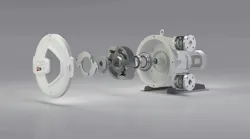
Clean-in-place has always been treated as a cost of doing business in hygienic manufacturing, not an opportunity. Plants tolerate the downtime, energy draw, and component wear because cutting corners on sanitation isn't an option in food and beverage, biopharma, or cosmetics production. The Bredel CIP pump is one of the more convincing arguments in recent memory that this tradeoff doesn't have to be permanent.
The design centers on a patented rotor with automatic retractable shoes. During CIP cycles, the shoes retract and allow the hose to fully open, delivering optimal flow velocity, more than 6.6 ft/s (2 m/s), without the pump running at all. That mechanism does double duty by eliminating hose compression at elevated cleaning temperatures, extending hose life, and removing one of the most common failure points in hygienic pump systems.
Where that mechanical shift really shows its value is on the plant floor. In applications such as brewing, facilities running the Bredel CIP pump have cut cleaning time by roughly four hours a day by reversing the pump to retract the shoes and power down during CIP, while achieving energy savings of up to 16% annually. Fewer maintenance interventions and lower replacement costs follow from the same design change. For an industry that has long treated CIP inefficiency as unavoidable, those are hard numbers to ignore.
Hygienic assurance is built into the pump's fundamentals rather than bolted onto it. Fluid contact is limited exclusively to the interior of the hose, which protects product integrity and removes cross-contamination risk between batches. The pump complies with FDA, EC1935, and 3-A standards, simplifying validation for operators in regulated environments where documentation is as important as performance.
The combination of hygienic assurance and process continuity is what separates the Bredel CIP pump from conventional hygienic pumps, which typically require the line to stop for cleaning. Because the Bredel pump stays fully integrated within the process line, operators can run faster, more frequent CIP cycles without sacrificing uptime, which is a balance that's historically been difficult to strike.
The pump is built for operators handling sensitive or abrasive fluids, including yeast, fruit purées, and biopharmaceutical ingredients, where gentle and accurate handling is essential. Its peristaltic technology delivers consistent dosing without degrading the product. For plants looking to upgrade rather than replace existing equipment, the pump's retrofit-ready design allows on-site installation into current lines, keeping capital disruption to a minimum.
Downtime, energy use, component life, product quality: few CIP solutions move the needle on all four at once. The Bredel CIP pump is a clear exception, and a look at where hygienic process equipment is headed.

Chemelex: Raychem Elexant 3500i Closes the Gap in Heat-Tracing Control
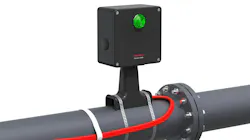
Industrial heat tracing has long forced a choice between two extremes: mechanical thermostats offering only basic on/off control, or advanced controllers priced and built for applications that don't need the full feature set. Facilities running mechanical units get a step up from no control at all, but little else: no alarming, no remote visibility, no diagnostic insight.
Chemlex's Raychem Elexant 3500i Electronic Thermostat is built for the space in between. A compact, full-featured family of electronic thermostats for freeze protection and process temperature maintenance, it's designed for oil and gas, LNG, chemical processing, power generation, and pharmaceutical facilities. Built on a common hardware platform, it ships in five variants, from Standard to Ground Fault Detecting, so operators can specify the right functionality without overbuying and upgrade later through interchangeable electronic modules rather than replacing the enclosure.
Reliability is where the design shows its intent most clearly. The unit's hybrid switching relay is rated to 250,000 power cycles, 2.5x the typical 100,000-cycle life of a mechanical thermostat, which translates directly into fewer maintenance interventions over the life of an installation. Approval up to 32 A and 277V AC supports longer cable runs and fewer circuits overall.
On the connected variants, Bluetooth and RS-485 connectivity bring configuration and monitoring into the Raychem Elexant Connect App, with integration into existing DCS and PLC systems. Automated self-tests every 24 hours and low-current alarming down to 0.1 A give operators a way to catch developing issues before they become failures, rather than finding out after the fact.
Rated for hazardous locations with Type 4X/IP66 enclosure protection and an operating range of -67° to 140°F (-55° to 60°C), the Elexant 3500i is built to hold up in the same environments it's monitoring.
LeanDNA: APEX Brings Prioritized Action to Supply Planning

Discrete manufacturers now have more data than ever and, often, less clarity to show for it. ERP, MES, supplier portals, and quality systems generate constant streams of inventory and production data, but that information sits in silos and forces buyers and planners to interpret static dashboards rather than act. The result is familiar to most plant floors: reactive firefighting, chasing shortages, and missing commitments despite constant effort.
APEX by LeanDNA targets that gap directly. Built for buyers, planners, and supply chain leaders at discrete manufacturers, the platform analyzes millions of part-supplier-plant combinations, flags emerging risk early, and prescribes prioritized actions ranked by financial and operational impact. Rather than a dashboard requiring interpretation, APEX tells teams what to work on and why.
The distinction lies in its manufacturing-specific training. APEX works from real operational constructs, including bills of material, supplier constraints, safety stock, and Clear-to-Build readiness, allowing it to distinguish a shortage that halts production tomorrow from one that resolves within lead time.
The results from named customers back up the approach. Siemens Querétaro increased material availability by 10% and reclaimed 80 hours of buyer time weekly. Daher cut critical shortages by 53% in a single month; Husky Shanghai cut them by 59%. Modine lifted Clear-to-Build performance from 40% to 95%. Johnson Controls eliminated more than 700,000 manual ERP updates.
For manufacturers navigating tariffs, reshoring, and constant demand swings, APEX points toward supply chain software built to prioritize and execute, not just report.
LUDECA, Inc: CRY8128 Pinpoints Leaks and Faults in Real Time
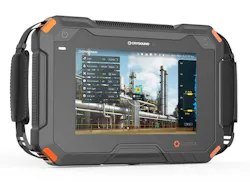
Industrial inspections built around leak detection, partial discharge, and mechanical wear have traditionally meant separate tools and separate passes across a facility. LUDECA's CRY8128 Ultrasonic Imager collapses that into a single handheld unit and does it roughly 10x faster than traditional detection methods.
The camera pairs 200 microphones and 100 kHz bandwidth with what the company describes as the fastest processor in the industry, allowing it to pinpoint gas leaks and estimate leakage volume and economic loss in real time. On the electrical side, it displays Phase Resolved Partial Discharge charts as they happen, helping identify discharge type without waiting on post-processing.
What separates the CRY8128 from a standard acoustic imager is its integration of infrared alongside the ultrasonic acoustic feed, displaying thermal and acoustic imaging simultaneously rather than requiring two separate inspections. In high-temperature applications such as steam trap monitoring, that combination lets operators confirm a finding thermally and acoustically in the same pass, with a measurement range of -4° to 932°F (-20° to 500°C) and infrared resolutions up to 640x512.
The hardware is built for the field: a rubber-molded housing weighing 3 lb (1.4 kg), a detection range up to 656 ft (200 m), and up to 10 hours of runtime on a user-replaceable battery, so a depleted pack can be swapped and charged without stopping the inspection. Wireless transfer sends data directly to LUDECA's reporting software, which handles both ultrasound and infrared analysis for post-processing and report generation.
Sandvik Coromant: CoroDrill DE10 Simplifies High-Volume Hole-Making
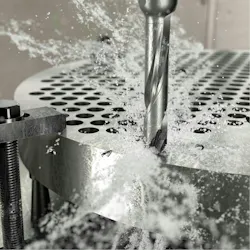
Exchangeable-tip drills promise less downtime than solid carbide tools, but that promise only holds if the tip change itself is fast, reliable, and doesn't introduce its own inconsistency. The CoroDrill DE10 is built around getting that exchange right.
The drill pairs a replaceable solid carbide tip with a high-strength steel body through a patented pre-tension clamping interface, one engineered to hold high clamping force and stability even at elevated feed rates and cutting speeds. The tip itself is produced through advanced injection molding of solid carbide, a manufacturing approach that allows for precise geometry, reinforced cutting edges, and consistent centering, without relying on a pilot drill to get there.
What separates the DE10 from conventional exchangeable-tip drills is how little the tool asks of the operator. Tip changes are tool-free and require no spare parts, and a universal -M5 geometry performs across a wide range of materials rather than requiring a different tip for every job. That combination, Sandvik Coromant reports, has produced tool life and durability improvements of more than 40% in testing conditions, along with improved hole accuracy and surface finish straight out of the cut.
Internal coolant channels manage heat removal and chip evacuation during operation, while the rigid tip-to-body interface holds dimensional accuracy through the life of each tip. When a cutting edge wears out, replacement takes seconds rather than a full reconditioning cycle, keeping a high-volume line closer to running than waiting.
For shops making the same hole thousands of times a shift, the DE10 points toward a simpler equation: fewer variables between setup and finished part, and less dependency on operator skill to get there consistently.
SmartSights: Peer Closes the Gap Between Alarm and Resolution
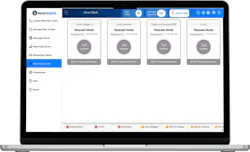
MES and OEE systems excel at collecting shop floor data, but most stop short of tracking what happens after an alarm fires. Knowing a line went down is one thing; knowing what was actually done to fix it, and whether that knowledge carries forward, is another. And that gap is where a lot of continuous improvement programs quietly stall.
Peer, from SmartSights, is built to close it. The issue management and resolution platform keeps workers and managers connected from the moment an alert triggers through full resolution, capturing not just that a problem occurred but what corrective action resolved it. Integrated with existing MES or ERP systems, and built on the company's WIN-911 alarm notification software, Peer extends beyond downtime logging into full issue accountability, building a searchable knowledge base of corrective actions as it goes.
That resolution-tracking piece is what separates Peer from standard alarm notification tools. Many systems can tell a team something is wrong; fewer connect that alert to a documented, repeatable fix, and fewer still make that history available the next time a similar issue comes up.
The impact shows clearly at Cook Medical's Vandergrift, Pennsylvania, facility. After shifting a Pipette assembly line from batch to continuous processing, the medical device manufacturer needed faster response to unplanned downtime without redundant equipment to fall back on. Configured with wireless Andon lights and real-time facility-wide displays, Peer cut response time on the line from 19 minutes to 5, a 75% reduction, with a return on investment within 4 months.
For frontline teams under pressure to move faster than traditional reactive maintenance allows, Peer represents a shift toward connected, accountable problem-solving, one where every issue closes with a record of how it got solved.

ESAB: Ruffian EMP 270G Packs Full-Power Welding Into a Field-Ready Rig

Field welders have long accepted that an engine-driven rig means sacrificing something such as output, portability, or ease of setup. The Ruffian EMP 270G doesn't ask for that tradeoff. Built on ESAB's next-generation inverter and a made-in-America 23.5-hp Kohler engine, it delivers 270 A at 100% duty cycle and 11 kW of generator power at just 425 lb (193 kg), lighter and smaller than machines in its class. A 7-in TFT display keeps parameters visible from across a jobsite, while synergistic lines and tool-free maintenance access cut setup and service time.
The machine handles a wider process range than most engine drives, running 7018 alongside 6010/6011 and hardfacing electrodes, plus carbon arc gouging with 3/16-in carbons. With multiple 120/240V AC outlets, the Ruffian doubles as jobsite power for grinders, plasma cutters, or a second welding station, turning one machine into a genuinely mobile shop. A rugged, fully removable door exterior simplifies battery access and oil changes, and the unit carries a three-year warranty for the harsh-duty environments it's built for.
EXAIR: Ultra Duty Line Vac Holds Up Where Standard Units Wear Out
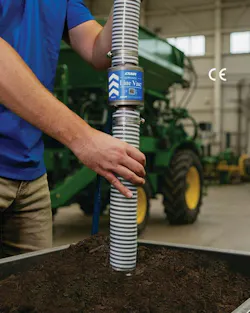
Abrasive bulk solids, sand, blasting media, glass, and grinding waste tend to shorten the life of standard pneumatic conveying equipment fast. EXAIR's Ultra Duty Line Vac is built specifically to outlast them, pairing a hardened alloy body with a precision ceramic insert that resists wear from the harshest materials in blasting and finishing environments. That construction pushes throughput up to 50% higher than EXAIR's standard Line Vac, with no moving parts, no electricity, and airflow tunable through a simple pressure regulator for tasks like hopper loading, waste removal, trimming collection, and material transfer.
Available in 1.25, 1.5, and 2-in (3.2, 3.8, 5.1 cm) sizes to fit standard hose and tube diameters, it's offered as a standalone unit or as a complete kit with a filter separator, pressure regulator, and mounting hardware for quick installation. The unit is CE-compliant and meets OSHA pressure requirements, built for facilities that need maximum durability without giving up performance in the harshest industrial environments.
Innovatools, Inc.:Modular Brake Rethinks Portable Metal Fabrication
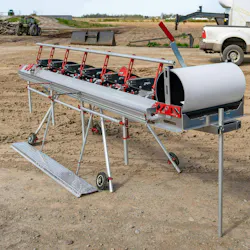
Portable bending brakes have long forced a trade-off: short enough to move, or long enough to be useful, rarely both. Innovatools' Modular Aluminum Brake System breaks that constraint with a patented modular architecture that lets fabricators configure bending capacity to the job, then add modules as needs grow rather than replacing the machine outright. Built from high-strength aluminum with integrated transport wheels, the system breaks down into manageable sections for hauling and storage while holding the rigidity of a fixed-length brake.
The modular format also changes how the system ships. Fixed-length brakes typically require oversized freight, which drives up cost and transit time. Because Innovatools' system separates into compact modules, it can move through standard parcel and air networks instead, cutting shipping costs and expanding access for shops in remote or international markets.
Paired with modular trim coil holders and cutting accessories, it turns a fabrication shop or jobsite into a self-contained production platform, capable of producing custom components on demand rather than waiting on suppliers. The same modularity supports repair and upgrades over time, extending the machine's working life instead of forcing full replacement as output needs change.
Phoenix Contact: BLUEMARK E.CARD Speeds Up High-Volume Marker Printing
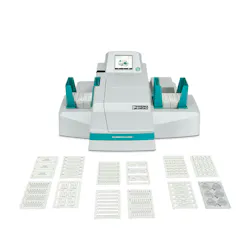
Industrial card marking asks for speed, durability, and adaptability all at once, rarely an easy combination. The BLUEMARK E.CARD from Phoenix Contact delivers by automatically sensing whether a card is plastic or metal and adjusting its ink combination accordingly, printing at 600 dpi in under 53 s/card. Its thermal inkjet and UV LED-curing process produces markers built to hold up in harsh industrial environments, whether the job is standard control cabinet marking or wire marking that needs to withstand tougher conditions.
A 40-card autoload magazine keeps jobs running without interruption, and additional cards can be added mid-job without stopping the print run. Intuitive MARKING software organizes projects and catches misordered cards before they print, and swapping ink cartridges replaces the print head automatically, keeping maintenance low. The modular ink concept lets the printer adapt its approach by application rather than forcing one setup to cover every material and use case.
ABLE Turns Line Data Into a Shared Picture
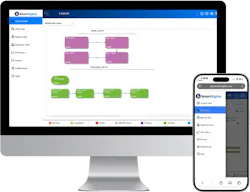
Most OEE systems watch one machine in isolation, missing how a stop on one asset ripples across the rest of the line. SmartSights' ABLE connects every asset instead, building time-synchronized production records in real time rather than the next-day guesswork many plants still run on. At G&J Pepsi, manual logs showed five weekly stops on one line; ABLE revealed more than 375, and deployment lifted production 15% while cutting engineering time up to 70%.
A separate case shows the same gap in a food and beverage plant that knew its efficiency was low but had no data to explain why, relying on operator memory and manual spreadsheets that missed minor stops entirely. After eight months running ABLE with root-cause analysis, plant efficiency rose 20%. A fault-learning subsystem gets sharper over time, turning recurring problems into documented, actionable patterns instead of tribal memory, and integration with existing ERP or CMS systems means plants can act on that data without building a parallel reporting layer.