Podcast: Editor's Product Picks: Warehouse AI, E-Mobility Testing, and Rugged Flashlights
Key Highlights
New Equipment Digest Editor-in-Chief Laura Davis rounds up four products worth knowing about:
- a coupling and brake system built for e-mobility test stands
- an AI-powered platform for warehouse data capture
- a connected AI forklift platform
- a pair of high-output rechargeable flashlights.
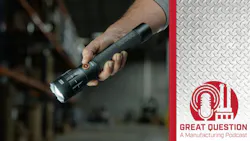




Manufacturing floors are under more pressure than ever to move faster, catch errors before they become costly, and keep equipment running without adding headcount—and this episode's product lineup reflects that pressure from four different angles. Editor-in-Chief Laura Davis highlights a coupling and brake system built for the tighter accuracy and faster dynamic response e-mobility test stands demand; an AI-powered platform that automates data capture across receiving, warehouse movement, and shipping; a connected AI forklift platform designed to close the gap between what your systems say is happening on the floor and what's actually happening; and a pair of rechargeable flashlights built to survive a drop or a downpour. From the test bench to the loading dock to the bottom of your toolbox, here's what's worth your attention this episode.
Below is an excerpt from the podcast:
This month's picks are all about closing a gap, whether that's a gap in measurement accuracy, in warehouse visibility, in operator performance, or just in how much light you've got when you need it.
We'll start on the test bench.
E-mobility test stands demand wider speed ranges, tighter measurement accuracy, and faster dynamic response than traditional drivetrain test environments — while still requiring the precision and process safety that torque measurement depends on. That's the problem this next product family is built around.
The ROBA-DS 9120 is a weight-optimized aluminum shaft misalignment compensation coupling, built on a steel disk pack coupling platform. Compared to the steel version, the outside diameter is reduced by up to 10 millimeters, and mass and mass moment of inertia drop to 40 to 60 percent of the steel version, depending on design and size, with no reduction in performance density. The coupling supports speeds up to 32,000 RPM.
The balance between rigidity and elasticity is designed to minimize restoring forces on connected system components. A balance quality of G two-point-five at 5,000 RPM supports smooth, low-vibration operation across the full speed range — which matters because vibration is a direct factor in measurement accuracy. Standard manufacturing tolerance is IT6, and a nickel-plated surface, stainless steel disk packs, and galvanized connecting screws provide corrosion protection. Backlash-free shaft connections come by way of shrink disk hubs, supporting reproducible measurement results — and the whole thing is modular, so it scales from R&D test stands up to end-of-line testing.
For test stands with vertical axes or linear motion — common in automotive drive testing — there's also a profiled rail brake that clamps moving masses in a backlash-free, high-rigidity hold, available in hydraulic, pneumatic, and electromagnetic configurations. A companion piston rod brake secures linear movements on round rods using a fail-safe, de-energized-closed design, with a six-size range covering holding forces from 15 to 3,800 pounds-force. A compact motor brake installs directly at the drive motor for holding or dynamic stopping duty.
Rounding out the family is a brake-checker module that monitors safety brakes without sensors, while simultaneously supplying them with power. Using current and voltage analysis, it flags conditions like low supply voltage, undersized supply lines, elevated coil temperature, and enlarged air gap — issuing a warning before a brake can no longer release. Paired with a gateway module, brake data becomes continuously readable over Ethernet and viewable on a dashboard, so you're looking at planned maintenance instead of unplanned downtime.
If your test stand work lives or dies on measurement accuracy and dynamic response, this is a system worth a closer look.
Moving on to a platform built to solve a very different kind of visibility problem.
Warehouses, distribution centers, and manufacturing facilities are under constant pressure to move freight faster, cut errors, and keep operational visibility across every touchpoint, all without adding headcount. Peak Automation Intelligence is an AI-powered platform that automates data capture and material flow intelligence across receiving, in-facility movement, and shipping.
It's built on machine vision, smart optics, mobile computing, and unified analytics, and it's made up of four operational modules plus a centralized analytics layer. Dock Door Insights captures every barcode on a pallet in a single pass, even at angles or on labels that are otherwise hard to scan, and it analyzes shipment structural integrity to inform safe storage and transport. Pallet Insights uses specialized optics to read barcodes right through shrink wrap, enabling touchless shipment classification without unwrapping — which helps cut down on chargebacks from verification errors. Tunnel Insights integrates with conveyors for high-speed scanning that combines machine vision, radio frequency identification, and AI to catch damage, mislabels, and compliance risks without slowing the line. And Materials Movement Insights equips forklifts and workers with automated data capture, AI safety alerts, and guided workflows, flagging unsafe loads, damage, and potential misroutes in real time.
All of that data feeds into Peak Analytics, a unified dashboard that consolidates information from docks, forklifts, pallets, and conveyors, validates read accuracy, and surfaces the patterns that point to bottlenecks.
Check this one out if you're trying to get dock-to-shipping visibility without adding extra labor.
About the Podcast
Great Question: A Manufacturing Podcast offers news and information for the people who make, store and move things and those who manage and maintain the facilities where that work gets done. Manufacturers from chemical producers to automakers to machine shops can listen for critical insights into the technologies, economic conditions and best practices that can influence how to best run facilities to reach operational excellence.
Listen to another episode and subscribe on your favorite podcast app
About the Author
Laura Davis
Laura Davis is the editor in chief of New Equipment Digest (NED), a brand part of the Manufacturing Group at Endeavor Business Media. NED covers all products, equipment, solutions, and technology related to the broad scope of manufacturing, from mops and buckets to robots and automation. Laura has been a manufacturing product writer for six years, knowledgeable about the ins and outs of the industry along with what readers are looking for when wanting to learn about the latest products on the market.