Selecting seal materials for industrial equipment: rubber, PTFE, or metal?
Key Highlights
- Selecting the correct seal depends on key factors like temperature, pressure, fluid type, and whether the application is static or dynamic.
- Rubber elastomers are versatile and cost-effective but require proper material choice to match chemical and environmental conditions.
- PTFE seals excel in low-friction, chemically aggressive environments, especially in moving applications, but often need energizers for effective sealing.
- Metal seals are suitable for extreme temperatures and high-pressure static applications but are sensitive to handling and installation damage.
- Proper handling, installation, and maintenance are critical; mistakes can lead to leaks, increased costs, and equipment downtime.
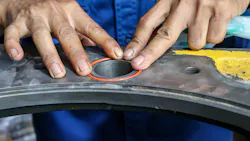
When a seal leaks, most are quick to assume it’s failed. In reality, the seal itself is often not the problem. Instead, leakage occurs because the wrong seal was selected for the application. In other words, what appears to be a product failure can be a design or specification issue.
Choosing the correct seal begins with understanding the conditions in which it will operate. Four key factors drive material selection: operating temperature, system pressure, the gas or fluid being sealed, and whether the application is static or dynamic.
Rubber elastomers
Rubber elastomers are the most common sealing materials and are suitable for most static sealing applications. They generally perform well from approximately -60 °F to 600 °F, depending on the specific compound. From a pressure standpoint, rubber seals can handle applications ranging from vacuum up to roughly 1,500 to 3,000 PSI, with even higher pressures possible when backup rings are used.

Rubber materials also offer a wide range of chemical compatibility. Instead of viewing rubber as a single material, it is more accurate to think of it as a family of materials, each designed for different environments. If a rubber seal experiences chemical compatibility issues, the problem is often that the wrong elastomer was selected rather than rubber being unsuitable altogether.
PTFE
When applications involve motion, polytetrafluoroethylene (PTFE) becomes a strong candidate. PTFE offers significantly lower friction than rubber, making it well suited for rotary and linear sealing applications. It also provides excellent chemical resistance because it is much more inert than most elastomers. Its operating temperature range extends from approximately -300 °F to 500 °F, while pressure capability ranges from vacuum to roughly 5,000 to 10,000 PSI when properly supported.

One important consideration is that PTFE typically requires an energizer to maintain sealing force. In highly aggressive chemical environments, the rubber energizer can be isolated from the process fluid, or a PTFE-encapsulated O-ring may be used to combine its chemical resistance with the resilience of an elastomer.
Metal seals
When applications push beyond the limits of rubber and PTFE, metal seals become the preferred solution. Metal seals operate across extreme temperature ranges, from roughly -500 °F to well above 1,200 °F depending on the alloy. They can seal everything from ultra-high vacuum to pressures exceeding 100,000 PSI and also provide extremely low permeation and helium-tight sealing when leakage must be minimized.

Materials and the application
Although every industry uses rubber seals in some capacity, different materials become more common as application requirements become more demanding. Rubber O-rings can be found almost everywhere, from consumer products to aerospace equipment.
PTFE is frequently selected wherever low friction is critical. Rotary shafts, linear actuators, and suspension components commonly use PTFE sealing elements because they withstand continuous movement more effectively than rubber alone.
Metal seals are often reserved for environments where leakage cannot be tolerated, or operating conditions are more severe. High-pressure oil and gas systems and semiconductor manufacturing commonly rely on metal seals because of their ability to withstand extreme pressures and minimize permeation.
Cost and performance
Generally, rubber is the most economical sealing option, PTFE occupies the middle of the price range, and metal seals are the most expensive.
Within the rubber family, however, costs vary considerably. Silicone is often one of the least expensive choices. Fluorocarbon rubber (FKM) offers greater performance at a higher price point. At the premium end is FFKM, a perfluorinated elastomer that provides exceptional chemical and temperature resistance. In some applications, FFKM seals can cost as much as PTFE and certain metal sealing solutions.
Material cost alone should not drive the decision, however. While premium materials increase initial cost, selecting an inadequate seal can result in equipment downtime or additional component damage that far outweighs the savings.
Mistakes
One of the most common mistakes is assuming all rubber materials behave the same. For example, nitrile rubber performs well in many applications but is vulnerable to ozone. A nitrile O-ring exposed to air containing ozone develop surface cracking and fail prematurely. Replacing it with a material such as ethylene propylene diene monome (EPDM) or FKM can dramatically improve service life in those conditions.
Another frequently overlooked factor is temperature cycling. A seal may technically be rated for temperatures up to 400 °F but repeatedly cycling between room temperature and that upper limit accelerates compression set and shortens seal life. In applications with frequent thermal cycling, a higher performance material such as FFKM may provide significantly longer service despite its higher cost.
Pressure cycling creates similar challenges. As pressure repeatedly changes, rubber O-rings experience slight movement that can eventually cause twisting. Once twisted, the seal creates leakage paths that compromise sealing performance.
Sometimes the solution is not changing materials but changing geometry. Square-profile seals, for example, resist twisting better than traditional O-rings in applications involving repeated installation or movement.
Handling and maintenance
Seal performance depends not only on proper selection but also on proper handling. Rubber seals are relatively forgiving. While installers should avoid cutting or twisting them during installation, accidental drops generally do not cause damage.
Metal seals, however, require much greater care. Small nicks or scratches introduced during shipping or installation can become leakage paths. Even metal seals rubbing together in the same package may sustain damage that compromises performance. They also require substantially higher installation forces than rubber seals.
Although seals are often among the least expensive components in a machine, they frequently become the most costly component when they fail. For that reason, seal selection should be considered an important part of equipment design rather than an afterthought. The objective is to choose a seal capable of lasting through the equipment's preventive maintenance cycle without becoming the source of unplanned downtime.
In many cases, equipment owners understand their operating conditions better than the original equipment manufacturer. During preventive maintenance, replacing an original seal with one better suited to the actual application can significantly improve reliability and service life.
Continuous improvement
While the primary seal material families have existed for many years, innovation continues within each category. Much of today's advancement comes through improved formulations and seal geometries rather than entirely new materials. Manufacturers continually refine rubber compounds to improve temperature capability, resilience, stretch, and chemical resistance for specific applications.
Some newer rubber compounds even incorporate lubricants directly into the material. As the seal operates, lubrication gradually migrates to the surface, providing long-term friction reduction without relying on externally applied lubricants that can wash away or wear off.
These incremental improvements continue to expand performance while reinforcing the fact that selecting the right seal depends less on finding a universally superior material and more on matching the seal to the specific demands of the application.
About the Author
Kyle Timm
Kyle Timm is an engineer at Valin Corporation, a subsidiary of Graybar, a technical solutions provider for the technology, energy, life sciences, natural resources, and transportation industries. For 50 years, Valin has offered personalized order management, on-site field support, comprehensive training, and applied expert engineering services utilizing automation, fluid management, precision measurement, process heating, and filtration products.