Designing industrial power resilience for grid instability and energy scarcity
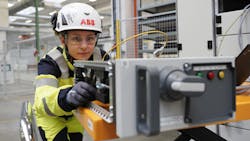
As grid instability becomes a routine operating condition, power reliability must be designed into the electrical system from the start. Many facilities will need retrofitting with the same level of attention to detail.
According to ABB’s Pedro Robredo, senior vice president of Americas for ABB Electrification Service, the challenge is a mismatch between how plants traditionally approach electrical infrastructure and the demands of today’s operating environment. Industrial facilities across the U.S. are experiencing regular outages and power fluctuations that quietly degrade assets and reduce operational efficiency.
Stabilizing power at the facility
If manufacturers can’t rely on utilities to guarantee stable power, there are ways to maintain operational continuity and protect sensitive equipment. Robredo says energy storage and advanced uninterruptible power supplies (UPSs) can help facilities smooth out voltage fluctuations, isolate key assets from grid disturbances, and maintain production even during brief outages.
In order to act as an effective buffer against power issues, integrating energy storage and UPSs into a facility requires planning upfront for proper sizing, monitoring, and system control.
Robredo notes that deploying storage is not only about capacity, but also about enabling plants to actively control their energy usage. Load shifting, or running energy-intensive processes during periods of lower grid demand, can also reduce exposure to peak-stress periods and minimize the operational impact of instability.
Energy storage as infrastructure, not equipment
Microgrids and on-site storage systems are increasingly common in industrial facilities for protection against the grid’s fluctuations and to take ownership over power generation. They also provide the flexibility to manage demand dynamically.
Energy storage can provide clean, reliable power regardless of external grid conditions. The technology has improved tremendously in the last 10 to 15 years, Robredo says. On-site energy storage systems use large lithium-ion battery systems, typically placed outside of the building to receive, store, and generate power when needed. “It’s now more affordable,” he says. In some cases, microgrids can be a profit center selling unused power back to the utility. Current battery technology has vastly improved, Robredo says, and can charge and discharge very quickly, which was a problem with systems of the past.
ABB also has a partnership with GridBeyond to put intelligence into the energy storage systems. “We use AI to look at what’s happening on the utility side and the opportunities to sell power back,” Robredo says.
The market for energy storage systems is growing fast, Robredo says, starting around five years ago. He predicts usage of energy storage to nearly triple by the end of this decade. “I imagine in 10 years, the world is going to be very different,” he says. He also thinks that energy storage systems will become a stand-alone part of the grid used by the utilities and individual facilities to balance power supply. “It’s a very reliable way of doing it,” he adds.
One of the challenges with energy storage systems, he says, is cost. Battery technology costs have come down some, but “they can be very expensive upfront,” he says, estimating between $5-$10 million for equipment and installation.
To help offset the capital expenditure cost for plants, ABB offers an asset service model for energy storage. It’s a subscription service, so ABB takes care of installation and operation of the energy storage systems, for a regular fee from end users. “Sometimes you even get a windfall or a profit from the energy storage system being used to put power back into the grid,” he says.
For many manufacturers, the shift from capital expenditure to service-based operating models reduces financial risk. Instead of committing millions in upfront capital and assuming the long-term technology obsolescence risk, facilities can structure storage as an operating expense. Manufacturers gain a predictable cost structure and access to ongoing technology upgrades without committing large amounts of capital upfront. Service-based models can mitigate technology obsolescence risk by transferring lifecycle management to the provider.
For facilities where unplanned downtime has a high cost per hour, ownership of the energy storage system may make more sense. Avoiding major outages and costly downtime could financially support and offset a multi-year storage investment.
Ultimately, the economic case for storage strengthens as grid instability increases, and the financial value of resilience rises with it.
Asset management in an unstable power environment
Maintaining equipment reliability in the face of grid instability requires a proactive approach to asset management. “We need to extend the life of the assets through service and also use predictive maintenance to also extend the life of the assets,” Robredo says. Run-to-fail strategies leave plants more vulnerable to sudden outages and cumulative damage from power deviations. Simply extending the life of your assets with better maintenance and attention to power issues can make a difference.
“If you wait for things to break, it's going to cost you probably 10 times more than if you actually are looking at the condition and doing something about it to make sure that you don't get to the point of failure,” Robredo says.
By leveraging condition-based and predictive maintenance strategies, manufacturers can monitor asset performance, detect early signs of stress, and intervene before failures occur. Maintenance teams can plan interventions strategically rather than reacting to breakdowns. Instead of responding to power failures, plants can begin managing electrical assets with the same discipline applied to rotating equipment and production machinery.
AI-enhanced analytics add another layer to predictive maintenance. “Now, with AI, not only can we look at conditions, but we can go well beyond the historical facts and get to a point where we can start to see patterns that are not obvious,” he says. The dream is being able to do this in real-time, making changes to the power load and on the assets in real-time. “We’re not quite there yet,” he says, but AI will eventually give operators a glimpse beyond individual assets into the condition of the factory as a whole in real-time.
Why collaboration defines the next phase
Electrical resilience increasingly depends on collaboration across the industrial ecosystem, Robredo says. No single plant, OEM, or utility can address grid challenges in isolation.
“Everybody that’s involved with electrification today has to realize that no one can do it alone,” Robredo says. “These things are complex, and you have to play along. You have to be able to collaborate.”
This collaborative approach extends to data sharing, load management, and demand shaping. Manufacturers can adjust operations to align with grid conditions, while utilities gain better visibility into consumption patterns for demand planning.
About the Author

Anna Townshend
managing editor
Anna Townshend has been a journalist and editor for almost 20 years. She joined Control Design and Plant Services as managing editor in June 2020. Previously, for more than 10 years, she was the editor of Marina Dock Age and International Dredging Review. In addition to writing and editing thousands of articles in her career, she has been an active speaker on industry panels and presentations, as well as host for the Tool Belt and Control Intelligence podcasts. Email her at [email protected].