Case study: On-site nitrogen generation cuts costs for stainless steel laser cutting
Key Highlights
- Giles expects the on-site nitrogen system suggested by Mobile Mechanical Services to pay for itself in about two years and save about $500,000 in over 10 years.
- On-site nitrogen will replace Giles’ dependence on bulk nitrogen deliveries.
- Giles uses nitrogen at approximately 99.995% purity for laser cutting stainless steel and the system will help maintain product quality.
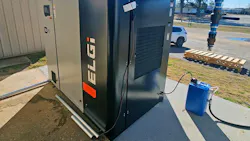
- The ELGi EG75 variable-speed compressor adjusts compression-air output closely to Giles’ needs and provides a complete long-term solution.
Giles Foodservice Equipment has an 81,000-square-foot manufacturing facility with approximately 50 employees in Montgomery, Alabama. It makes food service equipment, including fryers, hoods, heat lamps and oil-cleaning equipment, serving a broad range of food service customers and applications. It also manufactures many of the stainless-steel components used to build that equipment.
Giles Foodservice Equipment customers include Walmart (with 11,000 stores in the U.S.), Publix (with 1,442 stores in the U.S.), and Chester’s Chicken locations (with more than 1,300 in the U.S.) inside many Speedway, Circle K, 7-Eleven, Love’s and Pilot stores.
Pure nitrogen generation requires major compressed feed air
“One of our key manufacturing processes is laser cutting stainless steel. We use the laser to cut components that are later formed into tanks, equipment frames, faceplates and other parts used in our food service equipment. Nitrogen is used during the laser-cutting process to help keep the cut clean and support cut quality,” says Giles Manufacturing Engineering Manager Josh Blalock.
The laser-cutting process requires nitrogen at approximately 99.995% purity.
“Producing nitrogen at that purity requires a significant amount of compressed feed air, so sizing the compressor and generation system correctly was important,” Blalock explains.
“Two of the biggest considerations for us were cost and control over our supply. Purchasing bulk liquid nitrogen was expensive, and relying on deliveries meant our nitrogen supply depended on an outside provider,” Blalock adds.
Giles Foodservice Equipment began working with Mobile Mechanical in August 2024 with planning that took more than a year to evaluate, scope and implement. That process included a feasibility study, system selection, site visits, discussions and installation.
Blalock credited Mobile Mechanical with working through the project rather than just providing a quote.
“We ultimately chose the ELGi solution because of the overall value, warranty coverage, and the level of involvement Mobile Mechanical brought to the project,” Blalock says, adding that they were fortunate to partner with a company that studied the application and explained the options.
“Our role was really consultative. We helped Giles understand the technology, evaluate whether it made sense financially, determine the compressed air requirements, select the equipment, and install the system,” says Mobile Mechanical Services Sales Consultant Nathan Toro.
Blalock explained that “this was not a simple equipment purchase. It took time to understand our nitrogen requirements, evaluate the economics and determine the right system for our manufacturing process. Having Mobile Mechanical involved throughout that process gave us a partner that understood the application and could work through the project with us.”
Adapting the ELGi EG75 for on-site nitrogen generation
The ELGi EG75 variable-speed standard compressor with filtration and a nitrogen generator provides the feed air to produce high-quality nitrogen for the laser. The standard compressor did the job, and special modifications were not necessary.
According to ELGi, the 100-horsepower compressor delivers up to approximately 375 cubic feet per minute (CFM) of compressed air at typical pressures around 100 pound per square inch (PSI). This provides consistent airflow needed for stable nitrogen generation and laser cutting.
The variable-speed component helps the compressed air system respond to changes in demand by “matching compressor output more closely to what the system requires. Proper sizing was also important so the compressor could provide the feed air needed by the nitrogen generator without unnecessarily producing more compressed air than required,” Blalock says.
The system started on-site around November or December 2025, according to Blalock, adding that Giles continues to work with Mobile Mechanical to support the system. Blalock does not anticipate any changes to the company’s nitrogen requirements or production needs and says that the current system is meeting Giles’ needs.
Mitch Bailey, senior technician for Mobile Mechanical, explained that “once the system is installed and commissioned, it is designed to be relatively straightforward for the customer to operate. It does not require a dedicated employee to constantly manage it.”
Bailey explained that Mobile Mechanical handles scheduled preventative maintenance, which is at approximately 2,000 hours or 6 months; 4,000 hours, or annually; and 8,000 hours or every two years, depending on components and operating conditions.
This maintenance includes servicing the compressor and checking components to keep the system operating reliably, which includes checking temperatures, inspecting for leaks, and making sure the compressor receives proper air flow and cooling.
Specifically, Bailey says that “on the compressed air side, common requirements include checking oil levels, filters, drains, operating temperatures, pressures and alarms. Oil, oil filters, air filters, and air-oil separator elements also need to be serviced according to the manufacturer’s schedule.”
As for the nitrogen-generation side, Bailey added that it “relies heavily on clean, properly treated compressed air. Filters need to be maintained so moisture, oil and contaminants do not reach the generator. Similar PSA nitrogen-generator systems also call for periodic filter inspection, valve checks and purity-related maintenance.”
Is on-site nitrogen generation the right choice for your facility?
For other manufacturers considering on-site nitrogen generation as a possible solution, they should determine whether cutting costs is their biggest concern or whether it is reliability, purity, production capacity or dependence on nitrogen deliveries.
It’s important for companies to understand that “on-site nitrogen generation is not a one-size-fits-all solution,” Toro explains.
For most companies looking to save money, “Savings will vary significantly depending on the customer’s nitrogen consumption, current nitrogen costs, electricity rates and application,” Toro says, adding that other factors to consider include production schedules, cost of gas, delivery fees, rental fees and other supplier charges. Nitrogen demand depends on the application and production process.
“This includes their nitrogen consumption, purity requirements, pressure and flow needs, delivery charges and any additional fees tied to their current supply,” Toro explains, adding that Mobile Mechanical also looks at how the manufacturer’s demand changes throughout production. He says that the cost of continuing to purchase nitrogen is weighed with the cost of generating it on-site, including electricity required to run the compressor.
“Some operations may have relatively consistent requirements, while others may change with production. We would evaluate each customer’s demand profile before recommending and sizing a system,” Toro says.
For example, manufacturers with production schedules and product mix changes from job to job, such as trailer manufacturers, prefabrication shops, aftermarket parts manufacturers, lifting equipment manufacturers and sheet metal fabricators, could have fluctuating nitrogen needs.
Toro also recommends facilities look at the complete system because the “compressor, filtration, nitrogen generator and downstream equipment all need to work together.”
Sizing is determined by the required nitrogen flow, pressure and purity, Toro explains, adding that higher-purity nitrogen requires more compressed feed air.
Bailey added that no matter where the system is installed it needs to be designed for the pressure and flow that the application requires. For example, laser cutting operations require nitrogen to be delivered to several hundred PSI, and every component in the system needs to be rated for the required operating pressure.
“For us, the key is understanding both the customer’s average demand and peak requirements. That allows us to size the compressed air and nitrogen-generation system so it can support heavier production periods without being unnecessarily oversized for the times when demand is lower,” Toro explains.
Additionally, cost savings could be lower for companies based on how their systems are designed, if they are in a long-term bulk nitrogen contract and/or if they choose to maintain an outside nitrogen supply as a backup.
Finally, another factor to consider is the company’s long-term manufacturing plans so that the system can support future growth.
Calculating savings
Mobile Mechanical believes that Giles will save $500,000 over a 10-year period with the new system. Blalock explains “the savings estimate came from comparing what we were paying for bulk nitrogen with what it would cost us to generate nitrogen on-site. The calculation also accounted for the electricity required to run the compressed air system, so it was not simply a comparison between purchased gas and free nitrogen.” Bulk nitrogen deliveries cost about 80 to 90 cents per 100 cubic feet of nitrogen, according to Mobile Mechanical.
“The system was projected to pay for itself within approximately two years,” Blalock says. “The actual savings could potentially be higher because some delivery and other supplemental charges associated with our previous nitrogen supply were not included in the original calculation.”
About the Author
Corey Sipe
Corey Sipe has more than 20 years of experience in journalism working for a variety of daily, weekly, and monthly newspapers and websites, including almost 3 years as associate editor for Simplify Compliance on its EHS Daily Advisor (now called EHSLeaders), Facilities Management Advisor and Total Security Advisor B2B publications. He also served as the social media administrator for EHS Daily Advisor.