Bomb-defusing robots successfully handle explosive threats in real-world tests
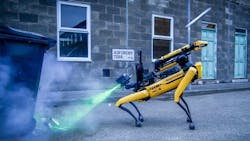
Let’s play a game. Close your eyes and envision a typical industrial robot. Maybe it’s a humanoid robot transporting cumbersome boxes as it traverses a large warehouse. Maybe it’s a robotic dog determining the health of various machines as it walks the plant floor. Maybe it’s a drone monitoring a facility for safety and security incidents as it flies through the air. Now, think of three adjectives to describe the robot. I bet you imagined words like “efficient,” “precise,” “reliable,” and “versatile.” One word that probably didn’t come to mind was “heroic.”
It might seem like a stretch to think of an inanimate object as “valiant” or “courageous,” but a team of U.K. scientists is working to change that. They are using robots of various types to perform one of the most difficult and dangerous jobs there is: detecting and defusing bombs. According to the BBC, robots have been used in some capacity to disable explosive devices for the past 40 years. This latest generation of robots, however, is nothing like its remote-controlled predecessors. These robots use the latest tech to keep military personnel and civilians safe while improving the efficiency and safety of these critical missions.
Scientists at the U.K.’s Ministry of Defence recently conducted live tests to see if robot dogs and other advanced robotic systems could detect and defuse various bomb threats. According to the Defence Science and Technology Laboratory (Dstl), the trials, which were conducted over the course of four days, were a success. The robots were tasked with a variety of actions, including:
- Remotely classifying and identifying threats
- Defusing bombs
- Threat and people detection
- Opening doors and climbing stairs
Dstl partnered with L3Harris, Marlborough Communications Ltd, and AeroVironment (Tomahawk Robotics) on the trials, which support the U.K. Government’s Plan for Change. This government initiative is designed to enhance national security through the implementation of new and advanced technologies. These tests prove that robotics can improve explosive ordnance disposal (EOD) capabilities by minimizing human exposure to dangerous situations, improving operational efficiency, and maintaining public safety. Specifically, robots can be used to:
- Reduce the need to put a bomb disposal operator in harm’s way
- Allow delicate and precision movements to be completed remotely and reliably
- Identify threats and monitor safety cordons
- Increase the pace of operations and reduce disruption to the public
In a recent quote, Minister for Defence Procurement and Industry, Maria Eagle, said, “This advanced technology demonstrates our commitment to protecting the military personnel who keep our nation safe, at home and abroad. By working with industry and combining cutting-edge robotics with existing expertise, we’re ensuring our bomb disposal teams have the best possible tools to carry out their vital work safely and effectively.”
Chief Science and Technology Officer, Dstl, Prof Andy Bell, added, “This is a great example of how Defence can achieve an advantage through the exploitation of technology, fusing together military and commercial systems to keep our people and country safe from deadly threats. Working in partnership with industry and academia, Dstl is delivering mission success through science and technology advantage.”
About the Author
 Alexis Gajewski
Senior Content Strategist
Alexis Gajewski is a manufacturing writer and editor with nearly 20 years of experience covering the people, practices, and technologies that keep industrial facilities running. For more than a decade, she served as Senior Content Strategist for Plant Services, creating content for plant managers, engineers, and maintenance professionals on a variety of industrial topics.
During her tenure, Alexis worked to develop the brand’s digital strategy and helped launch and produce Great Question: A Manufacturing Podcast. She also created The Lighter Side of Manufacturing, a weekly blog that explored the inventive and sometimes humorous side of the industry.
Alexis co-founded Influential Women in Manufacturing, a recognition program that honored 49 women in its first two years, earned an industry award for Best Product Launch, and received a proclamation from Illinois Governor JB Pritzker and a commendation from U.S. Senator Tammy Duckworth.
She also led newsroom operations and development at a large media company where she set editorial standards, developed training curriculum, and helped support AI adoption for more than 150 editors across 80+ brands spanning manufacturing, industrial processing, automation, and more.
Additionally, Alexis works as a freelance writer and editor, and her areas of interest include continuous improvement, the skilled workforce, and the role of emerging technology on the plant floor.
Connect with Alexis on LinkedIn
Related

 shutterstock_2541339301