Understanding Ethernet and edge devices in monitoring performance metrics
Key Highlights
- Ethernet cabling standards from Cat 5 to Cat 8 are crucial for ensuring reliable, high-speed data transfer.
- Edge devices process critical machine data locally to minimize latency and enhance real-time decision-making.
- Proper data filtering and storage strategies, such as local edge processing and cloud analytics, help manage large data volumes efficiently.
- Security measures like firewalls, encryption, and network segmentation are vital to protect sensitive manufacturing data from cyber threats.
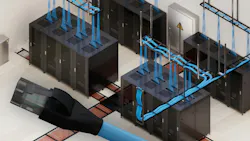
Predictive maintenance requires a communication infrastructure capable of transmitting machine data quickly and securely from the factory floor to the people and systems that need it. As manufacturers deploy more connected equipment, vision systems, and AI-enabled applications, the amount of operational data generated inside a facility continues to grow.
Generally, this data can be stored on an on-prem server or the cloud, and edge devices are bringing that data and real-time analysis function closer to the equipment. Successful data management must start within the manufacturing facility itself, especially when transmitting critical performance metrics with minimal latency as the goal. Proper data management is a comprehensive undertaking that requires a balance of both hardware and software that integrate seamlessly to empower the operator to make informed decisions through the IIoT.
A solidified standard
Evaluating data management must begin with Ethernet cabling, as it’s the standard for connecting a variety of network layers within a facility. Ethernet ensures consistent performance data delivery through uninterrupted transmission, especially in protocols like Ethernet/IP, Profinet and Modbus TCP. But it’s not a one-size-fits-all approach when integrating or upgrading Ethernet cabling.
The speed depends on the bandwidth that’s needed, and manufacturers need to be aware of the range that’s available. Ethernet cabling typically spans from Category 5 (Cat 5), which is a standard offering with speeds up to 100Mbps and 100MHz bandwidth, up to Cat 8, which boasts speeds up to 40Gbps and 2,000MHz, which is typically only leveraged within data centers. We’re soon approaching a day when 1.6-terabit cabling will be common in hyperscale data centers, as AI continues its proliferation. But for now, Cat 5-7 is what most manufacturers need.
A practical example would be low-speed command/control for a conveyor belt that’s mostly sending off/on signals and limited data. Cat 5e - slightly more robust than Cat 5 - would be a logical choice. Comparatively, something like a machine vision camera taking hundreds of photos rapidly for quality control purposes would require 10Gbps or higher, and thus need a Cat 6a bandwidth.
Jacketing choices for cabling are also important, and they, too, depend on usage and the environment. Manufacturers have to determine if they need hardened (outdoor or water-resistant cables), industrial (oil and chemical resistance), high flex or any combination of those options. For example, a cable in a food plant that will be periodically washed down will need waterproofing, while a cable in a controlled and sealed NEMA box could likely be a regular commercial cable. Additionally, Ethernet connectors play a role in connectivity, as metal connectors instead of plastic ones make a difference in preserving transmission in harsh environmental settings.
Manufacturers should then consider their individual processes and machinery, take inventory of all the data points they could be monitoring, and refine that list to the critical metrics they should be monitoring, like those that can predict failure and/or directly impact productivity, such as speed, temperature, and vibration. It’s important to be deliberate in deciding what to monitor, as managing data can be burdensome. If organizations try to track too many metrics, it can be easy to get inundated with information, some of which may not be a priority. An application of how Ethernet helps facilitate that monitoring process would be the aforementioned conveyor belt that needs off/on, motor load, and belt speed to determine if it’s functioning optimally. Ethernet helps by providing a singular interface that multiple sensors or devices can report into. For example, multiple programmable logic controllers (PLCs) or supervisory control and data acquisition (SCADA) systems can all report into a singular IP using Ethernet via a communication protocol, such as Profinet or EtherCAT.
Living on the edge
Naturally, there are additional resources at manufacturers’ disposal beyond Ethernet cabling that help monitor predictive and preventative maintenance metrics, which is where additional hardware like edge devices comes in. Edge computing devices can be placed strategically throughout a factory floor to monitor the performance of key machinery. It’s often helpful to view deployment of these devices in layers that integrate and communicate to achieve a common monitoring goal.
Generally, smart devices like sensors, which serve as the eyes and ears of monitoring, are in layer one. Sensor information feeds the controllers, including PLCs, in layer two. They send data to the industrial Ethernet network in layer three, where all info can be shared and combined in a single system. This is also where switches, media converters, and routers sit. Layer four is the last physical layer and where the actual edge devices sit. These are local computers that do the actual processing of the information received, such as an industrial PC. The PC will then use software to filter and process the information to report on it, adjust, predict, etc. Layer five is cloud and analytics, requiring major software, and layer six is full business systems, like enterprise resource planning (ERP).
Once the devices and layers are established, it’s important to then filter the data, and there are a variety of ways to do so based on the application. Some devices filter against a predefined limit, such as if an application’s temperature rises above a certain level or falls outside a designated range. Some filtering can be related to a change-of-state, i.e. on-on-on-on-off, and thus only reports when a state changes. Still another example would be event filtering like start, stop, fails, open, or reaching a specific count. Again, it’s important for manufacturers to be specific about what exactly they need to be tracking to streamline the monitoring process.
Then comes the question of where that data is stored, as systems can be overloaded quickly, especially with large data files like imagery or videos. One of the key benefits of edge devices is their proximity to the machine they’re monitoring. Most manufacturers want to keep important data local and use the cloud for long-term analysis and historical record-keeping, because local networks are typically not subject to latency and connection issues. Usually, real-time control and protection will stay at the edge, as well as predictive maintenance data and machine vision.
There’s also a security element to edge device usage. Edge devices are physically connected and keep more data and usage internal rather than operating remotely and/or in the cloud. This bifurcated approach segments networks and devices by providing a buffer between the industrial network and the outside. It is also a redundancy measure that allows local devices to continue functioning if the long-distance communications or cloud is down for whatever reason. Further security measures for edge devices include firewalls, encryption, or authentication requirements. It’s also important to note that cybersecurity regulatory measures like the Cyber Resilience Act (CRA) may soon be coming to U.S. manufacturing, so manufacturers need to be aware of how their digital technology is monitoring processes and storing information safely.
At its core, successful predictive or preventive maintenance is about understanding what the machines are reporting and how it is helping avoid downtime. Ethernet cabling and edge computing devices are repeatedly found in today’s manufacturing facilities because they are foundational elements of successful data management. Ethernet cabling is the lifeblood, and edge devices are the on-site brains that make up the complex body of modern manufacturing. They allow manufacturers to be strategic about how they’re translating real-time data into operational decisions and encourage greater flexibility and scalability as market needs dictate, which is invaluable in nearly every industrial sector.
About the Author
Dustin Guttadauro
Dustin Guttadauro is the product line manager for L-Com, an Infinite Electronics brand. Dustin’s experience with the company spans nearly two decades and includes positions in service, support and product management. He studied Mechanical Engineering at the University of Massachusetts Lowell and resides in New Hampshire.