Podcast: Human-shaped robots - what's the point?
Key Highlights
-
Humanoid robots dominate attention, but many remain in pilot stages with unclear ROI vs. simpler automation like cobots or wheeled systems.
-
Short-term value favors practical designs (wheels, arms) over full humanoids due to cost, stability, and battery limitations.
-
Growth in AI-driven vision boosts robots like quadrupeds for safety tasks, expanding real-world industrial inspection use cases.
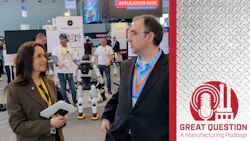




In this episode of Great Question: A Manufacturing Podcast, IndustryWeek's Dennis Scimeca and Machine Design's Rehana Begg talk all of the walking robots at Hannover Messe, the massive trade show that took place in Germany in late April. Amongst the automation equipment, software, machines and controllers were a lot of upright, humanoid robots. In nearly every hall at the show, robots walked arounds. Some danced, some picked up small objects and put them in a box, some waved to passersby and some did things that looked like they might be marginally useful on a manufacturing shop floor.
Dennis and Rehana discuss the pros and cons of our new robot overlords with some help from Kal Mos, executive vice president for research & development at Siemens. If Dennis Scimeca is a skeptic on the need for robots to look like us, Mos is the opposite: a believer that we've built the world for people and robots should adopt our form factor to get around.
Below is an excerpt from the podcast:
Robert Schoenberger: Hello, this is Robert Schoenberger with IndustryWeek. And recently, I attended the Hannover Messe trade show with colleagues Rehana Begg from Machine Design and Dennis Scimeca, also from IndustryWeek. We saw a lot of manufacturing technology, from automation systems to machining systems to lasers to software to just about everything. But what we really saw over and over again, humanoid robots.
Rehana Begg: I did go and see the Hermes Award winner at Schaeffler's booth had a really good conversation there with a man by the name of David Kerr, who is the president of their humanoid robotics. An interesting conversation because what they're focusing on and the reason they won this year's award was for their platform, the actuator platform that includes high-efficiency servo motors with integrated power electronics and encoders. So what's so unique here is that it's configured with two planetary gear units or shaft-mounted gear units. What is why? So why is this important? So the objective in the development of this technology was to improve or to achieve maximum installation space with high continuous torque.
Okay, let me unpack that just for a second. So they improved the installation footprint or reduced it by 20%. That's really quite significant if you think in terms of humanoid robotics. And it's also designed for rapid scaling and its form factors. The materials used, that's the other important thing was the copper full factor, so for light weighting, which is really important in humanoid construction. The other thing I can tell you about that platform that they were able to reduce the gear systems to about 500 grams less in mass than an improvement in efficiency. And another nice stat that I got from that conversation was he said that 50% of the bill of materials hardware cost of a humanoid, of a complete humanoid, comes from the actuator platform. So that's pretty significant benefits or achievements and efficiency gains that they've had with their win this year.
Dennis Scimeca: This is the first time I've ever been to Hannover Messe. I saw hydraulics, bearings, connectors, electrical equipment, precision casting, grinding and coating services, injection molds, data platforms, pneumatic tubes, cabling. I even saw roller wheels, like roller skate roller wheels, but large. It's all here, and there's tons of people doing all of it.
That said, it's a lot smaller than I thought it was going to be. I made to understand that the organizers want everything condensed this year, there seemed to be, made understand, fewer exhibitors, so between the two of those things I was able to walk the whole floor, so I'm glad this was my first one. I didn't think I was going to be able to do that. In terms of interesting things I saw, I mostly focused on humanoid robots. Humanoid robots are going to become my new, what do you call it? when you're kicking something when it's down, you're always beating it up because you don't like it. What's the phrase I'm looking for? Whipping boy, whipping boy. Yes, humanoid robots are becoming my new whipping boy. We're going to move from AI to humanoid robots because I actually,
I think I saw all of them at the show. And I asked people, what makes your humanoid robot unique? And a couple of times the answer was nothing. I appreciated the answer.
Robert Schoenberger: To Dennis's point, there were a lot of humanoid robots on the floor of Hannover Messe, and most of them were really small child-sized units, really, more designed for marketing and approaching people in malls and doing industrial work. There were a handful of industrial units, and I talked to several people who talked glowingly about what the research is doing right now in terms of preparing for a future in which humanoid robots will take a big part in the industrial space.
That said, not everything was all that wonderful, and we talked in depth to some people at Siemens about their thoughts on humanoid robots. Here is Dr. Kal Mos, Executive Vice President of Research and Development for Siemens.
Kal Mos: At the end, it's extremely valuable to have a humanoid form factor. The whole world, as everybody's saying, the whole world is designed for humans, right? We designed this chair for us, we designed this table for us, we designed the transportation for us, we designed the factory pipeline for us. The whole world is designed for humans. So if you can create a machine that acts like human, looks like human, of course it will be very, very valuable.
Now, until you reach that at a reasonable cost, it may not be the starting point, though. You might have more value in the short term for a machine with a wheel, as you saw on the show floor, because that's easier to move around. If you replace the legs or the double paddle, you can actually put in that thing the battery, so you can have a bigger battery. And you don't have to deal with a lot of stability issues because these things keep it more stable. So there's a lot of concerns about the feet, for example. So that's the first thing that you might want to think about compromising on in the short term and say, okay, maybe we start with maybe something that moves on wheel as a starting point. And then when I solve the problem of battery, when I solve the problem of balance and all of this stuff, maybe I go to the humanoid.
But my strong belief is that the humanoid, as you can see it online today on all this YouTube video, is the right form factor. It is the right target. And eventually when we create that at higher cost with good battery lifetime and all of these things, it will be the right goal.
Dennis Scimeca: What function does the torso serve on a humanoid shape robot?
Kal Mos: So what do you want to replace it with?
Dennis Scimeca: Let's use the example of the Cobot arm that's on the floor right now. It doesn't make a torso. All it needs are the arms. So what's the torso? If you have a humanoid robot, now you've just added a torso, you've added an extra arm, two legs and a head. You just made the robot much more complicated than it used to be. It's true. So why do that if you can use a simpler machine that only has the functionality it requires?
Kal Mos: I think you're absolutely right again on the short term as we get into that. And I go back to the question that this whole world is not designed for these new machines, it's designed for us. So that's why we're trying to get to a machine that looks like us, because it makes it possible for us not to change everything around us.
If you look at this machine that you see now without a torso, it's just arms on a moving wheel, it's perfect for certain function, it will help us in the short term. But now as you start thinking about, does it fit in every area where humans are working on today? Probably not. Does it fit in the transportation system that we have for workers? Maybe not. Does it fit in, like, there are lots of things that are designed around us as human.
So, and as I started, it's really a value versus cost. So for today, I think this is a good machine to start with and it will help us in addressing so many of the use cases. But if we can reach another level where we can create a full humanoid form factor, I think this is the right eventually target for us.
Rehana Begg: On the flip side of that, the other thing that I did not see much of, we saw lots and lots of humanoids, is the quadruped robot, like Spot. I did see one and I talked to someone about what they were being used for, are they still as popular as before, and they are, especially when it comes to safety environments, sniffing out gases that they're used for. The vision quality has been improved that I've been watching year over year. So they're able to do more things using vision technology and artificial intelligence, learning from models and what different types of things that they can sniff out, pardon the pun. So that was pretty interesting.
Dennis Scimeca: Yeah, but they're all so small. I think that was one of the differentiators as a company over there. They made one that's 165 centimeters tall, I think, which is roughly human height. It's the only one I've seen. They've all been small. I don't understand that. So we want to create this thing that looks human, but it's tiny. Most humans aren't tiny. So just, I don't know. I don't understand a lot of the logic behind it. It's fun to watch them fall. That's always good.
Rehana Begg: I actually went and asked, the humanoid robotic maker, are you going to be improved? How have you improved over the last time I saw this? You know, this really was just for demonstration. The fact is that everybody is delving into it. They need to understand more about it. They're learning about the technologies and the components that go into these robotics. And right now, I think I certainly feel that I've seen a whole lot more use cases, not necessarily out of the pilot stage yet, but many more places where you could potentially have a humanoid do pick and place. Yeah, still doesn't account for the form and function.
Dennis Scimeca: Yeah, that's the classic example. Someone showed me robots to pick and place. Said, but yeah, you could do that with a six-axis roam and a camera. Why do I need this thing? No answer. I never get any answers from anyway.
About the Podcast
Great Question: A Manufacturing Podcast offers news and information for the people who make, store and move things and those who manage and maintain the facilities where that work gets done. Manufacturers from chemical producers to automakers to machine shops can listen for critical insights into the technologies, economic conditions and best practices that can influence how to best run facilities to reach operational excellence.
Listen to another episode and subscribe on your favorite podcast app
About the Author
Robert Schoenberger
Robert Schoenberger has been writing about manufacturing technology in one form or another since the late 1990s. He began his career in newspapers in South Texas and has worked for The Clarion-Ledger in Jackson, Mississippi; The Courier-Journal in Louisville, Kentucky; and The Plain Dealer in Cleveland where he spent more than six years as the automotive reporter. In 2013, he launched Today's Motor Vehicles, a magazine focusing on design and manufacturing topics within the automotive and commercial truck worlds. He joined IndustryWeek in late 2021.
Dennis Scimeca
Dennis Scimeca is a veteran technology journalist with particular experience in vision system technology, machine learning/artificial intelligence, and augmented/mixed/virtual reality (XR), with bylines in consumer, developer, and B2B outlets. At IndustryWeek, he covers the competitive advantages gained by manufacturers that deploy proven technologies. If you would like to share your story with IndustryWeek, please contact Dennis at [email protected].
Rehana Begg
As Machine Design’s content lead, Rehana Begg is tasked with elevating the voice of the design and multi-disciplinary engineer in the face of digital transformation and engineering innovation. Begg has more than 24 years of editorial experience and has spent the past decade in the trenches of industrial manufacturing, focusing on new technologies, manufacturing innovation and business. Her B2B career has taken her from corporate boardrooms to plant floors and underground mining stopes, covering everything from automation & IIoT, robotics, mechanical design and additive manufacturing to plant operations, maintenance, reliability and continuous improvement.