Podcast: How Kettering University's co-op model provides real-world manufacturing experience
Key Highlights
-
Rotating 12-week classroom and industry placements gives engineering students 2.5 years of real experience, preparing them to enter the workforce “mid-career.”
-
Deeply integrated co-op programs connect theory with real-world manufacturing challenges, helping students engage coursework with practical insight.
-
Manufacturers gain strong ROI from co-op programs by developing talent early, often hiring graduates who can lead projects immediately.
-
Treating talent like a supply chain—by partnering with universities—helps manufacturers address the skilled labor gap and build a reliable workforce pipeline.
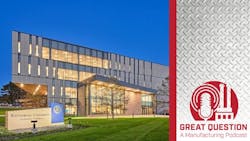




With artificial intelligence (AI), mass customization and shrinking lot sizes changing expectations in manufacturing, companies need new skills and abilities from those who they hire. So, where do you find an entry level engineer with years of experience and training in how to deal with the constantly changing needs of production?
In this episode of Great Question: A Manufacturing Podcast, Kettering University President Robert McMahan says getting students experience while in school is key. The former General Motors Institute (a private university, separate from the automaker since the early 1980s) has long used factory floors and design centers as training grounds for student education. Current GM CEO Mary Barra is among the school's alumni who got their first taste of manufacturing while studying engineering there.
In this episode, McMahan talks to IndustryWeek's Anna Smith about the school's educational co-op model and how schools need to collaborate with manufacturers to prepare the next generation of industrial leaders.
Below is an excerpt from the podcast:
AS: Welcome to Great Question: A Manufacturing Podcast. I’m IndustryWeek Staff Writer Anna Smith. Today we’ll be discussing Kettering University’s co-op model with the president of Kettering University, Dr. Robert McMahan.
Thank you for joining us today.
RM: Thank you so much for having me.
AS: For any listeners who might not be totally familiar, can you tell us about Kettering University's co-op model?
RM: How long do you have? The reason I say that is, we're unique in the United States. It's an interesting thing when you talk about co-op models or internships. It's kind of like saying university. There are a lot of different kinds of universities in the United States, and they deliver a very different set of experiences. An Ivy League school versus a large public university versus a small liberal arts college. These are all very different student experiences. They drive different outcomes, etc. Co-op as a term is kind of like that. Because co-op is, everybody says a co-op university, and there's an idea of what that represents. But there's actually an entire spectrum of experiences and types of institutions associated with that.
I would argue that Kettering is in some way kind of the ultimate incarnation of that model. Because, over 100 years ago, we were founded. We were founded by a group of industrial leaders. I mean, it really came out of industry. Flint, Michigan, at the time of the university's founding, was like the Silicon Valley of the US. There were startups and people flooding into the area. Of course, General Motors was formed here. For a very long period of time, the world's largest manufacturing facility was located here in Flint. And in that environment, the people who were building all of these companies and leading these industries realized that talent, acquiring talent was absolutely critical to their success and to the growth of their business.
That's true today, of course. Most leaders of companies, if you ask them what the single most gating item in terms of their ability to expand or grow their business, they will say, not my supply of X or Y, but they'll say talent, being able to attract the right people. This institution was formed by a group of people who were living that reality 100 years ago, and they had a very different idea of how education should actually be delivered and what that meant. They believed, one of the founders, Charles Kettering, said, in fact, and I'm paraphrasing, so I'm not quoting him accurately, but he was much more eloquent than I am, but he said something to the effect of, if we trained musicians the way that we trained engineers, we would require them to take 12 years of music theory before we ever let them touch a musical instrument. And that statement is absurd on its face, but the critique is actually valid because that's how we typically teach engineering. That's how we teach a lot of disciplines. Divorced from practice. We say that, you'll learn it at the university and then you'll go off and do your career.
IndustryWeek is the premier online source of news and information on manufacturing, leadership, continuous improvement, talent management and other issues critical to industry."
But the people here and what you produce often when you do that is people with engineering degrees, for example, that are looking for the coffee pot on their first day of work and have never attended an engineering design meeting or don't know how organizations work. The founders of this institution believed that in order to fully educate a professional, you had to create a virtuous circle between theory and practice. That at least half of what you needed to learn, you couldn't learn at the university, but the university needed to be the intellectual home, the facilitator of that experience as part of the curriculum.
So, our co-op model is distinct from almost everyone else's in the nation and the world, in fact, because our students, when they come to Kettering, they enter a rotation. They enter a rotation between the classroom and paid professional placements as full employees and members of the professional teams of organizations around the country and around the globe in their field of discipline, in their field of study, and aligned with their ultimately their career aspirations. So, you know, a student coming into Kettering might be studying mechanical or electrical engineering, and want to work in an environment where they are designing and developing the next generation of autonomous vehicles. Well, our students do that. They come here, they study for 12 weeks on campus in their discipline, and then they go into a professional role as a mentored engineer, in a company working on these advanced autonomous systems as a member of a team doing that design and development, for example. And then they come back to class. They do that for 12 weeks and they come back to class for 12 weeks. Then they do that again for 12 weeks. And they do this rotation for the entire time that they are here at the university from their first year. So when they graduate, they graduate with an engineering, a business degree from one of the best undergraduate engineering schools in the country, but they also graduate with two and a half years of professional experience. So our students, I like to say, our students don't graduate at the start of their career. They actually graduate mid-career.
Now, this is a very different experience than most students have, even at schools that are famous for their cooperative programs, because in those schools, a student may have one or two or even three semesters of co-op. Usually they're restricted to no more than that, even if they have that many. And they are not integrated tightly into the curriculum of the institution. You could think of Kettering's co-op program as having kind of crossed the threshold. There's not an institution out there that wouldn't say that having experience, an internship, or a co-op of some sort is important. But they use the logic that, well, I have one co-op and experience, and that's good, and maybe two co-op experiences, maybe two terms, that's even better. But when you adopt a model like ours and you say, this is as important to your education as what you learn in the classroom, then you cross a threshold and the whole system changes.
The university changes, the way that we educate changes, the calendar changes, the way we teach, the way we integrate students coming back to the university, because our students are going out in the real world and they come back every 12 weeks and they tell us what we need to be doing. So we're getting evaluated every 12 weeks as well. And all of that creates a very different partnership with industry and with organizations that work with us and work with our students because our students are in such high demand in part because the organizations that we work with, and we work with some 600 plus companies worldwide to do this, they span industries. They do everything from automotive to aerospace to pharmaceuticals to biomedicine to, web services, to artificial intelligence. They span the gamut of all these industries. when they are learning all of the things in those roles that we say are so important to the polished individual, all the soft skills that we talk about, how to work in organizations, how to be contributing, how to, all the communication skills, as well as the technical skills. So the partners that we work with are helping to develop the students, which they ultimately often employ at the end of the at the end of their time here at the university. They often employ and fast track into their organizations because they're so well prepared.
AS: So, you kind of already touched on this, but I wanted to ask, you know, how does combining the classroom education with extended rotations. How does that give students an advantage when they do go out into the career world?
RM: Well, we touched on that a bit already, of course, but it really does because they are not, our students are not just observing. They are participating, and they are participating in meaningful ways. Our students are full employees of the organizations that they work with. So often our students will earn $50,000 to $75,000 or more during the course of their education as employees. They have 401k programs. They have all the things that they would normally receive as an employee because they are full employees of the organization. They are subject to the same professional rules that any other employee and expectations that any other employee has. But they are also being mentored by the staff and the senior staff within that organization.
So, the skills that they are acquiring in those roles, you cannot acquire in a classroom. They simply can't. But it also has another important, there's another important aspect to this, and that is when you create that virtuous circle, when you not just have a co-op term, but it's so integrated into the fabric of the education, as we do, then it actually changes the way that the students themselves engage their education. So, think about this. You have two students. You're going to have one student who is in a great engineering program somewhere and they take a controls theory class. Okay, great. They leave with a theoretical understanding of controls theory. Now think about another student who's working in an autonomous vehicle engineering group that is working in control systems every day, is developing the next generation of these systems, etc. So when that student goes back and takes the controls theory class, they engage that material in a completely different way, because they've seen it. They understand its importance. They understand how it's applied. And they can actually ask questions and interact with their professors on a whole other level of sophistication. And the professor can also learn from them because they'll come back and say, well, you know, that approximation you're using in this lecture doesn't work for us. Those kind of things. That happens almost uniquely here because of the nature of the program.
AS: I wanted to ask, how are you keeping your curriculum aligned with AI and other types of emerging technologies so that students are, you know, fully prepared when they enter the job market?
RM: Well, the answer is kind of the same because our students, I said, a little earlier, our students leave every 12 weeks and come back every 12 weeks. Every 12 weeks, they tell us what they need, what's happening in industry, what's current. And so we understand how we need to evolve the curriculum to be relevant as industry itself is evolving. We're not waiting to get that information third hand. We're actually seeing it. And the students are telling us, ‘This is not used anymore. This is what's important.’ Same goes for AI as a discipline. There are a lot of things being written now and a lot of podcasts being done about AI and its importance and its importance that students exposed to AI, etc., understand the tools. That's true, but more importantly, it's critical that they understand how AI is used in industry and in development and how AI fails, right? How does an AI model fail under pressure? How does it respond to regulatory constraints? How do AI engines, that's where the real learning needs to take place in terms of the applications of these systems and that our students get through this program.
AS: From a manufacturer's perspective, what's the return on investment in hosting co-op students?
RM: Well, the return on investment is enormous because, well, at a very fundamental level, if you're working with a co-op student and you're doing it over time, you're maturing the student in your organization as the student is growing in sophistication, in their technical competence. So at a very low level, you're seeing that student up close. It's not, you're not going out and hiring somebody and it's, as we used to say in the south, a pig in a poke. You know, it's, you don't, you don't know what, the person is really capable of. Our co-op partners know what our students are capable of when they graduate because it's not uncommon at all for our students when they're hired by the companies that they were co-oping with to start their full-time employment with the company as a project leader not as a member of the team, but as a leader of the team. That happens quite frequently here because they already have two and a half years of experience of seniority in the organization. And furthermore, the company has been able to develop the talents and the skills of that employee actively as that student has gone through their university years. The return on investment there is and can be enormous.
I have personally seen students who by the time they have graduated in their senior year, all of our students complete a thesis project at the end of their senior year. And that thesis project is designed to solve real problems that their co-op provider has real process problems. We have provisions for maintaining proprietary information, even classified information in the thesis. So they can work on real things for the company. And I've seen many times where students graduate having five, six, or more provisional patent applications with their names on it in that company, from projects that they worked on, either their thesis or before, that have solved real problems, added real value. It's, you know, it can be tremendous. We have students who, as part of their thesis, save the companies millions of dollars in expenses or increased productivity. through their efforts. So it really is a win-win for companies to work with a university like this because it provides them with a very tangible benefit.
AS: Would you say the paid co-op structure makes education opportunities more accessible to students who might be from differing economic backgrounds?
RM: It certainly does because our students receive, can earn, like I said, $75,000 or more in during their time as a student. So that has a meaningful impact on affordability and access. But it's also true on the backside of the university when they graduate. Our students have one of the highest starting salaries of any university in the country. And that's a measure of value as well. So their ability to, if they had to take a loan, for example, during their college years, being in high demand and having a very high starting salary allows them to resolve that loan very quickly. And we see that in our students as well.
AS: And lastly, I just wanted to ask, as we see, conversations about the skills gap continue, do you believe we'll see more universities and programs adopt similar learning styles in the future to strengthen that, not even just manufacturing, but, you know, industrial talent pipeline?
RM: I think certainly so, but I would say that one of the interesting things about industry is, and I have a background that in both higher education, but more than that in industry and building companies and manufacturing engineering firms, if you go into a large manufacturer, they will have a whole section of the company, often sitting in the middle of the production floor, of people who are dedicated solely to supply chain management. And they can tell you where every bolt and washer that they need is going to come, where it's coming from, what loading dock it's going to land on at what time. They have very tight controls on their supply systems. But again, if you ask them what their biggest issue is with growing their business, it's not getting enough bolts. It's getting enough people with the right skill sets and the right talent to move their organization forward. But it's the only thing that many companies treat not as a supply chain problem, but kind of as a hunting and gathering problem. I go out and see what's there, and we'll get a few of those and bring them in, and maybe they'll work out for us. Working with an organization like Kettering gives companies and organizations an opportunity to really treat talent as a supply chain problem because you're investing in it and you're developing a supply and a resource that provides the type and quality and intensity of talent that you need. So you're going to see a large number of these models of varying degrees arise. Most institutions now offer some form of internship or co-op. But again, they're not equal, the experiences there vary greatly. One is better than none, of course, but where the real magic occurs is when you integrate it so tightly that the university behaves differently in response.
AS: All right, great. Well, with that, I wanted to say thank you again for joining us today.
RM: Anna, it's been a real pleasure. Thank you so much for having me.
About the Podcast
Great Question: A Manufacturing Podcast offers news and information for the people who make, store and move things and those who manage and maintain the facilities where that work gets done. Manufacturers from chemical producers to automakers to machine shops can listen for critical insights into the technologies, economic conditions and best practices that can influence how to best run facilities to reach operational excellence.
Listen to another episode and subscribe on your favorite podcast app
About the Author
Anna Smith
Anna Smith joined IndustryWeek in 2021. She handles IW’s daily newsletters and breaking news of interest to the manufacturing industry. Anna was previously an editorial assistant at New Equipment Digest, Material Handling & Logistics and other publications.