Podcast: What’s ahead for Manufacturing Extension Partnerships?
Key Highlights
- MEP helps small manufacturers improve productivity through plant layout, automation, robotics, AI, workforce training and other services.
- MEP centers assess manufacturers holistically and help integrate new technologies with existing systems and workforce capabilities.
- Manufacturers are exploring AI but remain concerned about data leaks, data readiness and translating AI into practical business applications.
- MEP’s national network can rapidly connect manufacturers across states, strengthening supply-chain resilience during critical needs.
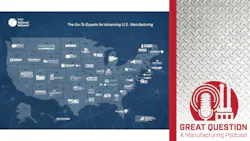




Manufacturing Extension Partnerships, state organizations that help small and medium-sized manufacturers, have been in the news in recent months as some saw their federal funding suspended or delayed. Things are looking better in the latest round of awards, however, as the funds have been delivered on time, and suspended funding was restored to Ohio.
In this episode of Great Question: A Manufacturing Podcast, Carrie Hines of the American Small Manufacturers Coalition talks about the future of the MEP program and the services that these centers provide.
Below is an excerpt from the podcast:
Laura Putre, IndustryWeek: Hello, and welcome to Great Question. I'm Laura Putre, senior editor for Industry Week. Today, we're talking about the Manufacturing Extension Partnership with Carrie Hines. She's the president and CEO of the American Small Manufacturers Coalition, the trade organization that serves the Manufacturing Extension Partnership Program in 48 states and Puerto Rico. Welcome, Carrie.
Carrie Hines, American Small Manufacturers Coalition: Thanks, Laura. Happy to be here.
LP: Maybe you could tell us, you know, for those of us who don't know or aren't real familiar, tell us about the Manufacturing Extension Partnership Program and who it serves.
CH: Sure, the Manufacturing Extension Partnership Program, or MEP, as we call it, is a public-private partnership within the U.S. Department of Commerce, operated under the National Institute of Standards and Technology. It essentially establishes cooperative agreements in all 50 states. Well, now 48 states in Puerto Rico that essentially provides technical assistance services to small manufacturers. And those manufacturers, we also serve mainly under 500 employees, but we also serve some a little bit larger than that, but very few.
LP: What sort of programming do they have?
CH: Essentially, what we do in providing technical assistance is we really meet the manufacturer where they are. So depending on what their needs are, it is things that we can deliver. So we can do everything from plant layout to integration with AI services to introducing robotics and automation to helping with workforce training, finding capital, and really providing advanced manufacturing technology services to manufacturers of all sizes.
LP: The MEP program, as we call it, has been in the news lately with centers. Some centers not receiving their federal funding or receiving it late, and California and Ohio, two of the largest, even had their funding suspended last year. Before we go into some of the highlights of programs in different states, can you bring us up to date on what is happening in in Ohio and California, and if any other states are having trouble receiving funds.
CH: Sure, it's definitely been a challenging year for the MEP program, but we're back on strong footing, thankfully. And just recently, just as recent as last week, about a quarter of the national MEP national network was recompeted. It was a mandatory 10-year re-compete, and Ohio and California were both included in that re-compete. Just last week, it was announced that a new winner in Ohio was announced, the Ohio Manufacturers Association. So we're really pleased to have MEP services restored to the state of Ohio. Unfortunately, California was not awarded, which is really disappointing. So we know that California can be its own little ecosystem, but with GDP for manufacturers, and it's super important to the manufacturing supply chain across the country. We're disappointed that it's not been awarded. We understand that it will be included in the next round, the next cohort of recompetes in April one.
LP: How is your organization involved in helping these MEPs get funding and and advocate for themselves?
CH: So the American Small Manufacturers Coalition is essentially a trade association of the MEP centers nationwide. So what we do is we advocate for programmatic and legislative resources to provide the necessary technical changes to the program and appropriations that allow it to do what it does across the country in providing services to manufacturers.
LP: What are some ways that MEPs can help manufacturers that people might not realize?
CH: Again, we really get in and instead of pushing something to them, we really get in and really assess their business, right? Manufacturers will call us and say, "I'm having a problem with this, and we can go in and help them with that. And then usually that service goes so well that we're like, well, what else can we do to improve our productivity? And we can do an assessment of manufacturers.
So we really look at it holistically and see where they can improve their productivity with efficiency, bringing in advanced manufacturing technologies, and really getting one the shop floor. I think that is the unique position of MEP, is a lot of our staff across the country are actually retired manufacturing employees themselves, and they love this business, so they want to get in and really provide that technical assistance.
So it's a lot different than other programs out there in providing that front office type of of help. We really get in the plant floor and we kind of get dirty. We understand the business. We help them bring in new technologies, new automations, new robotics. We help not only bring that in, but helping them train their employees to help implement it, and making sure that that's working with the rest of their systems.
The other great thing that MEP does, we do one manufacturer at a time. Because we're a national network, though, we can connect that across the country. So we're really influential in supply chains and connecting one state to another. So that's something that not a lot of manufacturers really think about. They think, I need help with this problem, but when they bring us in, we can provide a cadre of other services and connectivity to help them with other things they may not have thought of.
LP: Do you have any examples of cross-state collaboration that you’ve helped with?
CH: Yes, one of my favorite examples is actually, you know, it was kind of relevant. A couple years ago, there was a really bad hurricane that hit, I believe, the east. I'm sorry, the west side of Florida, and it was coming in, and they were trying to set up these, you know, field hospitals. They were preparing for to be hit, and they really needed help setting up field hospitals. Well, they realized that in doing so, they didn't have enough ventilators or ventilator parts to set up these field hospitals.
So they reached out to their local MEP in Florida, Florida Makes, and they said, "Do you know of anybody that can provide this specific part to these ventilators? We need this, and we need it fast. Well, within 24 hours, we were able to connect them because of that national network connection to a manufacturer in Massachusetts that produced just that part, and they were able not only to create a deal but ship those parts to Florida within 48 hours.
So to me, that is the power of the MEP National Network. We're able to make those connections, make those, you know, and something critical needs and really fast. So to me, that's one of my favorite stories of connectivity across the country.
LP: I'm sure during COVID there was some of that as well too.
CH: Yes, a lot of what we did in COVID is we actually took manufacturers and helped them modify their production to help produce PPE. So there were a lot of manufacturers that went from producing tequila, for example, and actually started making hand sanitizer. That's why some of it used to smell like tequila. So we used to do a lot of that. We transformed businesses from kind of, again, where they are, but we knew their production facilities, we knew their capabilities, and we could really translate that into the needs of the day.
LP: A lot of these small manufacturers that you work with, what kinds of questions do they have about technology? What are they, and what are their operations like, and what do they need to get up to speed?
CH: First of all, you know, small manufacturers are really innovative and they're really resilient. They can move quickly, which is great. Unfortunately, some of them, not all of them, are limited in their, you know, exposure to technology, right? So some of what we bring to the table is that exposure to different technologies that can help them. So, you know, again, many are very advanced, but and they're an advanced in one area. But because we work with so many, we are able to see the various technologies that could benefit all manufacturers. So we really are a resource that can expand their knowledge beyond maybe some of the circles that they're currently operating in.
LP: Are there concerns and questions they have about technology that are really front and center right now?
CH: I think one of the biggest ones right now is AI. Right, they know the value, they know the benefit, but they're also concerned about it. They're concerned about data leaks. Do they have the data that they can put it in to play? How can I help them beyond just the spreadsheets and and base operations of the business, right? So that's also where we are a trusted source of information. We can not only help them with kind of awareness and literacy of new technologies, but really seeing how that can translate to their specific business and implementation, and then take it even one step further to help them implement it should they decide to move forward.
LP: I find that in my reporting and talking to manufacturers that they're either like, really involved with the Manufacturing Extension Partnership, or they're not familiar with it at all. So how can people that aren't connected to this program get connected? And maybe they've worked with private consultants before. How are your services going to be different, cost-wise and otherwise?
CH: So I'll start with that question first. Is we do help, you know, all manufacturers, and we actually bring in a lot of third-party providers to deliver services. So not only do we deliver services ourselves, but we actually connect to the localmanufacturing ecosystem to bring in providers that they may not necessarily know are available. So we're a good conduit of that.
I want to say roughly, and don't quote me, but about 33% of our services provided, and it may be a little higher now, are provided by third-party providers or consultants. How our service is different, and really where the federal government's involvement is—this is important, is because it's hard to reach small manufacturers, right? The cost of getting to them and to educate them is a little bit more than your larger manufacturers. So that's where the federal government, that piece, comes into play.
Our market rate for services is market rate, so it's not subsidized per se. The federal government’s importance in this is really kind of buying down the cost of sales to small manufacturers. So it's just reaching them. So that makes this a little bit different. But again, we are charging market rate for services via directly or through the third party.
So to your other question, how do manufacturers get involved? First of all, they can always reach out to our website and we can put them in contact with their local manufacturer at smallmanufacturers.org, or they can go directly to the NIST website, which is nist.gov/mep, and they can find their local Manufacturing Extension Partnership center there.
LP: Are there services that they can access for the cost of membership in the program? Like, and is there a cost for membership? I know, like in in Cleveland, where I'm based, we have had a lot of programming you know that members can be a part of.
CH: Typically, there's not a membership fee for services. It's actually a per-service fee. But there are some services or groups offered by centers that do require membership. For example, in some states we have CEO roundtables that are held, you know, once a month where CEOs from various businesses get together. They bring in certain speakers. So that's more of a membership type of service. So it really depends on your local center and what they offer and whether or not those are kind of membership services or not, but most likely the technical assistance services provided by centers are really provided for the individual service itself and not under a membership fee.
LP: Piggybacking onto that question, what are some initiatives that Manufacturing Extension Partnerships are taking on now that you want to highlight. Some exciting things that they're doing.
CH: I think there's a lot of exciting things right now. With the advanced manufacturing technologies that are out there, things changing so rapidly, we really are getting involved with manufacturers again at all levels, but some of the newest technologies we're involved with is robots and cobots, automation and AI. I mean, those are the new exciting things. But we do that and all the way back to the base kind of production facilities, right? So the base, even you know, the quality improvement, we work on those ISO type certifications. We do that type of thing as well. So we really run the gamut because you really can't have just jumping into putting in a robot or a cobot without the workforce, without making sure that you have the plant layout to accept it. So in the process, improvements to put it in place. It’s not just one thing we do; we kind of do it all. But it is exciting in the world we're living in now with the advancement of technologies.
LP: Great. Well, thank you so much for talking with me. It sounds like manufacturers who really want to connect with other manufacturers to share best practices and find business opportunities as well have a one-stop-shop for the latest technology designed for smaller manufacturers—an MEP might be a good place for them to go if they're not already there.
CH: Yes, absolutely. We of course think we're the best place to go. So we welcome involvement of all small manufacturers, even just to get connected to our newsletter and see what training and services and opportunities are available.
About the Podcast
Great Question: A Manufacturing Podcast offers news and information for the people who make, store and move things and those who manage and maintain the facilities where that work gets done. Manufacturers from chemical producers to automakers to machine shops can listen for critical insights into the technologies, economic conditions and best practices that can influence how to best run facilities to reach operational excellence.
Listen to another episode and subscribe on your favorite podcast app
About the Author
Laura Putre
Senior Editor Laura Putre manages IW contributors and covers leadership as it applies to executive best practices, corporate culture, corporate responsibility, growth strategies, managing and training talent, and strategic planning. A former newspaper journalist, Laura has written for Slate, The Root, the Chicago Tribune, the Guardian and many other publications.