What the 10-degree rule gets wrong about lubricant life
Key Highlights
- The 10-degree rule oversimplifies lubricant oxidation, which actually depends on activation energy, formulation and operating environment.
- Lubricant degradation involves multiple reactions and interactions, making a single universal rate increase inaccurate across different oils and conditions.
- Factors such as oxygen availability, contamination, surface temperature and equipment condition significantly influence lubricant aging beyond bulk temperature measurements.
- Monitoring actual lubricant properties and operating conditions provides a more reliable basis for maintenance decisions than relying on temperature-based rules.

I read years ago that for every 10° C increase in oil temperature, the oxidation rate doubles and the lubricant’s useful life is cut in half. It appears in training courses, certification material, technical presentations, maintenance manuals and countless articles, frequently presented as though it were an established law of lubricant chemistry. It is not correct. In fact, it is blatantly inaccurate, albeit simple. Maybe that’s why it’s not been challenged. Simple is nice. It’s easy. It’s lazy.
Temperature certainly matters. Higher operating temperatures generally accelerate chemical reactions, increase additive consumption, promote oxidation and create conditions favorable to sludge, varnish and deposit formation. A machine that consistently operates hotter than intended should never be treated casually.
However, there is no universal chemical law requiring the oxidation rate of every lubricant to double with every 10° C increase, and there is no defensible basis for concluding that the service life of every oil must therefore be cut precisely in half. What began as a convenient engineering approximation has gradually been repeated as a scientific certainty. It is time to separate the useful principle from the mythology that has grown around it.
The Arrhenius equation does not produce a universal 10-degree multiplier
The ten-degree rule is usually attributed to the Arrhenius equation, which describes how the rate constant of a chemical reaction may change with absolute temperature:
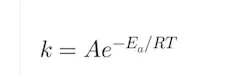
where (k) is the reaction-rate constant, (A) is a pre-exponential factor, (Ea) is the activation energy, (R) is the universal gas constant and (T) is absolute temperature in kelvin.
When the rate constant at two temperatures is compared, the relationship becomes:
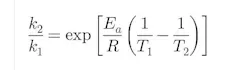
This equation does not say that the rate doubles whenever temperature increases by 10° C. The calculated increase depends upon the apparent activation energy, the starting temperature and the ending temperature. Unless those values are known, a precise rate multiplier cannot be calculated.
Consider an oil temperature increasing from 60° C to 70° C. Depending upon the assumed energy activation, the predicted reaction-rate increase changes.
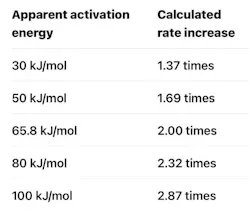
The oxidation rate doubles in this temperature interval only when the modeled reaction has an apparent activation energy of approximately 66 kJ/mol. A different energy activation produces different results.
Even if one lubricant happened to exhibit a twofold increase between 60° C and 70° C, the same lubricant would not necessarily exhibit the same multiplier between 90° C and 100° C. The Arrhenius equation uses reciprocal absolute temperature, not a sequence of identical ten-degree steps. The multiplier rate therefore changes with the temperature range. The so-called ten-degree rule is not the Arrhenius equation. It is a simplified temperature coefficient imposed upon it.
A lubricant is not a single chemical reaction
The simplification becomes even less defensible when applied to a fully formulated lubricant. Lubricant oxidation is not one molecule undergoing one reaction at one constant rate. It is a collection of interacting reactions involving:
- the base oil
- antioxidants
- antiwear agents
- metal deactivators
- detergents
- dispersants
- contaminants
- dissolved oxygen
- equipment surfaces.
Oxidation may begin with radical initiation and hydroperoxide formation, followed by propagation reactions that produce alcohols, aldehydes, ketones, acids and other oxygen-containing compounds. Those compounds may undergo additional reactions that increase viscosity or form polymers, insoluble material, sludge and varnish.
At the same time, antioxidants interrupt portions of this reaction sequence. Phenolic and aminic antioxidants may function through different mechanisms, react at different rates and influence one another. Metal deactivators may suppress catalytic reactions on copper or other surfaces. Water, wear debris and contaminants may create entirely different chemical conditions.
The dominant reaction at the beginning of the oil’s life may not be the dominant reaction after half of its antioxidant reserve has been consumed. Once the antioxidant system approaches exhaustion, the accumulation of oxidation products may accelerate dramatically. The oil therefore passes through an induction period rather than aging at one constant and easily extrapolated rate.
The effective activation energy can also change when the controlling mechanism changes. Treating the entire useful life of the lubricant as a single first-order reaction with one universal activation energy ignores the very chemistry that determines oxidation stability.
Research conducted through the National Institute of Standards and Technology illustrates this variability. In a study of polyol-ester lubricant base fluids and a qualified aviation lubricant, apparent activation energies for high-temperature thermal decomposition ranged from approximately 158 to 204 kilojoules per mole (kJ/mol), according to “Thermal Decomposition Kinetics of Polyol Ester Lubricants.” The investigators found that purity, catalytic surfaces and fluid formulation affected degradation behavior, and they specifically noted that a different mechanism might control degradation at lower temperatures, making a single kinetic extrapolation inappropriate.
That study examined high-temperature thermal decomposition rather than conventional oxidation in an industrial sump, so its numerical results should not be transferred directly to turbine, hydraulic or gear oils. Its broader lesson, however, is directly relevant: lubricant degradation does not possess one universal activation energy, one universal mechanism or one universal temperature multiplier.
Oxidation rate is not the same as oil life
The second half of the traditional statement contains another unsupported leap. Even if a selected oxidation reaction doubled, it would not necessarily follow that useful lubricant life had been cut exactly in half. Before life can be calculated, failure must be defined.
Does the lubricant reach the end of its useful life when antioxidant concentration falls below a specified value? Is it condemned when acid number increases by a defined amount, viscosity changes beyond its allowable range, Fourier transform infrared (FTIR) oxidation exceeds an alarm limit, insolubles appear, varnish potential rises or demulsibility deteriorates? These properties do not necessarily change at the same rate.
A lubricant may lose a substantial portion of its antioxidant reserve without showing a corresponding increase in acid number. Another oil may develop deposits while its bulk viscosity remains within specification. A third may experience contamination-driven degradation that has little relationship to its average operating temperature.
Oil life is therefore not an inherent clock hidden inside the lubricant. It is the time required for a defined property, condition or performance characteristic to reach a defined limit under a particular set of operating conditions.
- Change the endpoint, and the calculated life changes.
- Change the operating environment, and the calculated life changes again.
- Standard tests do not support a universal field-life rule.
- Standardized oxidation tests provide another important reason for caution.
ASTM D6186 determines oxidation induction time by exposing a small lubricant sample to oxygen at approximately 3.5 megapascal (MPa), or 500 pounds per square inch gauge (psig), at temperatures between 130° C and 210° C. The method is useful for research, quality control and product comparison, but ASTM explicitly states that no correlation has been established between the test result and service performance. If the result of a carefully controlled laboratory oxidation test cannot automatically be translated into field life, a universal temperature shortcut cannot reasonably make that translation either.
ASTM D943 evaluates inhibited mineral oils at elevated temperature in the presence of oxygen, water, copper and iron. The endpoint is based on the time required for the oil to reach a specified acid number. It is valuable for comparing certain turbines, hydraulic and circulating oils under defined test conditions, but field correlation may vary substantially with lubricant formulation and actual service conditions.
Different oxidation tests use different temperatures, oxygen pressures, catalysts, sample volumes, agitation conditions and endpoints because oxidation stability is conditional. There is no single test that converts a ten-degree temperature increase into a universally valid percentage reduction in field service life.
Temperature is only one variable in lubricant degradation
Two identical oils operating at the same measured sump temperature may age at very different rates. One system may have a large reservoir, effective air release, limited water contamination, clean surfaces and routine makeup-oil additions. Another may contain entrained air, catalytic wear metals, water, degraded seals and localized hot surfaces far above the measured bulk-oil temperature. Both systems may report an operating temperature of 65° C. Chemically, they are not experiencing the same service.
Lubricant degradation can by influenced by:
- oxygen availability
- aeration
- oil surface area
- copper
- iron
- water
- contamination
- base-oil composition
- antioxidant chemistry
- reservoir residence time
- filtration
- electrostatic discharge
- microdieseling
- hot spots
- makeup-oil rates.
Several of these variables can overwhelm whatever oxidation-rate difference might be predicted from bulk temperature alone.
There is also an important distinction between bulk-oil temperature and surface temperature. A gearbox sump may appear thermally acceptable, while the lubricant passing through gear contacts, bearing zones or restricted return passages encounters much higher localized temperatures. Applying the ten-degree rule to the sump temperature creates an illusion of precision while potentially ignoring the location where degradation is occurring.
Measure lubricant condition instead of relying on a rule of thumb
The ten-degree statement survives because it is simple and directionally useful. It tells maintenance personnel that unnecessary heat is undesirable, and that lesson remains sound.
The statement becomes dangerous when it is used to calculate drain intervals, predict remaining useful life, compare unrelated lubricants or claim that a specific temperature reduction will produce a precisely determined extension of oil life. A more technically defensible statement would be:
Higher temperature generally accelerates lubricant oxidation and additive consumption, but the magnitude of that acceleration depends upon the lubricant formulation, oxidation stage, apparent activation energy, oxygen availability, catalysts, contamination and operating environment. The frequently cited doubling of oxidation rate and halving of oil life for every 10° C increase is a screening approximation, not a universal law or a reliable field-life calculation.
Temperature should therefore be treated as a condition to be monitored and controlled, not as a complete life-prediction model.
Where lubricant life matters, the answer should come from representative testing and condition monitoring. Antioxidant depletion, FTIR oxidation, acid number, viscosity, insolubles, varnish potential and other relevant properties should be trended against actual operating conditions. Temperature history should be included in that analysis, along with contamination, aeration, equipment condition, oil additions and changes in duty cycle.
The purpose of a rule of thumb is to encourage appropriate attention when complete information is unavailable. It should never become a substitute for the information that can be obtained. Heat accelerates lubricant degradation.
The myth is that every lubricant, in every machine, at every stage of its life, responds to every 10° C increase in precisely the same way. Once that claim is examined against the Arrhenius equation, lubricant chemistry, standardized test limitations and actual operating conditions, the supposed law dissolves into what it always was: a convenient approximation repeated beyond the limits of its evidence.
About the Author
Michael D. Holloway
5th Order Industry
Michael D. Holloway is President of 5th Order Industry which provides training, failure analysis, and designed experiments. He has 40 years' experience in industry starting with research and product development for Olin Chemical and WR Grace, Rohm & Haas, GE Plastics, and reliability engineering and analysis for NCH, ALS, and SGS. He is a subject matter expert in Tribology, oil and failure analysis, reliability engineering, and designed experiments for science and engineering. He holds 16 professional certifications, a patent, a MS Polymer Engineering, BS Chemistry, BA Philosophy, authored 12 books, contributed to several others, cited in over 1000 manuscripts and several hundred master’s theses and doctoral dissertations.