Podcast: CT scanning plus AI is a QA breakthrough
Key Highlights
- AI-powered CT inspection cuts false accepts and rejects, improving defect detection accuracy and speeding inline quality control.
- Industrial CT goes beyond defect detection, supporting metrology, reverse engineering, additive manufacturing, and FEA validation.
- CT captures internal and external part data in one scan, enabling GD&T inspection, material analysis, and composite fiber evaluation.
- Early AI adoption in aerospace, automotive, and electronics is driving faster, more reliable quality assurance and production workflows.
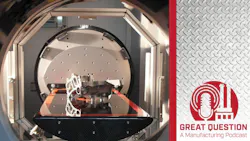




Computed tomography (CT) has a parallel life beyond its service in diagnostic medicine. From aerospace and automotive to defense and electronics, it’s one of manufacturing's most powerful quality assurance technologies.
By creating detailed three-dimensional views of both external and internal part features without destructive testing, CT allows manufacturers to detect defects, verify dimensions, and improve product performance. Now, artificial intelligence and machine learning are accelerating those capabilities even further, making inspections faster, more accurate, and increasingly practical for production environments.
In this episode of the Great Question Podcast, Hexagon Manufacturing Intelligence Technical Sales Engineer Roger Wende details how AI-enhanced CT scanning is reshaping non-destructive testing, metrology, defect analysis, and the future of digital manufacturing.
Below is an excerpt from the podcast:
Robert Brooks: Hello, and welcome to a new installment of the Great Question Podcast, brought to you by Endeavor Business Media's Manufacturing Group. I'm Robert Brooks with American Machinist and Foundry Management Technology. And both of those markets are keenly attuned to the salience of quality assurance and quality control in their operations and in their finished products.
One of the most advanced and reliable quality assurance tools, or more accurately, quality assurance technologies, is computed tomography (CT). And like every other aspect of manufacturing, quality assurance is significantly influenced by the expansion of artificial intelligence, digitalization, and machine learning. And I am no expert on computed tomography. My guest today is that expert. Roger Wende is technical sales engineer for non-destructive testing with Hexagon Manufacturing Intelligence. Welcome, Mr. Wende. Thank you for being with us today.
Roger Wende: Thank you for inviting me.
RB: Now, many of our listeners will be familiar with CT because it's a widely applied medical diagnostic tool, but it has a significant record in manufacturing. And I know you will bring all of this into clear focus for me and for them. So will you begin by sketching out the basics of this technology, computing tomography?
RW: Yes, I'm happy to. So CT or computer tomography, as you just stated, really fascinating technology that really started in the 1800s here in the UK. What we saw over the years and kind of understanding what CT stands for, computer tomography is actually coming from the Greek words tomo, meaning slice, and then tomography is to draw or to write. So essentially what you have is drawing the slice.
And what you're doing with the CT scans, you normally have an X-ray tube, you have the object you want to scan, and then you also have a digital detector. With the X-ray tube, when this was originally discovered, you'd actually have these electrons that would shoot down in a vacuum, hit a piece of metal. When that collision occurred, photon X-rays would radiate out through the object. Now, in order to capture this information, as these photons fly through an object, which usually has a multi-material, different absorption rates of these photons, they'll be collected in today a digital detector.
Now, these digital detectors, when these photons go in, go into something called a scintillator. It's essentially these crystals that turn the photons into visible light. And this visible light gives us a gray value information about the part. So what's really fascinating when you see an X-ray, as you stated earlier with the doctor's office, you'll see the different gray value information, and that's the absorption that you've got going through the material, and then that visible light, that different gray value information that we'll see in our display.
With a CT scan, instead of doing a traditional X-ray, you're actually rotating the part normally. In the human case, you're using standing still in the detector and X-ray source is rotating around you. But you're essentially taking pictures, lots and lots of pictures at different angles. And then you go through what's known as a reconstruction. This is a Feldkamp CT reconstruction method. And when you take all those sliced images, you'll get this volumetric data set. So now I'm able to slice through this information that we've collected and just actually do a lot of different types of engineering applications. I know most people are used to it in the medical side. For us, we're actually really focusing on the industrial side, working a lot of different engineering applications.
RB: That's an excellent explanation. That's right up my alley. I love that, I love this. So tell us then, what is the customary role for CT in manufacturing operations?
RW: So it's fascinating to see because when you look at classical NDT or non-destructive testing, you always have the core package. It's like a toolbox. I got all these tools to do a lot of different engineering tasks. So I have ultrasonic testing, visual testing, radiography testing.
In this case, the CT is essentially a new tool in the box. It's really come about in the last 25, 30 years. That's how new it is. But it's an exciting tool, and I'm happy to say that I was really part of it from the ground up. And we saw the roots of it heaviest in Europe, in Germany, because of the automotive industry. And the big companies would actually buy this expensive equipment, CT scanning parts, to see the failures that you may have. As time's gone through and time's gone by, because one of the unique devices collects all my surface information, as well as my material information. Over the years, what we're able to do is capture that data to allow us to go beyond quality control, but actually look at it from a metrology standpoint, when you do critical measurements, complete with GD&T. Maybe I need to do a material analysis because I am interested in finding voids, cracks, inclusions.
The other thing that's fascinating is working with composites and understanding the orientation of the fibers. because it's these fibers that give the parts their strength. And these fibers can consist of plastic parts with fibers, the actual composites you see, or even concrete that's got steel fibers on them, that can give the structural strength that you need. The other areas that sometimes people will actually do with CT scanning is reverse engineering, working with CAD files, assisting in additive manufacturing, helping with the design team, so now we're not just looking at metrology and quality engineering, But also we're working with the CAD designers.
And not to leave out the finite element analysis team, the ones that do simulation, because unlike a FEA model is what they call it, the finite element analysis, when I have this perfectly CAD drawn, I want to do physical testing on it today. Maybe I'm doing what's known as computational fluid dynamics or Von Mis stresses. I can actually capture the actual part with its known defects to see how the part can actually perform under those different strains.
RB: Wow, you're all across the manufacturing sector. I mean, everything. How does CT scanning fit into a manufacturing workflow?
RW: So in originally it was used for quality control. That's literally how it's first adopted. I'm interested in looking for cracks. I'm looking for porosity. Then what was interesting is in the plastic injected molding business, really in the automotive side, it's like, can we use a CT to actually convert the CT scan data in a metrology world, similar to a coordinate measurement machine or some of these laser scanners? So a lot of development, understanding about the CMM world, essentially, these coordinate measurement machines. So that's the golden standard, see how I can take some of these standards and understand it and apply it to the CT scans.
So the evolution really sped up in looking at it from a metrology standpoint, doing first article inspection work. So that was a really big area. But what was nice is I look at for defects too. Then we evolved a little bit further and said, hey, we have all this information. Maybe I do need to look at with other design teams. But normally in the very beginning, it was really this workflow of working at the defects. looking for missing components or damaged components. But then the metrology really kind of took over and we saw with certain products, especially with injected plastic molding business, it's actually faster to actually use a CT scanner than some of the traditional CMM machines or laser scanners.
RB: So I mean, the obvious off ramp for me here is to discuss all of this information, all of this data gathering. How does artificial intelligence changing the CT inspection process or the approach to CT inspection?
RW: So the whole idea of AI is fairly new in the CT world. When you take a look at all this gray value information, and this gray value information that you see, when you look at your part, you'll see these, it's actually a part's made of tiny little gray cubes known as a voxel. And these voxels come from 2 words, come from meaning from the volume, the VO from volume and the last few layers pixel. So you get the word voxel that has this gray value information.
So taking that voxel information and with this gray value information, you can always see that gray value information, use software to actually work with the different gray value information. But with CT scans, you also have something known as artifacts. and they can be different types of artifacts. Some call it ring artifacts, streaking, beam hardening. These are unique smearing of the gray value information that can make it challenging when you're looking at something as defects. Or if I'm doing battery analysis and I have to do a really fast scan and I want to be able to look at my anodes and cathodes and make sure that the angles are correct or I got the correct amount, there's not any particles. When you have a very noisy data set, and you're just working with traditional gray value information, you can actually have a lot of false accepts and false rejects.
Now this is where AI comes interesting because you can actually collect data sets and create trained data sets. Because what we're working on now is not just gray value information anymore, but what AI does, like our eyes, will help us define shapes. So we're literally teaching using AI, looking at not just gray value information, but shape. And that's where it becomes a game changer because it really lowers our false accepts and false rejects.
And the second thing you can actually do is speed, performance. So if you have very large CT scans and maybe 100 gigabytes, that's a large data set. The time to do traditional defect analysis may take quite a bit of time, but using this trained model, you can actually do that analysis much, much faster. So now we're talking about doing inline production work, and that's what we're seeing today is CT evolving with AI. when it comes to automation on the line or doing batch sampling. And that's becoming very, very popular.
RB: Let me interject it because there's a point I don't quite understand. So you can take the CAD model or a prototype or a first article from inspection and use that as the basis for your CT data reference and that becomes the basis for your inline inspection.
RW: It can be part of it. It's not all of it, because if you're also wanting to know about defects, you may actually then take known samples with defects and you actually use those known defects to create a trained model to help find defects. So our defects and castings, for example, may have three different type of defects like shrinkage, looking for voids and cracks. You may want to find these using these AI models, but you segment these out very cleverly using AI because your eye can actually see the shapes. But necessarily traditional methods, we just see a great value information and couldn't distinguish the difference between a void versus a crap. AI can help you do that.
RB: Very good. I get that that covers my next area of questioning about how does how do manufacturers approach CT processes. So are there defects that can be detected because AI. that could not be detected, but can be detected because AI has been introduced to the inspection sequence.
RW: The biggest thing that AI does is really help with the accuracy of the defects. So you're not finding a lot of the false accepts, false rejects. That's the biggest thing. So now the AI really gets it to where you have much more accurate information. And then it comes down to speed. So being able to take a part and do an inspection, as an example, taking an engine block, which is done today. You can actually take a CT scan of an engine block, use it because what I'm interested in finding is not only the voids, but the geometries and all the, if there's any sand trap, using the AI from scan to analysis, I can do that in less than two minutes per part on an engine block.
RB: Two minutes per part. Wow, that's very impressive. Does machine learning factor into defect detection and in terms of speed or preparation or setup or anything like that? Well, machine learning.
RW: Yeah, because with machine learning, when that was actually drew, so when you look at AI, AI's consisted of different umbrellas. So machine learning is a part of the AI umbrella. But now with the machine learning, it doesn't go in the same way as training it. So when I use machine learning, it's usually for the one-offs. So I will use machine learning to help label and create my labels of the different multi-materials or the different types of defects I may have. In that case, I will use machine learning, which is actually you, we have something known as paint and segment, where you're actually painting the defined different materials, and then you actually use it to help segment out the different materials that you have in there. I can then use those labels to be part of my deep learning, which is now when I use AI, and I have several of these scans, and I bring that into a different product to create this model that I'll actually run. Machine learning just definitely assists. We have different levels of AI depending on what those applications are. For one-offs or very low volume, I might use machine learning. If I'm doing high volume inspection, medium inspection, then I'm actually creating the model itself. So different approaches, definitely.
RB: Well, it's all coming so fast. I mean, this is what's striking me. Are there any notable impediments from manufacturers aiming to adopt AI in or CT scanning altogether?
RW: Right now, there's still a learning curve. because the AI models that we're actually introducing is so new. It just here at Hexagon, we just released on the, it's called VGSTUDIO MAX on this particular pipeline, was just released last year. So there's been a lot of learning that goes into it. And what's really fascinating to see is the learning curve that we've gone through is to see the quick adoption. And normally, your biggest adopters tend to be your larger companies. And right now, my larger companies could be those aerospace defense customers, especially when you look at electronics, a lot of complex parts there.
So when you're looking at circuit boards, using AI to segment out these multi-materials that has these artifacts, valuable tool, especially when it comes to speed and accuracy. So you're seeing these early adopters. And it'll trickle into the other industries and markets, such as the life science industry. When you look at American Museum of Natural History or the Smithsonian, the museum down in Florida, they're actually looking at this today, just now starting using AI to be able to segment out their components, which are usually these unique fossils or salamanders or lizards, because they want to study and understand these species.
RB: Yeah, I mean, I mentioned investment casters and additive manufacturers will be big consumers of this technology not too long if they aren't already. Do you have any documentation that defines how CT scanning improvements affect quality assurance in production or in results for the product quality.
RW: Yeah, over the years I've written white papers and then my colleagues have written white papers. So there's quite a few white papers today that are out there that's visible. You can actually find these usually online, over the years, going to conferences, doing trade shows, submitting these white papers. They are out there. I usually have them out there available for people to see or even going to the website. We'll have some of this information on our website. It's a nice place to kind of get an idea about all the studies been done in the area of CT and not just myself, but across the board. We have quite a few engineers The OEM manufacturers out there do a lot of white papers and case studies because they're looking at it also on the hardware side because the gaming industry has allowed us to be much more faster in efficiency. It's amazing how this gaming industry has really helped drive CT to new levels such as this AI world. It really having that hardware processing with large data sets is fascinating and great to have.
RB: Yeah, I imagine a lot of, I mean, in a lot of manufacturing sectors, but I imagine people who are production planners and quality control technicians would be very interested to follow up in that direction. Tell us, what are some future developments in CT scanning that our listeners might anticipate?
RW: Some of the new developments will always be, well, one of the new ones that's being developed is using liquid metal. So this is for high speed scanning in line application that's actually being developed, it's researched right now. Always looking at different detectors to improve the image quality. We're seeing industries actually using AI to work on the CT reconstruction side. I mentioned that earlier to be able to create this volumetric data, but where AI's come into place with CT reconstruction is to make the images better. So from our standpoint, from a software standpoint, we'll always look for great contrast. So if I have a really nice contrast, it makes it easier to do a variety of engineering tasks. So right in the early stages of taking all these projected files and reconstructing it, we're now seeing AI being used in this area.
So this is actually a new area that's a growing area. So we are seeing definitely growth on both on the software side for solving applications, but also on the hardware to be able to go with different applications, harder applications, with some of the new technologies that are being developed around the world. And it's literally being developed around the world. It's not just located here in the US.
RB: Well, this has been incredibly enlightening to me and I'm sure to many of our listeners. Thank you, Roger Wende for your time and your expertise. I know I'll be tracking you closely on this subject. If our listeners wish to do that, I encourage them to locate Roger Wende at LinkedIn or to visit hexagon.com where all of these capabilities are well presented. Thanks to our listeners for their time and attention today. Please stay tuned for the next installment of the Great Question podcast presented by Endeavor Business Media's Manufacturing Group.
About the Podcast
Great Question: A Manufacturing Podcast offers news and information for the people who make, store and move things and those who manage and maintain the facilities where that work gets done. Manufacturers from chemical producers to automakers to machine shops can listen for critical insights into the technologies, economic conditions and best practices that can influence how to best run facilities to reach operational excellence.
Listen to another episode and subscribe on your favorite podcast app
About the Author
Robert Brooks
Robert Brooks has been a business-to-business reporter, writer, editor, and columnist for more than 20 years, specializing in the primary metal and basic manufacturing industries. His work has covered a wide range of topics, including process technology, resource development, material selection, product design, workforce development, and industrial market strategies, among others. Currently, he specializes in subjects related to metal component and product design, development, and manufacturing — including castings, forgings, machined parts, and fabrications.
Brooks is a graduate of Kenyon College (B.A. English, Political Science) and Emory University (M.A. English.)