Podcast: 4 new machining and metalworking products
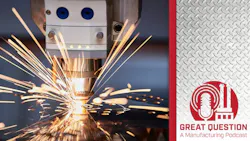




This month, New Equipment Digest Editor-in-Chief Laura Davis shares her picks — four products that caught her attention for solving real problems in machining and metalworking environments. On the list: Prima Power's Laser Next Core 3D laser cutting machine for job shops and flexible manufacturing, Walter's TC180 Supreme and TC280 Supreme solid carbide taps for high-volume threading in steel and cast iron, the Fives Landis TTG 3000 twin-turret multispindle grinder for complex component grinding in a single clamping, and Seco Tools' Jetstream Tooling M-Clamp toolholder system for high-pressure coolant delivery and extended tool life in difficult-to-machine materials.
Learn more about the products in this episode:
Below is an excerpt from the episode:
This month's picks share a common thread: they're all machining and metalworking products built for production environments where complexity, difficult materials, or tight tolerances are the constraint. Laser cutting, threading, grinding, and toolholding — four different problems, four focused solutions.
We'll start with laser cutting.
Prima Power's Laser Next Core is a 3D laser cutting machine aimed squarely at job shops and flexible manufacturing environments — the kind of shops running variable production mixes and frequent changeovers, where batch sizes are typically under 1,000 parts.
It handles both 2D and 3D cutting, and there's an optional welding head for lap and butt joints, so you're not locked into a single operation. Axis strokes are 10 x 7 x 2 ft — and Prima Power says the working volume is 58% larger than comparable class machines, with a footprint that's actually 25% smaller. Which helps if you're tight on floor space but dealing with large or complex parts.
On the cost side, cost-per-part runs up to 25% lower than market references, driven by reduced labor, minimal maintenance, and lower gas and power consumption. The safe-cutting nozzles alone reduce nitrogen use by up to 30%, which is a noticeable savings over time.
The machine uses maintenance-free linear drives and direct motors, and operation is simplified through one-click programming, a graphical teach panel HMI, and automatic head-offset compensation. For shops that rotate operators or can't afford long ramp-up time on new jobs, it offers the value of simplicity.
It can also be integrated into turnkey automated systems through the Robotics Integration Unit, which handles 3D laser cutting, part handling, loading, unloading, and quality checks. So if you're thinking about a more automated cell down the road, there's a path there.
Now let's move from laser cutting to threading — and specifically, threading in the kinds of materials that wear out tools fast.
Walter's TC180 Supreme and TC280 Supreme are two new solid carbide taps designed for large batch sizes and mass production, with automotive as the primary target application. Both are built from grade WJ30EL — an ultra-fine, highly wear-resistant solid carbide substrate — and both carry a HiPIMS-applied coating. HiPIMS, high-power impulse magnetron sputtering, produces a denser, more uniform coating than conventional PVD methods, which translates to better chip formation and longer tool life in production runs.
Both taps use a 6HX tolerance — that's slightly larger than a standard 6H tap, but still within standard tolerances. The purpose there is extended tool life and better compatibility with high-strength or abrasive materials like cast iron.
The TC180 is your blind-hole tap. It handles threads up to two times the nominal diameter in steel, cast iron, and non-ferrous metals — ISO P, K, and N material groups — in metric dimensions from M6 to M12. The geometry uses varying helix angles to generate short chips and support process reliability, and a short-chamfered guide section helps prevent fractures. There's also an axial internal coolant channel for chip removal. Chamfer form C per DIN 2197.
The TC280 is the through-hole version. Same material groups, same M6 to M12 range, but it also covers metric fine dimensions at M14×1.5 and M16×1.5. It's built to handle high cutting speeds without sacrificing reliability. Chamfer form B per DIN 2197.
If you're running high volumes in cast iron or steel and tool life is costing you, these are worth a look.
About the Podcast
Great Question: A Manufacturing Podcast offers news and information for the people who make, store and move things and those who manage and maintain the facilities where that work gets done. Manufacturers from chemical producers to automakers to machine shops can listen for critical insights into the technologies, economic conditions and best practices that can influence how to best run facilities to reach operational excellence.
Listen to another episode and subscribe on your favorite podcast app
About the Author
Laura Davis
Laura Davis is the editor in chief of New Equipment Digest (NED), a brand part of the Manufacturing Group at Endeavor Business Media. NED covers all products, equipment, solutions, and technology related to the broad scope of manufacturing, from mops and buckets to robots and automation. Laura has been a manufacturing product writer for six years, knowledgeable about the ins and outs of the industry along with what readers are looking for when wanting to learn about the latest products on the market.