Podcast: Inside the 2026 USMCA renewal talks and their impact on North American manufacturing
Key Highlights
- USMCA's six-year review could bring major trade policy changes affecting manufacturing and automotive supply chains.
- Proposed increases to regional content requirements may force automakers to rethink sourcing strategies.
- The U.S. is pushing for stronger domestic manufacturing through new U.S.-specific content requirements.
- Manufacturers should monitor ongoing negotiations, as annual reviews may continue beyond the July 2026 deadline.
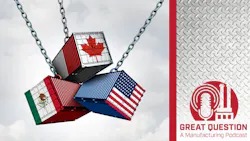




In this episode of Great Question: A Manufacturing Podcast, Patrick Childress, an international trade and disputes attorney at Holland & Knight, shares an update with IndustryWeek's Jill Jusko on how negotiations are proceeding with USMCA—also known as the United States, Mexico, Canada agreement—a trilateral trade agreement that comes up for its required six-year joint review on July 1. It's an agreement that has significant implications for manufacturers, particularly in the automotive industry.
Below is an excerpt from the podcast:
Jill Jusko: Welcome to today's episode of Great Question: A Manufacturing Podcast. I am Jill Jusko. I'm an editor with IndustryWeek, and with me today is Patrick Childress. Patrick is an international trade and disputes attorney at Holland & Knight, as well as a partner there, and previously he has served as assistant general counsel at the Office of the U.S. Trade Representative. Welcome, Patrick.
Patrick Childress: Thank you, Jill. Happy to be here.
JJ: Today Patrick is joining us to discuss where things stand with the USMCA, also known as the United States-Mexico-Canada Agreement, a trilateral trade deal that took effect in July 2020 and as many of you know, replaced NAFTA. Part of the treaty included a six-year joint review, which brings us to now 2026, which makes this a timely conversation. So, Patrick, I'll start with what is the aim of this formal review?
PC: Thanks, Jill. It's a great question, and I'm going to take a step back even further to talk about another unique aspect of USMCA, because it relates directly to the six-year review, and that's the fact that this trade agreement between the United States, Mexico, and Canada has a time limitation. So, when the countries agreed to sign up for USMCA, they did so, but only with this expiration date of 16 years into the future, this is unique amongst U.S. trade agreements, and it's something that the negotiators in the first Trump administration pushed for. Now, in addition to the 16-year time limitation, they included this six year review process that we're here to talk about today, and the purpose behind the six-year review process was a chance for the parties to sit down after the treaty had been in place for a long enough time to get a sense of how it's working and have a conversation about what's going well, what could be improved, and then be able to make suggestions for ways to change the treaties so that it can meet the various aims of the agreement in better ways. So that's what brings us to now. Fast forward six years, July 1, 2026 is the six-year anniversary of the agreement, and the parties are working toward that July 1 date. Although, as I'm sure we'll get into further on this podcast, there have been some bumps along the way. It's taken some interesting twists and turns.
JJ: Okay, so since you've mentioned the timeline, let's talk about the timeline of the USMCA negotiations. I gave very broad strokes, and you mentioned something else, but where exactly are we in the process? You mentioned July 1, but where are we?
PC: Well, per the terms of the treaty, so the text of the treaty says that the six-year review will occur on July 1. So, again, with the strict reading, the review is supposed to occur on that day, but of course, as we know, with a trade agreement this complicated and this important, there's no way that those negotiations are going to happen in a single day. So, for several months now, the parties have been engaged in negotiations leading up to that July 1 date. I mentioned earlier some twists and turns. One of the major ones of late is that currently there are no ongoing negotiations between the U.S. government and the Canadian government. Right now, the only active official negotiations that are happening are between the U.S. government and the Mexican government, and Canada does not have a seat at the negotiating table.
JJ: Okay, well, you're right. That is a very interesting component of the negotiations, given that they're trilateral in nature. In addition to that, can you tell me a little bit, how are things, I mean, to the degree that they're shaping up, absent Canada, how are things shaping up with the treaty overall, and specifically as it relates to our manufacturing audience. We have a, I know there's a lot about the automotive industry in part of it, and we have a big manufacturing and specifically auto industry audience.
PC: Yeah, no, great questions. The broadest answer is that the overall dynamic in the negotiations is one where the U.S. government is the one making demands and seeking big changes in the treaty, and the Canadian and Mexican governments are pushing back. Those governments are largely happy with the way things have gone under USMCA, and would like something as close as possible to the status quo. I do think there's recognition on behalf of Canada and Mexico that in order to keep the United States within the confines of the agreement, that they're going to have to make some strategic concessions along the way. There's going to have to be some give to the U.S. demands, otherwise the U.S. government is going to withdraw from the agreement altogether, and that's the dynamic that's been pushing these negotiations along, and it's one where the U.S. government's making demands, and Canada and Mexico are pushing back where they can, but ultimately I think everyone recognizes that some changes are going to have to be made in response to these U.S. demands. Otherwise, the administration could very well walk, walk away from the deal altogether, or at least threaten to walk away from the deal.
JJ: And if they walk away from the deal, does it end tomorrow or the next day after they walk away?
PC: No. So, there's a six-month waiting period. So, were the U.S. government to initiate the withdrawal process, there would be a six-month period where the treaty would remain in force. Then, at the end of that six months, if nothing happens to change the U.S. government's mind, then the treaty, then the U.S. would formally withdraw from the treaty. I'm putting this all on the context of the U.S. government; it could also be Canada or Mexico, but right now all indications are that Canada and Mexico are going to do what they can to keep the treaty together, and it's really the U.S. government that is the big threat to withdraw from the agreement at this point.
JJ: To this point, have there been any surprises for you in what we're hearing, what you're hearing about how negotiations are going, or pre-negotiations maybe is the better wording?
PC: I would say the big surprise is in addition to the US government moving forward negotiating bilaterally with Mexico, so this is bilateral negotiations in relation to a trilateral treaty. The other big surprise is the timing aspect, and I know that's one of the main things you wanted to talk about today, so I definitely wanted to touch on that. So we know we're heading up to this July 1 deadline, which is through the text of the treaty, the deadline for the USMCA six-year review. It's become pretty clear at this point that the parties are going to blow right past that July 1 deadline and continue these negotiations after July 1, so the question then becomes, what happens on July 1 if we don't get a an agreement to renew the treaty. So, a few things can happen on that July 1 date. One, the U.S. government can decide to withdraw from the treaty. I think that's definitely a possibility. The second is that the U.S. government can decide enough changes have been, have been made that it's happy with the agreement, and it signs up for another 16-year term. It's a possibility. I don't think that's very likely. And then, third, and I think this is the most likely scenario, is that the parties go right past July 1 and continue negotiating. What happens then is that the text of the treaty, as it is on July 1, remains in place. The treaty remains in force. So the short answer is not much would change on July 1 if the parties don't make any changes and continue negotiating. From there, we would move into a posture of year on year annual negotiations until the three parties agree to renew the treaty or one of the parties withdraws from the treaty, and it does seem like that's the direction we're headed at this point.
JJ: Wait, are you saying they could agree to blow past the deadline and then revisit this like every year? Is that what...?
PC: That's right. So, if you remember, the USMCA has a 16-year duration, and this first review is only six years in, so there's still 10 years of the treaty left, no matter what happens on July 1. So the treaty remains in force after July 1, even if the parties haven't renewed for another 16 year term, and then the treaty says what happens is each year there's another one of these annual reviews until until all the parties renew the treaty, so the short answer is the negotiations just continue after July 1, and it seems like the U.S. government, in particular, is completely comfortable with that eventuality, because they've actually scheduled further negotiating around with Mexico all the way through July 20, so beyond July 1, so it seems pretty clear at this point that negotiations are going to continue for some time.
JJ: Have you heard anything about negotiations on specific aspects of it that are of interest to manufacturers?
PC: Absolutely, yeah, we have heard some interesting news that's come out of the first official negotiating round between the U.S. government and Mexico. This was in Mexico City two or three weeks ago now, and we learned about some of the initial U.S. negotiating positions, and they were fairly aggressive. So, in particular, we learned about two specific points. One was that the U.S. government is proposed to increase the requirement for regional value content in automobiles. What that means is the percentage of the value in a traded automobile that is derived from North America, so from Canada, Mexico, or the United States, there's a certain percentage of each vehicle that needs to meet that threshold in order to be traded duty free under USMCA. Right now, that's at 75%. The U.S. government has proposed to raise that to 82%. That might not sound like a lot, but for these, for these manufacturers who built their supply chains to meet that 75% threshold, this would be a big change. The second is that the U.S. government has proposed, in addition to this regional value content requirement, a U.S. content requirement, so there would need to be a certain percentage of the value in every traded automobile, a certain percentage of that value would have to come from the United States, specifically, not just the region. This is a push from the U.S. government, of course, to increase manufacturing in the automotive space within the United States, that's another pretty aggressive position from the U.S. government. So, we'll have to see how those proposals fly with Mexico and Canada, but it does suggest that the U.S. negotiators are approaching these negotiations with a lot of confidence. They feel like they're coming into these negotiations from a place of strength.
JJ: Has there been anything else that surprised you, or you're just finding interesting as it moves along?
PC: Yeah, so there's been the fact that the U.S. and Mexico are proceeding on their own. That's interesting. This timing issue has been interesting, and then maybe one other thing to point out is that I've been surprised that Mexico [Childress meant to say Canada] hasn't been more aggressive in terms of getting back to the negotiating table. I would have thought they would have done more to make sure that they, that these bilateral negotiations don't proceed too far without them, is the big worry from the Canadian government perspective, or if I was putting myself in the shoes of the Canadian government, would be that the United States and Mexico go off on their own, reach agreement on, bilaterally on changes to this trilateral agreement, and then show up in Ottawa one day and say this is what we've agreed to, you have to take it or leave it, and I think if that occurs, the Canadian government is going to be under a lot of pressure to take whatever deal the United States and Mexico struck, because I don't think at this point it's a viable option for the Canadian government to walk away from this trade agreement altogether. We know that the Canadian government has been aggressively trying to diversify its trade pathways through discussions with EU and China, for instance, so this has been a big move in Ottawa that they're trying to diversify their trade, but for now it remains the case that the vast majority of their trade is still within North America, and as long as that's the case, I think the Canadian government's going to have to do everything they can to remain within the confines of the USMCA, and if that's the reality for them, then they really need to do what they can to get back to the negotiating table and make sure that they're a part of these negotiations.
JJ: Okay, so just to clarify, initially you said that you said I've been surprised that Mexico hasn't been more aggressive in getting back to the negotiating table. You meant Canada.
PC: I did. Yeah, apologies. I must have misspoken.
JJ: No, I just want to make sure that that we have it correct. Okay. Well, I think that's a good place to leave it for today. It will be interesting to see how things play out. And thank you, Patrick, for your time. And I'd also like to thank our audience for your attention.
About the Podcast
Great Question: A Manufacturing Podcast offers news and information for the people who make, store and move things and those who manage and maintain the facilities where that work gets done. Manufacturers from chemical producers to automakers to machine shops can listen for critical insights into the technologies, economic conditions and best practices that can influence how to best run facilities to reach operational excellence.
Listen to another episode and subscribe on your favorite podcast app
About the Author
Jill Jusko
Jill Jusko is executive editor for IndustryWeek. She has been writing about manufacturing operations leadership for more than 20 years. Her coverage spotlights companies that are in pursuit of world-class results in quality, productivity, cost and other benchmarks by implementing the latest continuous improvement and lean/Six-Sigma strategies. Jill also coordinates IndustryWeek’s Best Plants Awards Program, which annually salutes the leading manufacturing facilities in North America.