Case study: AI-powered 3D maintenance solution for Joint Light Tactical Vehicle fleet increases uptime and sustainability
Key Highlights
- AI, digital twins, and AR cut troubleshooting time 30–50% and improve first-time fix rates, boosting uptime and reliability.
- Predictive maintenance reduces unnecessary parts use by 40%, lowering costs, waste, and lifecycle carbon emissions.
- Replacing paper manuals with 3D, AR-guided workflows improves technician accuracy, training, and productivity in complex environments.
- Intelligent maintenance shifts teams from reactive cost centers to data-driven value drivers with measurable sustainability gains.
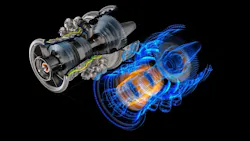
If your maintenance organization is viewed as a cost center instead of a value driver, it is time to revisit your business case. Maintenance optimization is well known for enabling operational improvements, but a powerful case can be made for its sustainability advantages as well. Making maintenance processes more intelligent and precise increases asset reliability, uptime, and performance while also delivering measurable environmental benefits.
Demand for intelligent, sustainable maintenance is strong in environments where equipment complexity is high and operational reliability is critical. “Defense sustainment programs are a good example because these systems involve complex platforms, distributed operations, and a constant need to reduce downtime while maintaining readiness," explains Javid Vahid, founder and president of Edlore Inc. “The same principles apply across many industrial sectors.”
Vahid presented a Marine Corps vehicle sustainment case study at MD&M West 2026, describing how Edlore and Siemens Government partnered to improve operational efficiency and sustainability in the Marine Corps Joint Light Tactical Vehicle (JLTV) fleet’s maintenance processes.
The JLTV Sustainment Program, funded by the National Council for Manufacturing Sciences (NCMS) for the Office of Naval Research (ONR), succeeded in reducing downtime, waste, and lifecycle carbon using digital twins, augmented reality (AR), and predictive intelligence.
Reactive and paper-based processes created operational inefficiencies and waste
Ensuring the JLTV fleet’s operational readiness is paramount, yet traditional maintenance processes had room for improvement. Pressure was growing to increase maintenance efficiency and reduce its environmental impact.
Existing reactive and labor-intensive repair processes led to high maintenance variability and downtime, which increased emissions and asset lifecycle costs and generated waste such as unnecessary parts replacement and the corresponding manufacturing and transport of those parts.
Naturally, JLTV service does not always occur in a depot; many maintenance operations transpire in the field, including in areas where cloud access is limited or unavailable. Sending multiple service teams out to troubleshoot downtime problems creates unnecessary fuel and travel costs.
Furthermore, technicians relied on various paper manuals, drawings, and other static technical documentation to support their work. The logistics of providing that information when and where needed consumed excess paper and energy. Static documentation similarly affected technician training, complicating efforts to address increasingly complex equipment and counter the skilled workforce shortage.
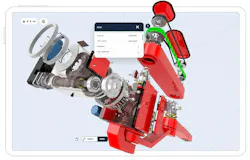
Technology trio envisioned as the catalyst for maintenance improvements
The convergence of three advanced technologies formed the technical architecture of the chosen intelligent maintenance solution, which was designed to operate securely both online and offline. This includes:
- Digital twins: Interactive 3D digital twins replaced static documentation with digitized, contextualized data for modeling the real-world asset state. Careful data organization and validation, required to convert the existing technical documentation into the integrated digital twin environment, helped to build trust.
- Augmented reality: AR-enabled precision workflows guide technicians through repair tasks, increasing diagnostic consistency and first-time fixes as well as improving productivity and safety.
- Predictive intelligence: Predictive AI with sensor-driven analytics enable real-time condition monitoring, early fault detection, and properly planned and optimized predictive maintenance, helping to reduce asset failures and over-maintenance, increase efficiency, and minimize waste.
Developers of the collaborative platform for sustainable maintenance operations set out to significantly reduce the time technicians spent searching through documentation and troubleshooting, decrease diagnostic uncertainty and waste, and enable smarter and more timely intervention.
Sustainable maintenance approach fulfills technician and management priorities
The digital transformation derived from the vehicle sustainment program revealed many benefits of using digital twins, AI-assisted diagnostics, and AR-guided procedures together. For instance, JLTV fleet maintenance operations are more precise and efficient with faster first-time repairs, higher asset uptime and utilization, improved asset lifecycle management, and reduced rework. Sustainment advantages include reduced travel and service visits, lower lifecycle costs and carbon, reduced paper and associated logistics, and lower consumption of energy and unnecessary parts.
Measurable benefits underscore the value of optimizing JLTV maintenance and sustainability:
- 30–50% reduction in troubleshooting time
- 40% reduction in unnecessary parts replacement
- 15–25% improvement in mean time to repair (MTTR)
For technicians using the new platform, the biggest change is clarity and confidence. “With an interactive 3D and AR-guided workflow, the technician can see the equipment in context, identify components visually, and follow step-by-step procedures directly on the device,” says Vahid. “From a management perspective, the conversation quickly shifts to operational outcomes. When digital twins, AI-assisted troubleshooting, and AR guidance are combined, organizations begin to see maintenance as a data-driven operational process rather than a reactive activity."
Looking forward, Vahid expects sustainable maintenance to become a much larger part of the conversation: “Sustainability in industrial operations is not only about energy sources or materials; maintenance itself plays a significant role in the overall environmental footprint of complex assets. Even modest improvements in maintenance efficiency can have meaningful impact when scaled across large fleets of equipment and infrastructure.”
About the Author
 Sheila Kennedy
Sheila Kennedy
CMRP
Sheila Kennedy, CMRP, is a professional freelance writer specializing in industrial and technical topics. She established Additive Communications in 2003 to serve software, technology, and service providers in industries such as manufacturing and utilities, and became a contributing editor and Technology Toolbox columnist for Plant Services in 2004. Prior to Additive Communications, she had 11 years of experience implementing industrial information systems. Kennedy earned her B.S. at Purdue University and her MBA at the University of Phoenix. She can be reached at [email protected] or www.linkedin.com/in/kennedysheila.