Podcast: 5 additive manufacturing products worth watching right now
Key Highlights
- Magnesium is now viable in metal AM at production scale with useful vibration-dampening properties.
- Continuous FFF production gets a traceability layer, with full part-level logging for quality validation and certification workflows.
- Multimaterial prototyping in a single print job is now available at a more accessible price point.
- Ultra-large-format metal PBF removes assembly joins from large structural components by building them in a single job.
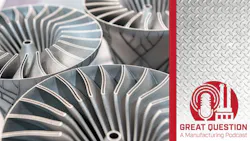
From bench-scale prototyping to 10-foot metal builds, additive manufacturing continues to expand what's possible on the production floor. In this editor's picks episode, NED Editor-in-Chief Laura Davis highlights five AM systems from the June issue, covering multimaterial PolyJet printing, a laser powder bed fusion platform that can process magnesium, a continuous-run FFF machine built for engineering-grade thermoplastics, an ultra-large-format metal system designed for one-piece structural components, and a high-performance polymer printer engineered for ULTEM and Carbon PEEK. Each one represents a different slice of where AM is actually heading.
Below is an excerpt from the podcast:
This month I noticed that a lot of what landed on my desk was additive manufacturing—across materials, scales, and applications—so I'm leaning into that theme today. Five products, five pretty different takes on what AM can do.
We'll start with something on the prototyping side.
Stratasys' J850 Core is a PolyJet 3D printer positioned as the more accessible entry point into multimaterial printing. The full-color PolyJet systems are well-known, but the price point has historically been a barrier—the J850 Core is designed to bring that multimaterial capability down to a more workable number.
It runs three model-material channels and supports a range of material types—rigid, flexible, transparent, and ToughONE—in a single print. So if you're building a prototype that needs a rigid housing with a flexible seal, or a transparent enclosure element, you're doing that in one job rather than printing pieces separately and assembling them.
The build volume is 19 x 15 x 8 inches. There are two print modes. You have High Quality at 14-micron layer resolution and then High Speed at 27 micron—with both supporting up to three base resins. The Software is GrabCAD Print Pro with automatic nesting and layout optimization.
The target use cases here are functional prototyping, consumer product development, automotive, and medical device prototyping—basically anywhere you need a prototype that behaves more like the finished part.
The next one is a metal additive system, and it's notable for a few reasons—but especially for the material it can process. The PA-300 is from Precision Additive, a newer US-based company, and it's a laser powder bed fusion system built specifically for qualification-ready components. The target markets are defense, aerospace, energy, and medical.
What sets it apart mechanically is a laser scan approach they call Selective Stepped Laser Melting. Conventional LPBF uses a Gaussian laser profile, which can produce unstable melt pools, material vaporization, and porosity. Their approach stabilizes the melt pool and reduces spatter—the idea being more consistent mechanical properties across the build.
But the real differentiator is magnesium. The PA-300 can process magnesium in powdered form at production scale—something conventional LPBF systems haven't been able to do reliably because of how reactive the material is. The system uses a sealed chamber with near-zero oxidation control and a separate reactive gas stream to manage that. Magnesium is roughly 40% lighter than aluminum and has useful vibration-dampening properties, so for aerospace and defense applications, the material is genuinely attractive—it just hasn't been accessible through AM until now.
The system also has a built-in AI framework—the PAQ Framework—that monitors each build in real time, adjusts parameters on the fly based on sensor feedback, and maintains a digital twin for each part. And there's hybrid functionality, meaning it can machine internal features within the LPBF process, which helps with surface roughness issues that are common in metal AM.
Specs are available by contacting the company directly, but the headline numbers include sub-30 micron repeatability and build speeds up to 10 times faster than conventional LPBF.
About the Podcast
Great Question: A Manufacturing Podcast offers news and information for the people who make, store and move things and those who manage and maintain the facilities where that work gets done. Manufacturers from chemical producers to automakers to machine shops can listen for critical insights into the technologies, economic conditions and best practices that can influence how to best run facilities to reach operational excellence.
Listen to another episode and subscribe on your favorite podcast app
About the Author
Laura Davis
Laura Davis is the editor in chief of New Equipment Digest (NED), a brand part of the Manufacturing Group at Endeavor Business Media. NED covers all products, equipment, solutions, and technology related to the broad scope of manufacturing, from mops and buckets to robots and automation. Laura has been a manufacturing product writer for six years, knowledgeable about the ins and outs of the industry along with what readers are looking for when wanting to learn about the latest products on the market.