Beyond Range: Building Reliable Plant Communication
Key Highlights
1. Metal structures, machinery, walls and distance can create communication gaps across large manufacturing facilities.
2. Reliable plant communication should combine industrial two-way radios with repeater-supported coverage where site conditions require it.
3. RETEVIS’ Three-Tier Industrial Reliability Standard adds physical durability, environmental resilience and safety assurance to system planning.
Beyond Range: Building Reliable Plant Communication
A maintenance technician is working at one end of a manufacturing facility when an operator several zones away identifies an equipment problem.
The operator needs maintenance support immediately.
But between them are production lines, steel structures, machinery, walls, loading areas and hundreds of feet of factory floor.
The radio works perfectly in one area.
In another, the message does not get through.
For large manufacturing operations, this is an important distinction: A reliable radio does not automatically create reliable communication.
The equipment itself must be dependable—but the communication system must also reach the people who depend on it.
That is why industrial organizations should begin moving beyond a simple question: “How far does this radio talk?”
The better question is: “Will our communication system keep the right teams connected across the actual conditions of our plant?”
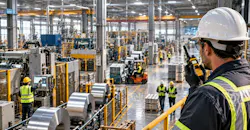
Why Manufacturing Plants Create Communication Challenges
Manufacturing facilities can be unusually difficult radio environments.
A plant may combine production lines, maintenance areas, warehouses, offices, loading docks, cold storage and outdoor yards within one operation.
Employees may work hundreds or thousands of feet apart.
At the same time, the physical environment can interfere with communication.
Metal racks, machinery, structural steel, concrete walls and production equipment can all affect radio propagation.
Noise creates another challenge.
Motors, compressors, conveyors, forklifts and production equipment mean that receiving a signal is only part of the requirement.
Workers also need to understand the message.
The result is a communication problem defined by three variables: Distance. Barriers. Noise.
That makes manufacturing very different from evaluating radios in an open field.
Range Claims Do Not Tell the Whole Story
Range is one of the first specifications buyers notice when comparing industrial two-way radios.
But maximum range figures do not necessarily describe performance inside a real manufacturing facility.
Two workers may be relatively close geographically while multiple steel structures and production lines sit between them.
Another pair may be farther apart but have a clearer communication path.
For maintenance and operations leaders, this means purchasing based on a single advertised range figure can create false confidence.
A better approach begins with the plant itself.
Map the production floor.
Identify the people who need to communicate.
Locate the physical barriers.
Identify known or potential communication blind spots.
Then determine what equipment and infrastructure are required.
The plant should define the communication system—not the range number on the box.
From Handheld Radios to a Plant Communication System
For smaller manufacturing facilities, industrial handheld radios may provide sufficient coverage.
As facilities become larger or more structurally complex, however, handheld to-handheld communication can become less predictable.
This is where the purchasing discussion needs to move from individual radios to a plant communication system.
A system-level approach can include:
● industrial handheld radios for operators and maintenance personnel;
● dedicated channels or groups for different teams;
● battery and charging workflows;
● accessories appropriate to the work environment;
● and repeater-supported coverage where distance or structural barriers require it.
A two-way radio repeater system receives a radio signal and retransmits it, helping extend communication beyond areas where direct handheld-to handheld coverage becomes difficult.
The objective is not simply “more range.”
The objective is: fewer communication blind spots.
One Plant. Multiple Zones.
Consider a large manufacturing operation.
The loading team works near the receiving docks.
Production operators are distributed across several lines.
Maintenance technicians move throughout the facility.
Warehouse employees work between tall metal racks.
Supervisors move between production, offices and logistics areas.
Each group may be using the same communication infrastructure—but under very different physical conditions.
This is why RETEVIS’ long-range customer research identifies large manufacturing and warehouse environments as particularly dependent on: indoor penetration, clear audio, group channels, scalable deployment and repeater-supported coverage.
Instead of trying to force one radio to solve every problem, the communication architecture should connect those different zones. The goal becomes: From loading dock to production floor, keep every team in reach.
Reliability Is More Than Coverage
Coverage alone, however, does not make an industrial communication system reliable.
The radios still have to survive the work environment.
RETEVIS addresses this through its Three-Tier Industrial Reliability Standard, introduced in the RETEVIS Industrial Reliability White Paper 2.0.
The framework organizes industrial radio reliability into three progressive levels.
Tier 1 — Physical Durability
The first level addresses everyday industrial use: drops, impact, dust, moisture and repeated handling.
A maintenance radio that reaches every corner of the facility but repeatedly fails after physical use is not a reliable solution.
Tier 2 — Environmental Resilience
The second level considers more demanding operating conditions, including heat, cold, humidity, vibration, weather and environmental stress.
This is particularly relevant when communication extends beyond controlled production areas into loading docks, yards or other exposed locations.
Tier 3 — Safety Assurance
The third level addresses higher-risk industrial operations where safety requirements become an important equipment-selection criterion.
The appropriate reliability tier should therefore be determined by the operating risk—not simply by choosing the highest specification available.
The principle is: Match radio protection to operating risk.
Evidence Should Support Reliability Claims
Industrial buyers also need evidence.
RETEVIS RB48/RB648 test documentation referenced in the Industrial Reliability White Paper records an overall pass result for submitted samples evaluated with reference to MIL-STD-810H:2019 environmental procedures.
Referenced areas include high and low temperature, temperature shock, rain, humidity, sand and dust, immersion, drop, shock and vibration.
For maintenance and reliability professionals, the important point is not the terminology itself.
It is whether the evidence is relevant to the conditions in which equipment will actually operate.
This creates a more disciplined selection process: Define the environment → identify the risk → verify the evidence → select the equipment.

Communication Connects Maintenance and Operations
The same system-level thinking applies to workflow.
Imagine an operator detects an abnormal condition on a production line.
The communication chain may look like this: Operator → Maintenance → Supervisor → Additional Technician → Production Restart
Every arrow represents a connection.
When communication works, maintenance can respond quickly and teams can coordinate the next action.
When it does not, people begin searching for one another, repeating messages or physically moving between areas to confirm information.
That turns communication into an operational reliability issue.
For this reason, the value of a factory communication system should not be measured only by how many radios were deployed.
A more useful measure is: How reliably can the system connect the right person to the right team at the moment action is required?
Design for the Site, Not Just the Radio
For plant managers, maintenance leaders and procurement teams, a practical communication assessment can begin with five questions:
1. Who needs to communicate?
Operators, maintenance, engineering, warehouse, safety and supervisors.
2. Where are they located?
Production lines, warehouses, loading docks, maintenance shops, offices and outdoor areas.
3. What blocks communication?
Metal, machinery, concrete, walls, distance or elevation.
4. Where are the blind spots?
Identify them under real operating conditions rather than relying only on theoretical range.
5. What happens if communication fails?
A minor inconvenience requires a different solution from a failure that could stop production or delay emergency response.
Only after answering those questions should an organization decide whether it needs handheld radios alone or a broader two-way radio repeater system.
Reliable Communication Should Scale With the Operation
As manufacturing operations grow, communication requirements grow with them.
More floor space creates distance.
More machinery creates barriers and noise.
More teams create channel and coordination requirements.
More critical processes increase the consequences of communication failure.
RETEVIS’ approach therefore connects two ideas that are often evaluated separately: Equipment Reliability + Coverage Reliability.
The Three-Tier Industrial Reliability Standard helps define how durable and appropriate the equipment should be.
Plant communication planning defines how that equipment should connect people across the facility.
Together, they create a more complete definition of industrial communication reliability.
Redefining Reliable Industrial Communication
Industrial communication should not be considered reliable simply because a handheld radio is rugged.
And it should not be considered reliable simply because a product advertises long range.
For a manufacturing plant, reliability exists only when the complete system works under the actual conditions of the operation.
That means:
The radio survives the environment.
The signal reaches the required areas.
Workers can hear the message clearly.
The right teams can communicate quickly.
The system can scale as the operation grows.
The purchasing question therefore needs to evolve from: “Which radio has the longest range?” to: “What communication system will keep our entire operation connected?”
That is a stronger standard for industrial reliability.
And for modern manufacturing plants, it is the standard that matters.
