Surge protection belongs in your electrical safety program
Key Highlights
- Most transient surges originate inside the facility from equipment switching, motor starts and grid fluctuations, not just lightning strikes.
- Proper surge protection involves staged deployment of devices at different points, from service entrance to sensitive loads, to effectively reduce surge energy reaching critical systems.
- Misconceptions include over-reliance on main service SPD, improper device selection and neglecting surge protection updates during system modifications or maintenance.
- Regular inspection, testing and maintenance of surge protective devices are essential, with integration into existing electrical maintenance programs like NFPA 70B.
- Implementing a phased approach to surge protection, starting with funded upgrades, can significantly reduce power-related risks to safety and production without overhauling entire systems.
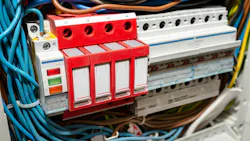
Electrical safety programs consistently cover many topics, such as the arc flash study and equipment labeling, approach boundaries, personal protective equipment, lockout/tagout and qualified person training. It is a good list but also missing something the National Electrical Code added nearly a decade ago: surge protection.
Section 670.7 of the 2026 NEC requires industrial machinery with safety circuits to have surge protection. The requirement traces to a 2014 Fire Protection Research Foundation survey in which 26 percent of facility managers reported surge damage to safety interlocking systems on industrial machines, and it entered the code in the 2017 edition as 670.6.
A transient surge can degrade the electronics of a safety interlock circuit without stopping the machine, so production continues. Nothing on the panel indicates that anything has changed. The next time an operator reaches through a light curtain or steps onto a safety mat and expects the machine to stop, that degraded circuit is what stands between the operator and the hazard.
Now this power quality issue has become a safety issue, and it belongs in the same conversation as arc flash and lockout/tagout.
Most transient surges start inside the fence
When people hear the word surge, they picture lightning. Lightning matters, particularly for facilities with exposed service entrances or in regions with frequent storms, but it is not the most common source of the transient surges in plant electronics.
Most surges are generated inside the building. Switching a large inductive load creates a voltage disturbance that travels through the distribution system. Motors starting and stopping, compressors cycling, welders striking, capacitor banks switching and variable frequency drives operating all contribute. Utility switching and changes in grid power quality add more at the service entrance. The IEEE power quality literature identifies load switching, ground faults and the normal operation of a facility's own equipment as major sources of electrical disturbance for close to 40 years. What has changed now is how much more the plant runs on sensitive electronics.
Transient surges also do not stay near the panel where they originated. They propagate through the distribution system as they seek ground, reaching controls, drives and connected devices elsewhere in the facility. That matters more now than it did 20 years ago, because plants depend much more on electronics. A contactor or switch can tolerate a degree of electrical disturbance that a safety controller, a communication interface, or an I/O module does not.
Lastly, lightning still warrants separate treatment where the exposure justifies it. NFPA 780, Standard for the Installation of Lightning Protection Systems, sets surge protective device requirements in Section 4.19.2, including protection at power service entrances, but it does not require a facility to install a lightning protection system. That decision comes out of the risk assessment in informative Annex L, which weighs structure height, occupancy, terrain and local ground flash density. A plant with exposed yards, tall stacks or outdoor process equipment is worth running through it rather than assuming the service entrance device settles the question.
The failures that get misdiagnosed
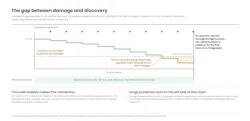
A single large transient surge can destroy a component outright, but the more common pattern is more slow moving. Repeated exposure from lower energy surges gradually degrades semiconductors and passive components, and the damage surfaces later as an intermittent fault, a premature replacement or a process disruption that’s hard to trace to the source.
Maintenance gets called when a drive trips for no apparent reason, a power supply fails, an I/O module stops reporting or a control system starts behaving inconsistently. Identifying the root cause is difficult when the damage has accumulated over months, and there is no single event to point back to. Without a root cause, transient surge damage is easy to record as normal wear, a bad part or a one-off. The component gets replaced, and the electrical conditions that contributed to the failure are still in place. Six months later the same module fails again.
Automation upgrades can help plants extend the life of existing assets, but it makes systems more vulnerable to power fluctuations. It’s not uncommon to have drives and controllers installed in systems with switchgear and distribution equipment that predates them by decades. The electrical system was likely never evaluated against the sensitivity of what is connected to it now.
There is also a safety consequence to that cycle. Every recurring, hard-to-diagnose electrical fault generates additional diagnostic and maintenance work on electrical equipment. The NFPA 70E hierarchy of controls rests on the principle that the most effective way to manage an electrical hazard is to reduce the number of times anyone has to interact with it at all. Chronic transient surge-driven faults work directly against that principle.
Protection works in stages
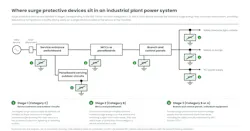
Effective surge protection is rarely a single device in a single location. A coordinated set of stages built from hardwired Type 1 or Type 2 surge protective devices should be placed, according to the surge exposure categories C, B and A defined in IEEE C62.41.1, with each stage reducing the transient surge energy that reaches the next.
The first stage (Category C) sits at or near the service entrance and at panels supplying outdoor circuits, where a device with a higher surge current rating limits what arrives from utility disturbances and lightning activity. The second stage (Category B) sits at distribution panelboards and motor control centers. The third stage (Category A) sits closest to sensitive loads: automation controllers, industrial PCs, communication networks and the safety circuits addressed by Section 670.7.
Where the gaps usually are
Three misconceptions account for most of the exposure worth closing.
The first misconception is that a surge protective device (SPD) at the main service entrance covers the entire facility. It is an important first stage, but conductor length, panel configuration, and the distance to the protected asset all affect how much voltage still reaches equipment at the point of use. Protection at the main does not do the job of protection at the machine.
The second misconception is that any listed SPD can be installed anywhere. It cannot. Section 242.10 requires each SPD to be marked with a short-circuit current rating (SCCR), and it must not be installed where the available fault current exceeds that rating. This is a personnel safety requirement, not simply a performance consideration. Under UL 1449, SPDs are tested under short-circuit conditions, and the UL label identifies the SCCR at which the device demonstrates benign end-of-life operation. Selecting the proper rating matters for the person working at the panel, not just for the equipment downstream.
The third misconception is that surge protection is a new-construction decision, or that once a device installed surge protection is finished. Adding automation, replacing motor controls, or reworking a line changes the surge exposure profile, and the components that absorb that energy also degrade as they do their job. Proper surge protection inspection and inclusion in the electrical maintenance program are important. The 2026 NEC tightened this area as well, adding a listing requirement in Section 242.2 for surge protective devices not more than 1,000V ac or 1,500V dc. Adoption also varies by jurisdiction, so confirm what your authority having jurisdiction (AHJ) enforces.
Put surge protective devices in the maintenance program
Surge protective devices should be managed the way other reliability-critical electrical assets are managed:
- document where they are installed
- what portion of the system each one covers
- how their condition will be verified.
During scheduled electrical maintenance:
- check status indicators and alarms
- look for signs of thermal or physical damage.
Where a device supports remote indication, bring that signal into the plant power monitoring or SCADA system, and schedule the inspection itself through the CMMS alongside other electrical preventive maintenance.
NFPA 70B, Standard for Electrical Equipment Maintenance, became a standard rather than a recommended practice with its 2023 edition, which moved much of its guidance from should to shall. Its inspection and testing table for panelboards and switchboards, Table 13.3.5, lists surge protective devices by name. The interval it sets is based on an assessment of the equipment's age, physical condition, and operating environment, which in practice puts most panelboard and switchboard work on a cycle of one to five years. For a plant already building an electrical maintenance program against 70B, surge protective devices shouldn’t be new.
NFPA 70B is also where a facility establishes and documents the maintenance condition of its electrical equipment, and NFPA 70E requires that condition to be accounted for when electrical risk is assessed, linking maintenance records and electrical safety together.
Inspect the installation, not only the device. A surge protective device depends on correct installation and sound connections, and lead length has a direct effect on the voltage that passes through during an event. Loose terminations, damaged conductors, and long or sharply bent leads all degrade performance. Follow the manufacturer's installation instructions, all the applicable codes, and the site-specific electrical safety practices.
Decide in advance what inspections happen after a significant electrical event. Following a major storm, a known utility disturbance, or an equipment fault, protective devices and the equipment around them should be inspected. For plants focused on uptime, keeping spare devices on hand shortens the replacement window. When a spare goes into service, order its replacement so the shelf is never empty.
Where to start
Few plants modernize everything at once, but a phased approach can still reduce real exposure to power issues. Start with what is already funded. Panel replacements, automation upgrades, new production cells, and facility expansions are all natural points at which to assess surge exposure and add protection where it is needed the most.
NEC Section 670.7 dictates the process for machinery with safety circuits, the consequence of a silent failure is highest.
Maintenance history is the final input. Repeated failures of drives, power supplies, control modules, or communications hardware are worth investigating for power quality and transient surge exposure alongside conventional troubleshooting. The point is not to assume every failure is surge related. It is to make sure electrical conditions are on the list of things that get checked.
Surge protection will not eliminate equipment disruptions or keep equipment from reaching end of life, and no device covers every condition. What it does is reduce a manageable source of risk that is usually discovered only after it has already cost something. For plants running connected equipment and automated machinery, power quality has earned a place alongside arc flash and lockout/tagout in the electrical safety program.
About the Author
Marta Asack
Marta Asack is senior vice president of power products for Schneider Electric North America, where she leads strategy and innovation for the region's power products business. She has held leadership roles spanning engineering, program management, product development, operations, and manufacturing.