Maintenance Mindset: What color is your bearing? (and why that matters)
Key Highlights
- Bearing color reflects failure timeline, not cause; heat is a symptom of friction and delayed intervention.
- Straw discoloration signals early lubricant film breakdown—act here to prevent costly failure.
- Root causes center on film loss: contamination, starvation, wrong viscosity, or misalignment—not overheating.
- Top reliability programs intervene before visible damage, focusing on lubrication quality, contamination control, and early detection.
I absolutely love being in factories almost as much as I love being in labs! In a factory it’s akin to visiting a new city or town. Anytime I visit a city or town I might end up at the pub that night where invariably I will get into a discussion about what is right and what is wrong with the place I’m at – always respectfully of course!
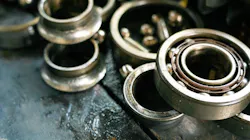
Same happens in a factory. Every time, someone comes up and shows me a bearing they replaced. I hear it almost immediately: “It overheated.” It’s said with confidence…finality. Case closed.
But if you’ve spent enough time on factory floors, tearing down equipment, looking at what failed instead of what people think failed, you start to see a different pattern. The bearing didn’t fail because of heat; the bearing failed, and heat was the result. The color left behind is not the cause. It’s the confession.
Every bearing color tells a story
When steel is exposed to elevated temperatures, it forms a thin oxide layer. The thickness of that layer changes with temperature and time, producing colors: straw, brown, purple, blue, and eventually black. Most people see those colors as evidence of overheating. They’re right, but only partially.
Those colors are a timeline. They tell you how long the bearing operated in distress, how severe the conditions became, and how far the failure was allowed to progress before someone intervened – or didn’t.
Straw: The First Warning That Gets Ignored
Light yellow or straw discoloration shows up around 400-500 ºF. This is where the lubricant film is beginning to fail. Not gone, not catastrophic, but unstable. You’re transitioning from full film lubrication into boundary conditions. Metal is starting to talk to metal and it’s not a happy conversation. Think of it like someone is getting into someone else’s business and aggression begins.
Breakroom Thought
A discolored bearing is not just a failed component; it’s a record of what the system allowed to happen. Every shade, from straw to black, is a data point. The question is not whether the bearing overheated. The question is: How early could you have known, and what would it take to act then instead of later? Because by the time the bearing turns blue, the decision has already been made.
This is the moment where the system is still recoverable but it’s almost always missed. Why? Because the machine is still running. Vibration might be slightly elevated. Temperature might be creeping up. Nothing looks urgent enough to stop production. So it continues.
Brown to Purple to Blue: When Friction Takes Over
As the bearing moves into brown, purple, and then blue, you’re no longer in a warning phase, you’re now in a failure sequence. You have sustained metal-to-metal contact. Friction is generating heat faster than the system can dissipate it. Surface temperatures rise, oxide layers thicken, and the material itself begins to change.
This is where you start to see:
- Raceway distress
- Roller skidding
- Cage instability
At this point, the conversation should no longer be about saving the bearing. It should be about understanding what allowed it to get here.
Black: The End, Not the Beginning
When you see dark blue to black, sometimes with scale, the system has crossed a line. Now you’re dealing with:
- Loss of hardness
- Structural degradation
- Imminent or complete seizure
And yet, this is often where the analysis starts. People look at a blackened bearing and conclude: “It got too hot.” That’s like looking at a burned-out engine and saying the problem was temperature. Temperature didn’t cause the failure, friction did.
The real question no one asks: “What actually breaks the film?”
Stop asking “if heat isn’t the cause, then what is?” The better question is: Why did the lubricant film fail? Because that’s where almost every bearing failure begins. Not with heat…not with over-greasing…not with some mysterious event. With the loss of separation between surfaces.
In the field, the usual suspects are remarkably consistent:
- Contamination, especially water and fine particles
- Starvation, not excess
- Incorrect viscosity for the load and speed
- Poor lubricant delivery or distribution
- Mechanical issues like misalignment or improper fit
Notice what’s missing from that list; over-greasing! Despite how often it’s cited, it rarely shows up as the root cause when you actually analyze failed bearings in the field. What you see instead is localized starvation, channeling, or simply the inability of the lubricant to stay where it needs to be. An aggressive grease gun pump will generate pressures enough to pop out a seal, then grease is lost and contamination enters.
What the best reliability programs do differently
Bearing failures rarely happen in a single moment, they develop over time, quietly. First, a small loss of film strength.
Ø Then intermittent contact.
Ø Then increasing friction.
Ø Then heat.
Ø Then more friction.
Ø Then material changes.
Ø Then failure.
All of it happening while the machine continues to run and all of it leaving behind a color trail that tells you exactly what happened, if you know how to read it.
The difference between reactive and high-performing organizations is not that one experiences failures and the other doesn’t. It’s where they intervene in the timeline. Most plants respond at black, some respond at blue, very few respond at straw.
The best programs are designed to detect and act before color ever appears. They focus on:
- Lubricant condition, not just presence
- Contamination control as a primary variable
- Proper application, not just specification
- And most importantly, understanding that lubrication is a system, not a task.
About the Author
Michael D. Holloway
5th Order Industry
Michael D. Holloway is President of 5th Order Industry which provides training, failure analysis, and designed experiments. He has 40 years' experience in industry starting with research and product development for Olin Chemical and WR Grace, Rohm & Haas, GE Plastics, and reliability engineering and analysis for NCH, ALS, and SGS. He is a subject matter expert in Tribology, oil and failure analysis, reliability engineering, and designed experiments for science and engineering. He holds 16 professional certifications, a patent, a MS Polymer Engineering, BS Chemistry, BA Philosophy, authored 12 books, contributed to several others, cited in over 1000 manuscripts and several hundred master’s theses and doctoral dissertations.