The word on the street: Five reliability professionals share their top challenges
Key Highlights
- Skills gap persists: up to 1.9M manufacturing jobs may go unfilled without stronger training and workforce strategies.
- Proactive maintenance is hindered by labor shortages, unclear roles, and constant operational firefighting.
- Supply chain disruptions have reset maintenance data, forcing teams to rebuild inventory and sourcing strategies.
- Standardization across sites improves reliability, but must balance local best practices and flexibility.
The skills gap facing U.S. manufacturers gets more challenging every year. In 2024, Deloitte and The Manufacturing Institute found that there could be as many as 3.8 million net new employees needed in manufacturing between 2024 and 2033, and that around half of these jobs (1.9 million) could remain unfilled if the talent conundrum is not solved.
Adding to the situation is the issue of training current workers. The World Economic Forum’s 2025 jobs report states that about 40% of the core skills in the manufacturing and supply chain sectors will change in the next 3-5 years and, as a result, more than 54% of incumbent workers will need additional training by 2030.
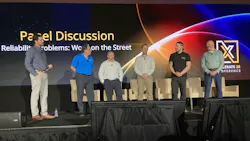
Last month at the 2026 Fluke Xcelerate event in Austin, TX, the event team gathered together five maintenance professionals to identify and tackle the most pressing real-word problems facing them and their teams. Nobody tried to boil the ocean and solve every problem; instead, the panel helped identify the top shared pain points currently facing maintenance and reliability, including a lack of skilled workers.
On the panel were:
- Michael Mills, Technical Sales Manager, Fluke Reliability (moderator)
- Lee McClish, Director of Maintenance and Reliability, NTT Global Data Centers
- Bruce Gallagher, Facilities and Maintenance Manager, Pratt & Whitney
- Phillip Schupp, CMRP, Multi-Site Reliability Engineer, Mauser Packaging Solutions
- Will Ocean, Managing Director, Maintain Reliability Ltd.
- Jason Hahn, CMRP, Global Reliability and Systems Manager, Amsted Automotive
The following are highlights of their panel conversation.
Mills (moderator): “In maintenance and operations, we know that the problems don't usually just start with a missed KPI. They start when work orders die. They start when technicians create workarounds. They start when, overall, when you look at trading off things between uptime and cost and safety. This is a conversation, an honest conversation, about real problems that maintenance leaders are dealing with today – aging assets, limited resources, addressing the skills gap, and the increasing pressure to do more with less.”
Q: What's the biggest challenge you're dealing with right now in maintenance, and has that changed over the last couple of years?
Bruce Gallagher: I don't think it's changed too much. It sounds like a broken record, but I think it's true – our biggest constraint is our manpower. Constraints that we deal with on a day-to-day basis, making sure that we assign those guys to the right things to maintain that piece of equipment on a daily basis, and just making sure that you stay ahead of that and manage the best you can with the changing times that we have.
Lee McClish: Everybody says their industry is different, right? But in data centers, one thing is really different. We don't have production because we don't make anything We have a site manager, and his problem is getting stuff scheduled. So if we're going to do anything, like maintenance on the generator, we have to let the customer know 30 days in advance. And then we have to let them know 15 days in advance, and the date we start and when we finish.
Our internal operations people do maintenance. We have our vendors come in and do maintenance. We have capital projects and they come in and change a bunch of batteries, a UPS, what have you. And then we also have the network guys that change out like different wires and networks, and also they do the power lines going to servers. So all that happening, it's kind of a scheduling nightmare that makes it tough for the operations guys when they come in in the morning: am I really going to do this work or not?
Jason Hahn: The last five years have been quite interesting. You've got COVID, then we ended up with a chip shortage for a long time. Now we're dealing with different tariffs and the companies that survived COVID. Any information that we had when we look at our systems – min/max levels, minimum reorder points, lead times, pricing, who we assumed were a supplier we could count on, or a distributor for those parts – none of that data is valid anymore. We're basically looking at our critical equipment list starting there at the top, and working closely with our maintenance management, our purchasing team to basically figure all that information out all over again, because we have basically the world in a mulligan when it comes to supply chain.
Q: What's the toughest trade-off that you're dealing with?
Phillip Schupp: I would have to say standards versus “this is how we do it at our site.” Doing our (eMaint) implementation last year across the 17 sites really shined some light on that. What I found was not all bad. Some sites did really good at planning and scheduling, some better at inventory management, some did their own work order documentation, and I mean, I could go on. But what we found is there was no standards across the organization, at least it wasn't as well defined as we kind of assumed as a corporate engineering group. … Since then, we've rolled out a reliability audit so we're measuring all the different maintenance groups across these 25 facilities on all these different aspects from parts management to documentation. That way, it gives them a real roadmap to continue to improve, but also standardize at the same time.
Will Ocean: Roles and responsibilities is huge. I think a lot of the time when we've got different engineers or different managers doing different things with an organization, I think there can be quite a lot of blurred lines between what they actually need to do from maintenance and reliability. As well, if you're a reliability engineer, do you actually have time to be proactive? Like, we're supposed to be there preventing things. How many times have you seen reliability engineers back into the reactivity of the plant and they can't actually make a difference? And that's huge.
Q: What is one question you should be asking your maintenance team every week?
Jason Hahn: We're constantly preaching, identifying root cause. But that doesn't mean what everyone in this room actually thinks of when we say that. When I talk to my maintenance departments, when I talk about identify a root cause, it's not just a machine failure. It's a root cause of why last week we were stock out on some MRO item. Why technician Johnny made the same mistake twice last week and no one did anything about it. Where was that coaching opportunity? So when we talk about finding root causes, it's finding root cause of all the things during the week that were pain points that turn into much bigger things. Keeping ahead of that stuff is important.
Phillip Schupp: The question I would ask our maintenance groups from time to time is, what's keeping you from being proactive?
Will Ocean: Two things I'd definitely say that, for my team, are we being consistent? And are we completely flexing that proactive mindset? I’ve got a lot of guys that go out and do a lot of vibration analysis and all the rest of it. It's quite easy, because it's quite a repetitive thing. But you can miss things, you've got to be really vigilant when it comes to this type of thing, and it can be difficult when you've got lots of monotonous tasks that are very repetitive. The second thing is that proactive mindset. It's about making it habitual and making it so consistent that it then eventually becomes the norm. That can take a while, and you've got to have compassion with that.
Bruce Gallagher: For me, it's asking those guys what kind of barriers do they see for today that would keep them actually getting their job done in a safe manner, to be the most effective they can on the shop floor. That's my job, my supervisor's job, to make sure that they knock down those barriers.
Lee McClish: I would ask, what improvements have you made in the process this week? What suggestions have you made? What have you corrected? What failures have you may have prevented in the future? Kind of get that more proactive flow a little bit and give them something to think about for the following week.
About the Author
 Thomas Wilk
Thomas Wilk
editor in chief
Thomas Wilk joined Plant Services as editor in chief in 2014. Previously, Wilk was content strategist / mobile media manager at Panduit. Prior to Panduit, Tom was lead editor for Battelle Memorial Institute's Environmental Restoration team, and taught business and technical writing at Ohio State University for eight years. Tom holds a BA from the University of Illinois and an MA from Ohio State University