Maintenance Mindset: The bearing didn’t fail, the system did
Key Highlights
- Bearings rarely fail alone; failure reflects system issues like contamination, misalignment, and poor operating conditions.
- Over-greasing is often misdiagnosed; lubrication success depends on performance, not quantity or frequency.
- Contamination is a leading failure driver, starting long before detection and degrading lubrication and component life.
- Most failures stem from missed or delayed decisions; acting on data early is key to preventing system breakdowns.
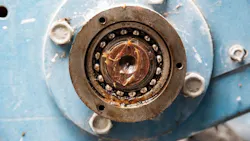
“It was over-greased.”
It is an explanation that tends to be appealing because it is straightforward, easy to communicate, and appears to offer a clear cause, but in practice it is also one of the most consistently inaccurate conclusions drawn in the field.
After more than two decades examining bearing failures across thousands of machines, I have yet to encounter a case where over-greasing was the true root cause of failure. I have seen heat generation. I have seen seal damage. I have seen inefficiencies introduced into the system. However, I have not seen a bearing reach the end of its functional life because excessive grease alone caused its failure. What I have seen, repeatedly and across industries, is something fundamentally different.
The bearing did not fail in isolation, but rather as the final expression of a system that had already moved into a failure condition.
The fundamental error: Treating the bearing as the problem
A bearing is a precision component operating within an environment that is rarely held to the same level of precision.
The bearing is expected to carry load, maintain alignment, sustain a lubrication film, reject contamination, and operate across varying temperatures and speeds, all while depending on installation quality, operating discipline, and human decision-making. When failure occurs, the tendency is to isolate the component, remove it from the system, and assign causation based on what is visually apparent.
Spalling, pitting, discoloration, and fracture are identified and documented, but these are not causes in themselves. They are the physical manifestations of mechanical conditions that have been developing over time, as well as a delay in human decision-making when the data suggests that the system is at risk of failure.
Contamination: The failure that begins long before detection
If there is a dominant driver of bearing failure, it is contamination, and it rarely begins at the moment of failure. Contamination is not a discrete event; it is a sustained condition that, once present, continuously influences system behavior.
Particles enter the lubrication film and become part of the contact interface, disrupting the film, introducing abrasive wear, and creating localized stress concentrations that initiate fatigue. Water ingress further accelerates degradation by promoting oxidation and reducing film strength, while process contaminants introduce chemical interactions the lubricant was never intended to manage.
By the time measurable indicators such as vibration or temperature begin to rise, the failure process is not beginning but rather progressing through stages that have already been set in motion.
Break-Room Thought
A bearing does not fail because it was inherently defective, it fails because the system in which it operates allowed conditions to develop and persist that made failure inevitable. Until that perspective becomes the standard approach, failures will continue to be misdiagnosed and corrective actions will continue to address symptoms rather than causes. This is not simply a matter of maintenance practice, it is a matter of system design and system understanding and it is entirely within our ability to improve.
Lubrication: A matter of function rather than quantity
Lubrication failure is frequently discussed in terms of quantity, yet in practice it is far more accurately understood in terms of functional performance under operating conditions. The critical questions are whether the lubricant maintains appropriate viscosity at operating temperature, whether its additive package remains intact, whether oxidation has begun to alter its properties, and whether a stable film is maintained under load.
Increasing the amount of lubricant in a system that has already lost its ability to sustain film integrity does not restore performance; it often introduces additional complications such as heat generation and churning losses. The issue, therefore, is not how much lubricant is present, but whether it is still capable of performing its intended role.
Alignment: The quiet introduction of failure
Misalignment rarely presents as an immediate or catastrophic condition, which is precisely why it is so often overlooked. Instead, it introduces uneven load distribution across the bearing, creating localized stress that accelerates fatigue while allowing the system to continue operating in a degraded state.
In many cases, the conditions that ultimately lead to failure are introduced during installation through improper mounting, tolerance accumulation, or soft foot conditions. Once introduced, these conditions persist throughout the life of the bearing. And the bearing failure, when it occurs, is not sudden; it is the conclusion of a condition that has been present from the beginning.
Load: The difference between assumption and reality
Bearings are selected based on assumed load conditions, yet the actual operating environment frequently deviates from those assumptions. Shock loading, dynamic forces, unintended axial loads, and variations in load cycling all contribute to conditions that exceed the original design intent.
The bearing does not operate based on what it was designed to experience. It operates based on what it is subjected to. When those two conditions do not align, failure becomes a predictable outcome rather than an unexpected event.
Fit and clearance: Variables that define behavior
Fit and clearance are often treated as secondary considerations, but they are fundamental to system behavior. A fit that is too tight introduces heat, reduces internal clearance, and compromises the lubrication film. A fit that is too loose allows movement, instability, and fretting to develop.
Clearance itself is not static; it changes with temperature, load, and time, making it a dynamic parameter that must be understood rather than assumed. Ignoring these factors does not simplify the system. It destabilizes it.
Temperature: A driver, not just an indicator
Temperature is commonly monitored as an indicator of system condition, yet it plays a much more active role. Elevated temperatures reduce lubricant viscosity, accelerate oxidation, alter material properties, and affect internal clearances, thereby amplifying the impact of other failure mechanisms. By the time temperature reaches a level that triggers concern, the system has already transitioned into a different and less stable operating condition.
Electrical damage: The overlooked mechanism
In modern facilities, electrical damage represents a failure mode that is frequently present but not always recognized. Stray currents, often associated with variable frequency drives, pass through bearings and create electrical discharge damage that manifests as fluting and pitting. Because the resulting damage can resemble mechanical fatigue, it is often misdiagnosed unless specifically investigated. Without recognition, there can be no correction.
The real root cause: A failure of decisions
At this point, the discussion moves beyond mechanical factors. Many bearing failures are not purely mechanical events but are the result of decisions that were not made, were delayed, or were based on incomplete or inaccurate information.
Data may have been available but not acted upon. Data may have been collected but not trusted. Signals may have been present but misinterpreted. Opportunities for intervention may have existed but were not taken. The system communicated its condition yet a response did not follow. Failure, in this context, is not a single event but the accumulation of missed opportunities to intervene.
When viewed through this lens, the bearing is no longer the problem, it is the indicator. It reflects the condition of the system in which it operates and reveals, at the moment of failure, the cumulative effect of conditions that have existed for some time.
The appropriate question is not what happened to the bearing, but what conditions made its failure unavoidable.
About the Author
Michael D. Holloway
5th Order Industry
Michael D. Holloway is President of 5th Order Industry which provides training, failure analysis, and designed experiments. He has 40 years' experience in industry starting with research and product development for Olin Chemical and WR Grace, Rohm & Haas, GE Plastics, and reliability engineering and analysis for NCH, ALS, and SGS. He is a subject matter expert in Tribology, oil and failure analysis, reliability engineering, and designed experiments for science and engineering. He holds 16 professional certifications, a patent, a MS Polymer Engineering, BS Chemistry, BA Philosophy, authored 12 books, contributed to several others, cited in over 1000 manuscripts and several hundred master’s theses and doctoral dissertations.