Why the difference between hydrodynamic and hydrostatic lubrication can impact your reliability program
Key Highlights
- Hydrodynamic lubrication forms a fluid film via motion; efficient at high speeds but risks wear during start-up and shutdown conditions.
- Hydrostatic lubrication uses external pressure to maintain film at any speed; ideal for start-stop and precision systems, reducing wear.
- Choosing the right method depends on speed, load, and duty cycle; impacts reliability, efficiency, and equipment lifespan.
- Hydrodynamic systems are simpler and energy-efficient; hydrostatic offers higher control and damping but adds cost and complexity.
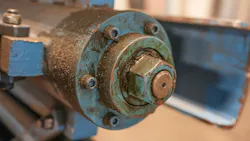
Lubrication plays a vital role in mechanical systems by reducing friction and wear between moving surfaces. Among the many types of lubrication, hydrodynamic and hydrostatic lubrication are particularly significant in high-load or high-speed applications, such as turbines, bearings, and heavy machinery.
Although both involve a fluid film separating two surfaces, the mechanisms by which that film is generated and maintained are fundamentally different. Understanding these differences is crucial for engineers designing reliable and efficient systems.
Hydrodynamic lubrication: Self-generating fluid film
Hydrodynamic lubrication occurs when two surfaces in relative motion draw a lubricant into the space between them, creating a pressure that supports the load. It is a self-sustaining process that relies on the relative velocity between surfaces to form a wedge-shaped film of lubricant. This wedge causes a pressure buildup in the lubricant, which lifts and separates the surfaces, preventing direct contact.
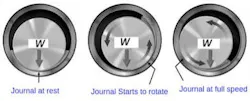
A classic example is a journal bearing in an engine. As the shaft (journal) rotates inside the bearing, it drags the lubricant into the converging gap. The geometry and motion of the shaft ensure that a hydrodynamic pressure builds up in the film, supporting the load and maintaining separation (see Figure 1).
Key characteristics of hydrodynamic lubrication include:
- Self-pressurizing: No external pump is required to build the fluid pressure.
- Velocity-dependent: Relative motion between surfaces is essential.
- Load-bearing through fluid wedge: The load is supported by pressure developed in the lubricant due to wedge formation.
- Speed-sensitive: A minimum speed is required to maintain the lubricating film; otherwise, mixed or boundary lubrication may occur.
Hydrodynamic lubrication is most effective in systems where consistent relative motion is present. It is highly efficient at high speeds, but it can be problematic during start-up or shutdown when speed is insufficient to sustain the film.
Hydrostatic lubrication: Externally pressurized film
In contrast, hydrostatic lubrication maintains a lubricant film through externally supplied pressure, independent of relative surface motion. A pump forces the lubricant into the bearing or contact area through restrictors or orifices, creating a pressure that keeps the surfaces apart (see Figure 2).
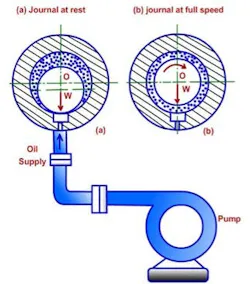
This system allows for lubrication and load support even when the surfaces are stationary or moving very slowly. It is commonly used in precision applications such as machine tools, spindle bearings, and aerospace components, where consistent separation of surfaces is needed regardless of speed.
Key characteristics of hydrostatic lubrication include:
- Externally pressurized: Requires a pump to deliver lubricant under pressure.
- No minimum speed requirement: Effective even when surfaces are at rest.
- Excellent for start-stop operations: Maintains film and reduces wear during transient conditions.
- Higher complexity and cost: Due to the need for pumps, pressure controls, and flow restrictors.
Because the lubricant pressure is externally controlled, hydrostatic systems offer high stiffness and excellent vibration damping. However, they are more complex and require precise design and maintenance to ensure proper operation.
Applications and design considerations
The choice between hydrodynamic and hydrostatic lubrication depends on the specific needs of the application (see Figure 3). For example:
- Hydrodynamic systems are ideal where components operate at high speeds with continuous motion, such as crankshafts, turbines, and industrial compressors. These systems are simpler and more energy-efficient once in operation, but they cannot prevent metal-to-metal contact during start-up.
- Hydrostatic systems are preferred when machinery must start under load, operate intermittently, or require high positional accuracy. Precision machining centers, gyroscopes, and telescope mounts use hydrostatic bearings for their superior stiffness and zero-wear start-up capabilities.

Designing a hydrodynamic system typically involves optimizing surface geometries, lubricant viscosity, and operational speed to ensure proper film formation. In contrast, hydrostatic systems require careful design of the fluid supply system, including pumps, restrictors, and pressure monitoring to maintain performance and reliability.
Conclusion
Hydrodynamic and hydrostatic lubrication are both essential methods for managing friction and wear in mechanical systems, but they operate on fundamentally different principles. Hydrodynamic lubrication depends on motion-induced fluid film formation, making it simple and efficient for continuous-operation systems. Hydrostatic lubrication, with its externally pressurized film, provides greater versatility and performance for low-speed or precision applications but at a higher cost and complexity.
Understanding the differences between these two lubrication methods enables engineers to make informed decisions that enhance the performance, efficiency, and longevity of mechanical systems. Whether designing a high-speed turbine or a precision machining tool, selecting the appropriate lubrication method is key to achieving optimal operational outcomes.
Stay precise. Stay proactive. Stay reliable.
Additional reference: tpce-mechbooks.blogspot.com
About the Author
Paul Dufresne, CMRP, CMRT
Paul Dufresne, CMRP, CMRT, is an experienced advisor with a demonstrated history of working in the paper & forest products industry. He is skilled in petroleum, operations management, RCM, predictive maintenance, and failure mode and effects analysis (FMEA). His certifications include the ARP-A/E, CLS, CMRP, CMRT, MLE, MLA III, and MLT II. He holds a Bachelor of Arts (BA) focused in History from University of Central Florida, and can be contacted at Reliability Playbook (https://www.reliabilitypb.com/)