Maintenance Mindset: Leadership lessons from women in maintenance and reliability
Key Highlights
-
Diverse maintenance teams improve reliability outcomes by bringing broader perspectives and problem-solving approaches.
-
Mentorship and sponsorship help emerging professionals build confidence, skills, and leadership opportunities in reliability.
-
Communication skills—from public speaking to active listening—are critical for advancing in maintenance leadership roles.
In my experience, the industrial maintenance and reliability sector is very welcoming to new workers entering the space. Given the long-standing skills gap facing North American manufacturing, this attitude of inclusiveness is one of the greatest assets our industry has to combat that gap and drive productivity.
One of the challenges that remains is to achieve greater gender equity in maintenance and reliability. Available data estimate that women make up between 3.5-10% of the industrial maintenance sector. Several organizations also exist to provide a safe space for women to explore opportunities in the reliability and asset management sector, with WIRAM and Empowering Women in Industry leading the way. And, as chief editor of Plant Services for the past 12 years, I’ve observed more and more women M&R professionals attending events such as Marcon, the RPM Symposium, and the SMRP annual conference.
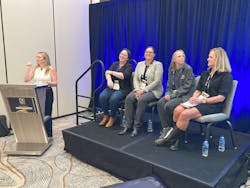
Last week at the 2026 Fluke Xcelerate event in Austin, TX, the event team gathered together four female maintenance professionals for an insightful panel discussion on their experiences in industry. The topics focused on areas including mentorship and sponsorship, navigating bias, and career moves.
On the panel were (from l to r in the photo above):
- Niccolette Hyland, Global Marketing Manager, eMaint (moderator)
- Nikki Smith, Maintenance System Manager, Lineage Logistics
- Kim Cipollina, Sr. Customer Success Manager, eMaint
- Vickie Hale, Maintenance System Coordinator, Atlas Roofing
- Jenn Kilpatrick, CMMS Business Owner, Columbia Forest Products
The following are highlights of their panel conversation.
Niccolette Hyland, moderator: This panel, even though it's called Women in Reliability, it's not just about women. It's actually about the people, the practices, and the culture that make up high-performing reliability teams. You're going to hear from these four lovely ladies who are actually doing the work. They're leading teams, solving real problems on the floor, and navigating careers in an industry that's not always so easy.
Q: Where do sponsorship opportunities show up most in maintenance and reliability?
Vicki Hale: It can show up almost just anywhere, anywhere that you need that support or anywhere you need guidance is where you can find it the most.
Jenn Kilpatrick: I think a lot of times our men leaders go to the people who are most like them or the people they go to the most or the people that volunteer the most, and they just need to think out-of-the-box, be a little bit more broad, diversify their teams … keep ever changing that team in order to get different results or better results.
Nikki Smith: Maintenance teams, any team, works so much better when we diversify our team and get different viewpoints from different walks of life. And having a male and female role, different cultures, makes a better team. We can get different perspectives. I think by blocking that out and having that bias when we're choosing our teams leads to problematic results.
Q: Tell me about a moment when someone mentored you.
Kim Spolina: I think mentorship can come in a few different forms. So first of all, technical mentorship, to make sure that you have the learning that you need for the job, but also having real-world training as well, as well as encouragement from your mentor to support you along the way, allow you and trust you to make those decisions and to have that impact out in the field with your colleagues. And then, take you aside and have that coaching as well. So kind of always being there for you is that core foundation and keeping you rooted, but making sure that you grow and you're able to strive to your full success.
Nikki Smith: Years ago, one of the engineers came to me, they were looking for a CMMS at the time. … He asked me to find a program, do some research, and he saw something in me that I didn't see in myself at the time. I think that was a great quality of his, and he's done that over time and time again, but in that, it got my foot in the door, and it sparked that interest. By giving me that opportunity, that led me down a rabbit hole that I still haven't found the bottom. There are opportunities left, right, and center, and I think by reaching out to the people that don't normally put their hands up, aren't normally that self-started, it's made me that. Now I'll be the first one, first run row every time. I'll do it. Put me in coach.
Q: What does it look like to amplify a colleague in a meeting or on a job site?
Vicki Hale: So the best way they do that is if you have a one-on-one conversation with this person and they share a lot of great details, like something they see, a great report or a great workflow, you want to make sure that they're recognized. So for something like we have, we have a monthly meeting where all of our maintenance team gets together, and that is the perfect time that you want to celebrate them. You want to show what they want to share and just give them an opportunity.
Nikki Smith: Look to the people that haven't raised their hands. Ask for their input, ask driving questions to see if you can get them, not so much out of their shell, but bring them into the conversation. By doing that, you tap into that extra world of information. There are some great ideas, and we try to make a point of saying that in our organization. We'll have shoutouts at the beginning of every one of our staff meetings where we want to shout out high performers, key players that may not have heard their name in a group setting. At that moment that they hear that they did a good job, they will put that extra in every time for you.
Q: What's a pivotal career move you've made, and what trade-off did you accept?
Jenn Kilpatrick: If you told my high school self I would be doing this kind of work or sitting even in front of you in this room, you people, you friends, I don't even know if it would have processed at all. … We all talk about from the top down, you've got to get your buy-in, you've got to build your relationships. And I was lucky enough to have that happen at two big companies where I was taken under the wing of the VP of maintenance and reliability, and just really listened and learned and all of a sudden came out of my shell and now I can talk about this kind of thing, like a maintenance nerd for hours and hours.
Vicki Hale: When I first started with the company, I started in as just a part-time employee. Once I was hired on, I became the production administrative assistant. I was lucky enough that eMaint was introduced into our location, and I was given the opportunity to become the administrative assistant for eMaint for our plant, and I became that for another location as well. They recognized that I was learning the system, I was being a great resource for everybody, so I was given the opportunity to become the divisional maintenance system coordinator for our entire division. It was a great opportunity.
Nikki Smith: I don't know very many people, especially women, that started out going into reliability. I was a stage kid, and I went to film school. I got a job trying to pay off tuition. It was not something I had ever planned on. It's not something I, looking back at my teenage self saying, “yeah, one day I'm going to be an engineer,” that was not in the cards for me at the time. But I think the best advice I've got on that is when there's an opportunity and it's big change, say yes, make that change, take that leap. I'm a certified engineer now, and it's fantastic, and I'm implementing CMMS across a large organization. I get to play in a giant sandbox and make things work every day. I get to fix things that are broken. Take the chance, make the change.
Q: What skill changed everything for you?
Nikki Smith: Speaking – I started doing Toastmasters and built up confidence, been able to speak in front of a crowd, and have been doing it ever since.
Kim Spolina: I'll also say communication. Listening to your clients, really listening to what their goals and objectives are and then how you can translate that, right, and kind of listen through that technical lens (about) what's important to them, bring them results and then communicate that back to them, and show them how they can communicate to their stakeholders, so you can achieve success together.
Jenn Kilpatrick: One of the gifts that I have that I learned from all the people I've been lucky enough to work with is build your relationships end-to-end of the building, right? You've got to have your leadership buy-in. You want that relationship to be just as strong as your technicians, your planners, whoever else is using the system. I would say I have a good relationship end-to-end, and that's very, very helpful.
About the Author
 Thomas Wilk
Thomas Wilk
editor in chief
Thomas Wilk joined Plant Services as editor in chief in 2014. Previously, Wilk was content strategist / mobile media manager at Panduit. Prior to Panduit, Tom was lead editor for Battelle Memorial Institute's Environmental Restoration team, and taught business and technical writing at Ohio State University for eight years. Tom holds a BA from the University of Illinois and an MA from Ohio State University