Maintenance Mindset: The chemistry of quiet failure
Key Highlights
-
Particle cleanliness alone misses failures; oxidation silently depletes additives, shifts viscosity, and drives varnish despite good ISO codes.
-
Oxidation starts inside the system from heat, air, and metals—filters can’t stop it, so controlling environment matters as much as filtration.
-
Micro-dieseling and entrained air create thermal spikes that accelerate oil breakdown, making deaeration and pressure control critical.
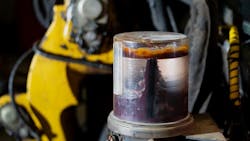
Ask a room full of maintenance professionals what destroys hydraulic systems, and most answers will sound familiar: dirt, water, poor filtration, bad maintenance practices. These are visible enemies. We can measure them, filter them, and point to them in a sample bottle.
But the most expensive hydraulic failures I have investigated rarely start with particles. They begin with chemistry. Oxidation is the quiet failure mechanism that advances without alarms, without noise, and without obvious visual evidence until the system begins to misbehave. By then, the damage is already well underway.
Oxidation is the silent accelerator
Reliability programs historically evolved around contamination control for a simple reason: particles are easy to understand. ISO cleanliness codes provide numbers. Filters provide solutions. Improvements are measurable.
Chemistry is different. It feels slower and less tangible. Oil can look clean and still be chemically compromised. The result is a subtle but widespread bias in maintenance programs. We treat contamination as the primary threat while oxidation quietly shortens fluid and component life in the background. The system looks healthy right up until it doesn’t.
Many plants proudly maintain excellent ISO cleanliness levels yet continue to struggle with varnish, sticking valves, and fluid instability. This confuses teams because the contamination metrics suggest everything is under control. The missing insight is that cleanliness and chemical health are not the same thing.
An oil sample may be particle-clean while simultaneously:
- Chemically oxidized
- Antioxidant depleted
- Rich in polar degradation compounds
Hydraulic oil is not a static substance. It is a complex chemical system designed to resist heat, stress, and oxygen exposure. Over time, that resistance declines. The fluid performs like a tired athlete. It still moves, but not with the same resilience.
Oxidation begins when oil molecules react with oxygen, especially in the presence of elevated temperature or catalytic metals. The chain reaction produces acids, sludge precursors, and varnish-forming compounds. Unlike particles, oxidation products originate inside the system itself. No filter prevents their formation.
As oxidation progresses:
- Viscosity begins drifting
- Additives are consumed
- Acid levels rise
- Insoluble compounds develop
Eventually these byproducts move downstream, finding the tightest clearances and coolest surfaces, where they settle and accumulate.
Micro-dieseling and reduced oxygen availability: Hidden contributors to fluid degradation
One of the least discussed contributors to fluid degradation is micro-dieseling. When entrained air bubbles collapse under pressure inside pumps or valves, localized temperatures can spike dramatically for milliseconds. These miniature combustion events thermally stress the oil at a molecular level.
The damage is invisible but cumulative. Repeated micro-dieseling accelerates oxidation, destroys additives, and contributes to varnish precursor formation. Systems with frequent pressure cycling, cavitation tendencies, or poor deaeration conditions are especially vulnerable. Again, contamination control alone does not address this mechanism.
Also, every oxidation reaction requires oxygen. The reservoir headspace acts as an oxygen source continually replenished through normal breathing cycles. Each temperature change brings new air into contact with the oil. This is why atmosphere control matters. By reducing oxygen availability through nitrogen blanketing or controlled expansion systems, oxidation slows at its origin point.
When oxygen exposure decreases, everything downstream improves:
- Varnish formation slows
- Additive life extends
- Acid formation moderates
- Servo valve reliability stabilizes
The change is subtle but profound. Instead of fighting degradation after it forms, the system simply generates less of it.
The reliability perspective shift
Reliability engineering often progresses through stages. First, we fix failures then we prevent contamination. Eventually, we realize that the system itself creates many of its problems.
Oxidation belongs in that third category. It is a natural consequence of the environment we allow around the fluid. Changing the environment changes the outcome. This perspective shifts maintenance from component-focused thinking toward system ecosystem management.
If oxidation is the quiet failure mechanism, then monitoring must go beyond particle counts.
Parameters that deserve greater attention include:
- Remaining Useful Life (RUL) of antioxidants
- Acid number trending
- MPC or varnish potential testing
- Air release and foaming behavior
- Temperature stability
These indicators reveal how the fluid is aging chemically, not just how clean it appears mechanically. The goal is to understand direction, not just condition.
Reliability is chemistry plus physics
Industrial systems fail at the intersection of chemistry and mechanics. We tend to focus on mechanical symptoms because they are easier to observe.
Lubrication reliability has always been chemical engineering operating inside mechanical hardware. When oxidation outruns maintenance strategy, components begin failing for reasons that appear random. When chemistry is managed properly, mechanical reliability follows almost effortlessly.
The most dangerous failures are rarely loud. They arrive slowly, wrapped in normal operating data, quietly reducing margins until the system crosses a threshold. Reliability professionals who learn to listen to the chemistry behind their systems often discover that the biggest improvements come not from better repairs, but from reducing the rate at which failure is allowed to begin.
Because the best hydraulic system is not the one that runs clean today, but the one that ages slowly tomorrow.
About the Author
Michael D. Holloway
5th Order Industry
Michael D. Holloway is President of 5th Order Industry which provides training, failure analysis, and designed experiments. He has 40 years' experience in industry starting with research and product development for Olin Chemical and WR Grace, Rohm & Haas, GE Plastics, and reliability engineering and analysis for NCH, ALS, and SGS. He is a subject matter expert in Tribology, oil and failure analysis, reliability engineering, and designed experiments for science and engineering. He holds 16 professional certifications, a patent, a MS Polymer Engineering, BS Chemistry, BA Philosophy, authored 12 books, contributed to several others, cited in over 1000 manuscripts and several hundred master’s theses and doctoral dissertations.