Maintenance Mindset: How better maintenance and thermal imaging could have prevented Francis Scott Key Bridge collapse
Key Highlights
- Minor installation errors, like incorrect wire-label placement, can lead to major system failures if not detected early through proper inspection techniques such as infrared thermography.
- Redundancy in critical systems, including power supply and fuel management, is essential to prevent cascade failures during emergencies, as demonstrated by the Dali and other industrial incidents.
- Advanced inspection tools and comprehensive preventive maintenance programs are vital for identifying latent defects before they cause catastrophic events.
- Lessons from maritime and industrial accidents highlight the importance of meticulous maintenance, system redundancy, and proactive safety protocols to mitigate risks.
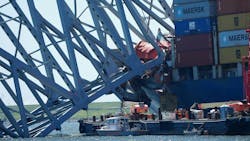
On November 18, the National Transportation Safety Board (NTSB) released its initial report on the Francis Scott Key Bridge collapse into the Patapsco River outside of Baltimore Harbor in 2024. The board will release a final report at a later date, but one thing was very clear from the initial report: better maintenance on the ship’s electrical system likely could have prevented the accident and loss of lives.
On March 26, 2024, the 984-foot-long Singapore-flagged cargo vessel Dali, took out the Francis Scott Key Bridge, as it was transiting out of Baltimore Harbor. The vessel experienced a loss of electrical power, then propulsion and steering loss, and struck Pier 17, the southern pier that supported the central span of the bridge. A substantial portion of the bridge collapsed into the river, and portions of the pier, deck, and truss spans collapsed onto the vessel’s bow and forward container bays. Local police were able to divert traffic on the bridge before the collapse, but a seven-person road maintenance crew and one inspector were still on the bridge and only two of them escaped the incident with their lives.
NTSB traced the cause of the accident back to one loose wire in the ship’s main switchboard that caused the initial power outage and cascaded into a catastrophe. It was a combination of poor system design and poor installation that compounded the loss of power.
How the electrical failure unfolded onboard the Dali
The ship’s wiring used wire-label bands or small shrink-wrapped thermoplastic sleeves indicating what each wire was for. On the single wire at fault in the high-voltage switchgear, the label’s plastic sleeve covered the insulating ferrule and increased its diameter, which prevented the wire tip from being fully inserted into the terminal block. There was a connection initially, but it was tenuous and came free over time. Once the wire disconnected, this tripped a high-voltage breaker, severing power from the step-down transformer and causing a blackout to the low-voltage systems such as lighting, steering, gear pumps, main engine cooling water pumps, and flushing pumps.
Poor maintenance practices led to the faulty wire, but poor design choices and lack of redundancy turned the power outage into a catastrophic failure. Once the low-voltage bus, or power distribution system, lost power, the main engine’s cooling water pump lost power, and the engine shut down automatically because of low cooling-water pressure, thereby removing propulsion from the vessel. Similarly, the steering-gear pumps lost power causing a loss of steering.
The vessel did have some backup or emergency procedures and equipment, but they failed to restore power quickly enough. The vessel’s diesel generators relied on a flushing pump, which was not designed or configured for fuel supply. It was actually designed to flush fuel out of the system for maintenance purposes, but was being used to supply pressurized fuel to the diesel generators. It also lacked redundancy and was designed to auto-restart after a blackout. When it lost power, the generators lost fuel supply, causing a second blackout.
The high-voltage breakers for the step-down transformer were set to manual mode, so after a blackout, a crew member needed to manually re-close them. NTSB noted that had they been in automatic mode, the low-voltage bus could have been restored within about 10 seconds, instead of nearly a minute, meaning more time for steering or propulsion recovery.
The emergency diesel generator intended to restore essential power also failed to start quickly enough. A radiator-damper limit switch reportedly did not indicate “open” in time, so start was delayed beyond the approximately 45 seconds required by regulations, according to NTSB.
The role of preventive maintenance: 4 takeaways for electrical and mechanical infrastructure
While it was a cascade of issues that led to the ship hitting the bridge, effective preventive maintenance practices could have prevented the issue in the first place. The improper placement of the wire-label band was an installation error, and NTSB noted specifically that a careful inspection with infrared imaging could have identified the poor connection long before it failed.
The choice to use a non-standard “flushing pump” for generator fuel supply without redundancy or auto-restart capability reflects poor design and operation oversight, and played a role in the tragedy as well.
Although this is a maritime tragedy, many lessons here carry over to any complex industrial system with critical electrical and mechanical infrastructure, such as:
- Small installation errors, like a wire-label band placed incorrectly, can lead to major failures. This is especially true the larger and more complex the system, and don’t underestimate minor workmanship/assembly errors.
- Redundancy matters, especially in fuel supply, cooling, power distribution, and emergency systems. Single non-redundant components are dangerous single points of failure.
- The use of advanced inspection tools, like infrared thermography, can detect hidden issues that cannot be detected by visual inspection alone. A good preventive maintenance program should include such inspections, especially on high-voltage/power-distribution systems.
- System design must consider failure modes. What happens when power is lost?
In a plant or factory, similar failure chains are possible. Poor installation leads to intermittent connections, which lead to equipment trips or losses of power. Then, critical systems fail, leading to unplanned downtime or catastrophic failure. Latent defects in wiring or power systems, compounded by design decisions and lack of redundancy, can lead to total system loss at sea and in factories.
This failure pattern isn’t unique: Past industrial accidents that mirror the Dali ship incident
The Dali ship incident also maps closely with other industrial incidents, where workmanship on a small component, power or fuel-supply failures, or a single point maintenance error cascaded into much larger events:
- In 1979, at Three Mile Island Unit 2, a partial reactor meltdown occurred when a mechanical and electrical failure of feedwater pumps and a stuck relief valve led to a reactor overheating. Operator misreadings of instrument indications worsened the event.
- In 2011, the Fukushima Daiichi nuclear accident and station blackout after a tsunami occurred when flooding at the site disabled emergency diesel generators and electrical systems. The loss of power prevented cooling and led to core damage. Similar to Dali, backup power/generator failures and fuel/power supply vulnerability turned a recoverable fault into catastrophic loss.
- In 1988, condensate leak from a maintenance error led to the Piper Alpha platform disaster off the coast of Aberdeen, Scotland. Simultaneous maintenance on a pump and a safety valve caused a condensate leak, which led to massive explosions on the North Sea platform. Maintenance failures and poor communication turned routine tasks into loss of life.
- In 2013, a large ammonium-nitrate explosion at West Fertilizer Company, a storage and distribution facility devastated the town of West, Texas. Storage, inspection, and maintenance oversight failures, including poor hazardous inventory management and facility design, led to tragedy.
About the Author
 Anna Townshend
Anna Townshend
head of content
Anna Townshend is the chief editor and head of content for Plant Services. She has been a journalist and editor for more than 20 years and joined Plant Services and Control Design as managing editor in June 2020. Previously, for more than 10 years, she was the chief editor of Marina Dock Age and International Dredging Review. In addition to writing and editing thousands of articles in her career, she has been an active speaker on industry panels and presentations, as well as host for Great Question: A Manufacturing Podcast. Email her at [email protected].