Skill Up: Caterpillar, NSF, and Starman New Photonics support workforce development
It’s no secret that the manufacturing industry has a workforce problem. Despite continued growth in the sector, attracting and retaining the right workers is a concern that keeps many executives up at night. A recent report predicts that the manufacturing industry will need as many as 3.8 million new workers by 2033, but 1.9 million of those jobs could go unfilled. To combat this issue, manufacturers, industry organizations, and government officials at all levels are investing in education and training opportunities across the country. Here are a few examples of how industrial stakeholders are coming together to inspire, educate, and train the next generation of manufacturing workers.
Caterpillar has launched a workforce commitment in Texas with an initial investment of up to $5 million as part of its five-year, $100 million Building the Future Workforce Initiative to prepare current and future workers for advanced manufacturing and industry technician careers. The investment will support efforts to reduce barriers to training, define future-ready skills, and strengthen career pathways through collaborations with Texas State Technical College, the Manufacturing Institute, and other local organizations, such as the Seguin Economic Development Corporation. In a recent quote, Christy Pambianchi, Caterpillar’s chief human resources officer, said, “Texas is a manufacturing powerhouse and a vital hub for innovation. Through this pledge, we’re capitalizing on those strengths and preparing Texans for the jobs of today and the advanced technology and manufacturing careers of tomorrow.”
Starman New Photonics received the first tax credit award through the New Jersey Economic Development Authority's Next New Jersey Manufacturing Program to support a $150 million investment in a 100,000-square-foot advanced manufacturing facility in Warren, New Jersey. The project will manufacture high-speed optical transceivers for AI infrastructure and is expected to create 250 new jobs, while expanding domestic production of a critical technology. In a recent quote, Charles Tebele, CEO of Starman New Photonics, said, “With its strong infrastructure, leading universities, and highly skilled workforce, New Jersey provides an exceptional foundation for this investment and for our long-term growth.”
The U.S. National Science Foundation awarded 12 new Regional Innovation Engines that will build technology-focused innovation clusters across 20 states to accelerate research, prepare talent for emerging jobs and strengthen regional economies. Each coalition will receive an initial $15 million over two years, with the potential for up to $160 million over the next decade if milestones are met, supporting workforce development in fields including advanced manufacturing, artificial intelligence, quantum computing and critical minerals. In a recent quote, Brian Stone, performing the duties of the NSF director, said, “These new NSF Engines will be transformational for America's innovation infrastructure — helping secure our national competitiveness in technologies and future industries that will be critical to our economic and national security for decades to come. These engines will unlock innovation and enable technologies that will improve the quality of life and result in good-paying jobs for all Americans."
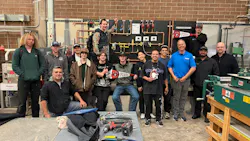
NIBCO and its Webstone brand donated a custom-built boiler and water heater system training board to Red Rocks Community College to provide students with hands-on HVAC and plumbing training. The equipment, originally built for the Community Over Competition Build at AHR Expo 2026, will allow students to install emitters and work with a fully operational system as part of their coursework. The Community Over Competition intiative aims to bring manufacturers, contractors, and industry advocates together for the trades. In a recent quote, Noel Sicard, instructor at Red Rocks Community College, said, “The donation of this training equipment provides our students with valuable hands-on experience that reinforces what they learn in the classroom.”
The Greater Omaha Economic Development Partnership and the Lincoln Partnership for Economic Development launched the AgWorks Corridor, an 11-county regional initiative spanning Nebraska and Iowa to strengthen value-added agriculture and support companies from startups through commercialization. The initiative connects agricultural manufacturing, food processing, ag-tech, and industrial bio-processing companies with regional research institutions, education programs, and a workforce that supports one in four jobs across the corridor. In a recent quote, Jason Ball, president and CEO of the Lincoln Chamber of Commerce and the Lincoln Partnership for Economic Development, said, “The collective population, workforce, education, research, and existing business and industry base of this region offers a compelling investment opportunity for any number of businesses.”