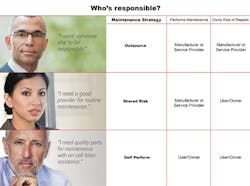
Production depends on compressed air. No air, no production. Therefore, maintenance managers are unlikely to be willing to make tradeoffs when it comes to compressed air system reliability. Opportunity costs in lost production usually far outweigh the cost of reliability-centered maintenance. A number of predictive maintenance techniques for compressed air systems exist, but who should be responsible for maintenance? Who owns the risk?
Some companies are self-performers of maintenance and have a full maintenance staff certified in predictive techniques such as ultrasound and thermography. They are more than capable of providing basic maintenance with some level of predictive maintenance (PdM). The self-performer strategy often is in place in large plants in which some mechanics and maintenance staff specialize in rotating equipment. It can also be found in smaller operations in which PdM diagnostics may not be employed but staff members less specialized in compressors perform regular preventive maintenance. When repairs are required, the manufacturer’s representative is called. We have found that 25% to 30% of customers choose to self-perform.
Other companies prefer shared risk. Because of trends in outsourcing strategies, a lack of expertise, and/or the costs to maintain a large maintenance staff, many operators seek to share maintenance operations with a service partner that will perform routine service and offer various levels of risk-sharing when repairs are needed. Compressor manufacturers provide service programs. If the compressor manufacturer performs the maintenance, coverage is available for up to 10 years on the air end for many new lubricant-injected rotary screw compressors. Shared risk is often a satisfactory middle ground between full self-performing and full risk transfer for the asset. This asset management strategy is found in all segments of general manufacturing and represents about 40% to 50% of the installations.
[sidebar id="2"]
Both self-performers and shared risk customers can opt to work with a service partner to extend coverage on some components of new compressors. There's usually a limited sign-up period, and agreements generally apply to compressors only rather than to the entire compressed air system.
The final approach is selection of a comprehensive service program designed specifically to cover an entire compressed air system. Some manufacturers desire this "no-surprises, fixed-cost" strategy so they can offload any risk onto the equipment manufacturer. Risk transfer agreements are not limited to a sign-up period or to coverage of compressors only. These packaged programs can be applied to an entire compressed air system, including supply-side components such as dryers and filters.
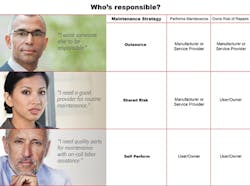
Using actuarial models, the equipment provider spreads the cost of the risk across multiple installations, and it is often less than the probable cost during the equipment’s lifecycle. We see an estimated 20% to 35% of installations using full risk-transfer models. This “set it and forget it” strategy ensures level quarterly payments, eliminates the need to buy and stock parts, covers any and all repairs, and provides the greatest assurance of no unplanned downtime.
When considering your maintenance strategy, consider the tradeoffs in risk and responsibility. In many cases, some or all of the risk can be placed back on the equipment provider. How much risk and responsibility you wish to transfer will depend on your maintenance strategy and your desired business outcomes.
About the Author
 Alexis Gajewski
Senior Content Strategist
Alexis Gajewski is a manufacturing writer and editor with nearly 20 years of experience covering the people, practices, and technologies that keep industrial facilities running. For more than a decade, she served as Senior Content Strategist for Plant Services, creating content for plant managers, engineers, and maintenance professionals on a variety of industrial topics.
During her tenure, Alexis worked to develop the brand’s digital strategy and helped launch and produce Great Question: A Manufacturing Podcast. She also created The Lighter Side of Manufacturing, a weekly blog that explored the inventive and sometimes humorous side of the industry.
Alexis co-founded Influential Women in Manufacturing, a recognition program that honored 49 women in its first two years, earned an industry award for Best Product Launch, and received a proclamation from Illinois Governor JB Pritzker and a commendation from U.S. Senator Tammy Duckworth.
She also led newsroom operations and development at a large media company where she set editorial standards, developed training curriculum, and helped support AI adoption for more than 150 editors across 80+ brands spanning manufacturing, industrial processing, automation, and more.
Additionally, Alexis works as a freelance writer and editor, and her areas of interest include continuous improvement, the skilled workforce, and the role of emerging technology on the plant floor.
Connect with Alexis on LinkedIn