Motor redesign offers an overlooked option when replacements aren’t available
Key Highlights
- Redesign services can adapt stock motors for different voltages, frequencies and speeds, providing quick solutions to supply chain issues.
- Converting single-speed motors to two-speed configurations enhances process flexibility without adding complex drives.
- Expert evaluation of thermal, magnetic and mechanical limits ensures redesigned motors meet performance and reliability standards.
- Leveraging local motor redesign capabilities reduces downtime and costs compared to waiting for OEM replacements or custom builds.
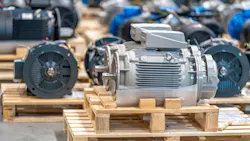
Supply chain disruptions, extended lead times, and the growing number of specialized motor applications have created a challenge for many industrial facilities: What do you do when a critical motor fails and the replacement you need simply isn’t available? Traditionally, end users have had limited options. They could wait months for an OEM replacement, buy an expensive custom-built motor, or try to modify the driven equipment to use a stock motor. None of these choices is ideal with downtime and budgets on the line.
Fortunately, there is another option that many maintenance teams overlook. Highly qualified motor repair service centers possess the engineering expertise and redesign tools necessary to transform a readily available stock motor into a machine that closely matches the performance characteristics of a difficult-to-source replacement.
Service centers like EASA members can redesign motors for different voltages, frequencies, speeds, power ratings, and even multiple-speed operation. EASA’s conservative, standards-based motor redesign methodologies provide a structured process for evaluating these changes and determining whether a redesign is technically feasible.
Starting with the right motor candidate
The first step is to identify a suitable stock motor. Usually, it’s reasonable to assume a constant-torque relationship in ratings for a starting point. For example, a customer requiring a 25 hp, 6-pole motor may be able to use a readily available 40 hp, 4-pole machine as the basis for a redesign because (25)(6) = 150 is reasonably close to (40)(4) = 160. Of course, core dimensions, slot combinations, magnetic loading, and thermal capability should all be considered.
Voltage and frequency changes
One of the most common redesign requests involves adapting motors for different power systems. A motor originally intended for 460 volts may need to operate on 575 volts. In most cases, voltage changes can be implemented through winding redesign without negatively affecting efficiency or reliability. The redesign process adjusts turns, conductor area, and winding configuration to maintain approximately the same magnetic field and current density.
Frequency conversions between 50 Hz and 60 Hz are also common requests, particularly as equipment moves between global markets. But such changes require careful engineering consideration because synchronous speed depends on both frequency and pole count. Load characteristics can be especially important for variable-torque loads such as pumps and fans, where even a simple frequency change can significantly affect the required horsepower and torque.
Understanding these relationships is critical to achieving a successful redesign. For example, if a piece of equipment with an integral cooling fan designed for 50 Hz operation is relocated to a region with a 60 Hz power supply, utilizing a 20% higher voltage (e.g. 380 V 50 Hz to 460 V 60 Hz) is generally acceptable for the motor. However, increasing the speed of the fan by 20% will increase the motor load by approximately 1.23, or 73%, causing significant overload and rapid failure.
Changing speed through pole modifications
A powerful capability of qualified repair facilities is the ability to redesign motors for different numbers of poles. Since motor synchronous speed is determined by frequency and pole count, changing poles can often provide a practical solution when an exact replacement is unavailable. Increasing the number of poles reduces the operating speed; decreasing the pole count has the opposite effect. These redesigns, however, require evaluation of:
- slot combinations
- winding factors
- magnetic loading,
- and thermal performance.
Adjusting output power
Horsepower changes are another common request. End users may discover that a process no longer requires the original power level, or a replacement motor may have a different rating than the failed unit.
The feasibility of increasing or decreasing output power depends on the motor's magnetic and thermal limits. Experienced redesign engineers can determine realistic power targets by evaluating:
- flux density
- current density
- core dimensions
- cooling capability.
. Access to EASA’s extensive database allows member service centers to compare proposed designs with large populations of similar machines, reducing risk and improving confidence in the final recommendation.
From single-speed to two-speed operation
A lesser-known capability of motor redesign is converting single-speed motors to two-speed machines. Although the increased use of variable-frequency drives has made this less common, demand remains significant.
A single-winding, two-speed design uses one winding to provide two operating speeds through external reconnection. This approach can be attractive where process flexibility is needed without adding a variable-frequency drive.
For applications requiring higher performance or more widely separated speeds, it may be possible to redesign a motor as a two-winding, two-speed machine. In these designs, separate stator windings are installed for each speed. Although more complex, this method provides additional flexibility and is commonly used in applications such as hoists, cranes, and other industrial equipment requiring distinct operating speeds.
A competitive advantage for end users
The ability to redesign motors provides end users with an option that falls between a standard replacement and a completely custom machine. Instead of waiting for long manufacturing lead times, maintenance professionals can often leverage locally available motors and the engineering expertise of qualified service centers to restore operations more quickly.
Successful projects require a thorough understanding of electromagnetic design, thermal limits, winding practices, and mechanical constraints.
When a critical motor is unavailable, the question should not be, “Can I find an exact replacement?” The better question may be, “Can an EASA member facility redesign a motor that is available today?” In many cases, the answer is “yes.”
About the Author
Mike Howell
Mike Howell is a technical support specialist at EASA, St. Louis, MO; +1 314 993 2220; www.easa.com. EASA is an international trade association of more than 1,700 electromechanical sales and service and repair firms in nearly 70 countries.